




The Freedom of Form in Fiction

The author of Patient, Female (Milkweed Editions, 2026) encourages writers to experiment with radically different forms to combat the blank page.
Tags:
Jump to navigation Skip to content
Articles from Poet & Writers Magazine include material from the print edition plus exclusive online-only material.
The author of Patient, Female (Milkweed Editions, 2026) encourages writers to experiment with radically different forms to combat the blank page.

The fiction writer Aamina Ahmad highlights journals that have published her short stories, narratives “interested in the way contemporary Pakistani society functions,” and “the pressures it exerts on ordinary people.”

An artist transforms library checkout cards into handmade odes to literary works with illustrations in gouache.

Daniel Simon, the editor in chief of World Literature Today, discusses how literature can promote cross-cultural dialogue and how the journal has evolved ahead of its centennial.

Write a poem that explores memories of the end of summer, a story that features a character working on a project about a person’s biography, or a travel journal with poetic observations of a singular moment or image in time.

A fiction writer considers how long, or short, any given narrative needs to be, and in the process finds a new appreciation for an often-neglected form: the novella.

Founded in 2013 by Greg Wolfe and now based in Seattle, Slant Books takes up Emily Dickinson’s encouragement to her reader: “Tell all the truth but tell it slant.”

Undaunted by the emergent technology, librarians reflect on the need for AI literacy and the undeniably human components of their job.
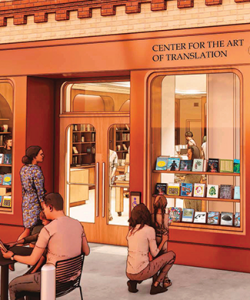
The Center for the Art of Translation will move into a new brick-and-mortar, three-story cultural space in 2027, just blocks from the legendary City Lights Booksellers & Publishers.

The first lines of a dozen noteworthy books, including If You Love That Lady by Maya C. Popa and Without Terminus by chaun webster.

Spearheaded by Ohio Humanities and Literary Cleveland, a yearlong commemoration of Toni Morrison’s oeuvre is underway, featuring statewide, national, and virtual events.

Eden Royce, R. O. Kwon, Aimee Bender, Susan Muaddi Darraj, and Jamel Brinkley introduce the authors of this summer’s best debut fiction: P.C. Verrone, M Lin, Joe Bond, Amanda Rizkalla, and Devyn Defoe.

In Lift Every Voice, Phillip B. Williams explores the devastating effects of avoiding grief, and sitting with that feeling, more than two decades after his father’s death, is what allowed him to finally mourn and eventually make his art.

Calling on June Jordan and E. L. Doctorow, Emily Dickinson and Tupac Shakur, an acclaimed poet and nonfiction writer parses how the past is ever-present, and how our setting becomes our writing.

A bookstore manager discusses the practicalities of the ISBN, the key identifier that acts as a book’s passport as it travels from publisher to bookshops to the hands of readers.

Wondering where to look and what to look for as you research agents? An industry veteran offers guidance on best resources and best practices for finding possible fits.

A frequent conference-goer offers tips and best practices for connecting with a microcommunity—a small, intentional gathering of peers within the larger world of a writing conference.
Between signing with an agent and bringing a book to editors, writers almost always take one more crucial step: receiving edits from their agent. Agents describe what authors can expect by way of notes at this stage and how these revision prepares a book for market.

Writers may dream of partnering with a literary agent who offers it all, from staunch advocacy from a sympathetic ear. But in practice, the best agent may be one who’s less fairy tale and more human.

Persistence is a virtue in landing an agent—but if you’re not connecting, when is it time to regroup? An agent offers professional wisdom on balancing tenacity and realism, and on assessing what to do next if your search has stalled.

An agent unpacks the intangibles a query letter needs to convey, including your own sense of your story, your professionalism, and your voice.

“Writing is like any other bodily function for me—necessary, rhythmic, and almost involuntary.” —Kate Christensen, author of Good Company

The author of Patient, Female (Milkweed Editions, 2026) reflects on how painful experiences can carry comedic potential for writing.

“There was a time when I would have called my nonwriting life an impediment, but these days I see it more like I need to be a whole person.” —Deb Olin Unferth, author of Earth 7