Named after Plaza de la Vigía (Watchtower Square) in Matanzas, Cuba, Ediciones Vigía was cofounded in Matanzas in April 1985 by visual artist Rolando Estévez Jordán and poet Alfredo Zaldívar. Over the past forty years, Ediciones Vigía has transformed from a small informal gathering of creatives into an artists’ collective and artisan book press. “The founding group began by producing single-sheet flyers to announce meetings and cultural events for writers and artists in Matanzas,” says Brian Pablo González Lleonart, an editor at Ediciones Vigía. “Over time that informal gathering grew into a small publishing workshop: Those flyers evolved into more ambitious printed artifacts, then into pamphlets, folded pieces, and eventually fully conceived handmade books.”
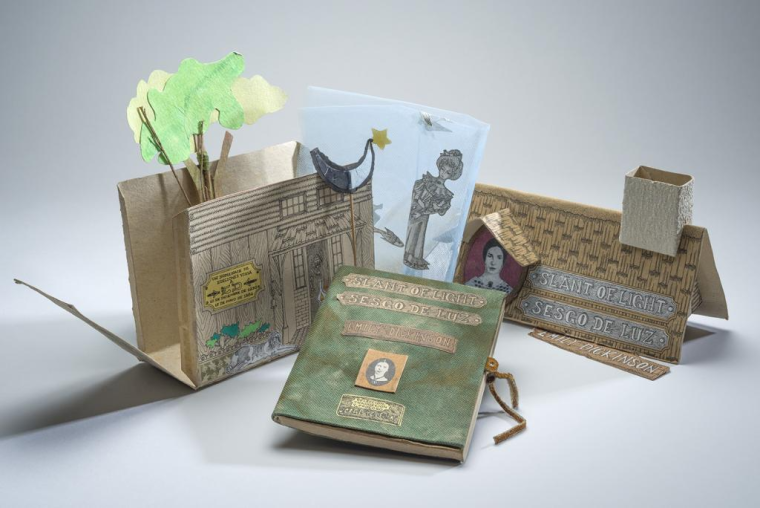
Slant of Light / Sesgo de Luz, inspired by the work of Emily Dickinson, was designed by Rolando Estévez Jordán and published in 1998 by Ediciones Vigía.
All Vigía books are crafted by hand with a bricolage approach and tend to use recycled or repurposed materials such as butcher paper, yarn, fabric, dried flowers, leaves, tinfoil, textured papers, and scraps. Inviting slower, tactile engagement and a nonlinear reading experience, Vigía books allow readers to turn flaps, lift layers, and look through windows. The artists, writers, designers, and volunteers who work at the press are involved in every step of the bookmaking process and participate in the cutting, collating, gluing, assembling, and decorating of books. In its early years Vigía focused mainly on publishing works by relatively unknown Cuban poets and writers—particularly those associated with Matanzas and local literary circles. Over time, however, the press expanded to include artistic responses to the work of renowned international writers. One such book project (above) is inspired by the work of Emily Dickinson. Slant of Light / Sesgo de Luz was designed by Rolando Estévez Jordán and published in 1998. Currently housed in the Special Collections at the University of Michigan Library, the edition interprets Dickinson’s work through Ediciones Vigía’s characteristic approach, combining typography, illustration, and material experimentation. Publishing about fifteen books per year, Vigía produces up to two hundred copies in each print run. Some titles appear in Spanish only, but when responding to the work of international authors, the books often contain both Spanish and English elements. And “because each copy is handcrafted, small differences…make each book unique,” Lleonart says, “which is part of the charm.”