In 2000, Danielle Ofri, a relatively new attending physician at Bellevue Hospital in New York City, asked her medical students to do something new with their patient histories and treatment plans. Instead of instructing medical students to record formulaic notes, she requested they ask their patients what it was like to have osteoporosis or diabetes or cancer. When she read the resulting essays, a light flicked on. There was an urgency to storytelling about the world of the body—be it the experience of illness and healing or being a patient or caregiver.

Danielle Ofri, editor in chief of Bellevue Literary Review, with the first and most recent issues.
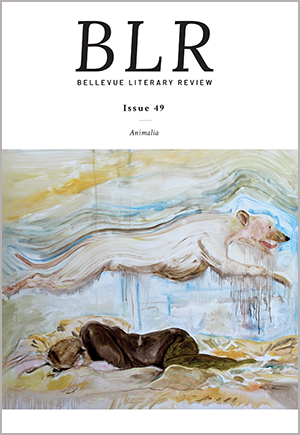
Thus, Ofri and two other physicians, Jerome Lowenstein and New York University’s then chair of medicine Martin Blaser, were inspired to create Bellevue Literary Review (BLR), with Ofri as editor in chief. Fiction editor Ronna Wineberg and poetry editors Donna Baier Stein and Roxanna Font Aliaga completed the founding editorial team. Celebrating its twenty-fifth anniversary in 2026, BLR illuminates the nuances of lives in illness and in health through two annual print issues of poetry, fiction, and nonfiction, plus a growing platform of online events and content.
“At the beginning we were really building from nothing,” recalls Wineberg. When they put out their first call for work, the editors were uncertain if anyone would submit, but they soon received more than a thousand submissions.
The inaugural issue was published in the fall of 2001, in a moment of national crisis. Nevertheless, after some debate, the founders celebrated with a launch at Bellevue Hospital. “All the posters of the missing from 9/11 were all along the entranceway. It was almost traumatic to walk in,” Ofri recalls. “A hundred-plus people had to walk through that [to attend]. And it just sort of drove home that in times of vulnerability and fear, we really do turn to the arts.”
If there is a universal anxiety, Ofri realized, it’s illness. She also believed the cultural fascination with the health care provider—demonstrated by popular television shows, books, and films set in hospitals—suggested an interested audience. “Who are these people who have such power in our lives at the most vulnerable moments?”
Novelist and physician Abraham Verghese, who published a story in BLR’s fourth issue, notes the vulnerability inherent in medical settings. “Hospitals are a crucible, with all human emotions heightened under the duress of illness and with the challenges of delivering care.” While plenty of medical schools publish student and physician work, he adds, “I don’t think there’s anything that compares to BLR in the way it transcends its environment to become a mainstream literary publication.”
That readership didn’t happen by accident. Wineberg says the editors intentionally published work at the intersection of literature and medicine. “A journal about illness would be depressing. We wanted all the pieces to have a creative bent.... We decided we wanted to broaden the lens.” The ideal BLR piece may not be directly about illness at all, she says, but about health, healing, and the relationship to the body.
Jason Baum’s short story “Rocket” from Issue 45, which won the PEN/Robert J. Dau Short Story Prize for Emerging Writers in 2024, is a good example: A man builds a rocket, hoping that with a few months orbiting in space, he’ll finally get sober. “What makes [BLR’s] work so meaningful is their commitment to publishing stories that explore health and well-being in all its forms—mental, physical, environmental, even animal,” says Baum.
The editors established the BLR Prizes, judged by luminaries like Amy Hempel, Ada Limón, and Chang-rae Lee, to honor outstanding writing related to themes of health, healing, illness, the mind, and the body, and BLR pieces started garnering placement in Pushcart Prizes and Best American Short Stories. The journal gained recognition by publishing then-emerging writers like Verghese, Celeste Ng, and Leslie Jamison and expanded its staff as submissions grew to five thousand annually. The journal’s publishing model was steady and successful for nearly twenty years.
Then, during the pandemic in the spring of 2020, NYU ended its support. Ofri scrambled to find a new home, but no one could commit in the midst of the pandemic. So BLR gathered a board of directors and became a nonprofit. Twenty years after its inception, the journal was once again taking a major risk in a time of struggle and uncertainty. And once again, taking the risk resulted in a transformative reward. “It’s the best thing that ever happened to us,” Ofri says. “We’re not just a journal [anymore]. Suddenly we were a literary arts organization.”
BLR is still a respected literary journal—it received the Whiting Literary Magazine Prize in 2021—but it now anchors a much larger community, centered around storytelling in the medical humanities.
“All of our programming has really grown in leaps and bounds,” says longtime managing editor Stacy Bodziak. While the journal remains the core, she says, “storytelling is the word that encompasses everything we’re doing.” A new set of events features live storytelling, poetry, dance, art, and film on topics such as gun violence and caregiving.
To celebrate its twenty-fifth anniversary, BLR is launching a suite of new programs including writing workshops for general audiences, medical trainees, and medical professionals; an ambassadors program in which a BLR editor and board member introduce a group of undergraduate students to the journal and to medical humanities; a book club; and more.
BLR is again transforming and expanding at a fraught time. Amid proliferating attacks on science and health care and politicized medical debates, the BLR team now sees how clear their role is in crisis. “We in medicine need to stand up very loudly and defiantly,” Ofri says. “At this moment when there is such rupture and attacks on communities, the idea of offering a community and a home and a place to be is even more important.”
Michelle Wildgen is the author of four novels, most recently Wine People (Zibby Publishing, 2023), and the cofounder of the Madison Writers’ Studio. She has led writing workshops for physicians for ten years.