The first episode of the People’s Recorder podcast begins with host Chris Haley declaring: “In the 1930s, during the Great Depression, when many said America was at her lowest point, something truly weird and amazing happened. We started to listen. As a nation, I mean.” Nearly a hundred years later, amid acute national division, it is worth remembering that writers were and remain vital conductors for listening to and sharing the stories of others.
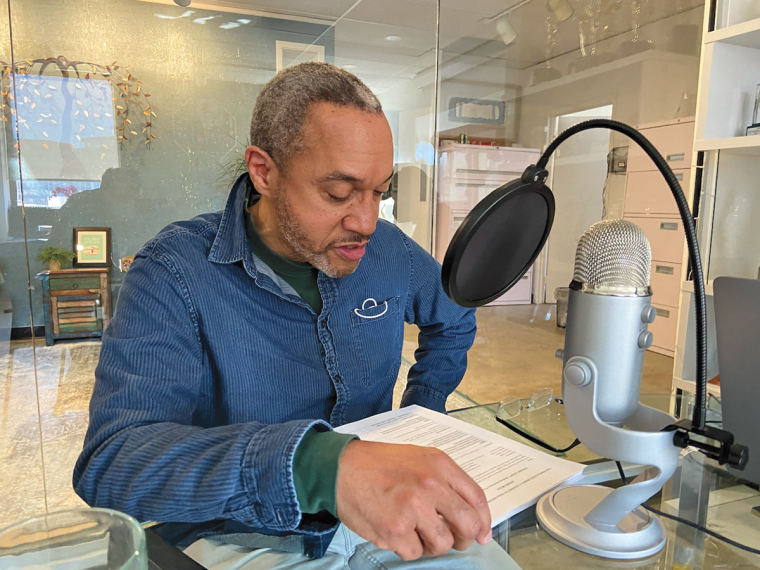
Host Chris Haley narrating the People’s Recorder podcast. (Credit: Courtesy of Spark Media)
The People’s Recorder, written and produced by David A. Taylor in collaboration with Andrea Kalin and James Mirabello of Spark Media, debuted in early 2024, releasing its first season in monthly episodes exploring the history of the 1930s Federal Writers’ Project. Funded by President Franklin D. Roosevelt’s New Deal, the Writers’ Project employed around six thousand people at its peak, many of whom were artists and writers. Poet W. H. Auden later called it “one of the noblest and most absurd undertakings ever attempted by any state.” As the primary work of the initiative, authors produced guidebooks for states featuring travel routes, descriptions of cities and towns, and local folklore and legends. But the project had another, lesser-known initiative: an oral history project. “It was the first time that the federal government had ever sponsored research into the lives of everyday Americans,” says Peggy Bulger, the former director of the American Folklife Center at the Library of Congress. Writers interviewed over ten thousand people across the country—occasionally recording audio but more often transcribing their conversations—in migrant camps, schoolyards, soup kitchens, hair salons, and prisons, according to the podcast. Interviewees included a woman who worked in a North Carolina textile mill, a rodeo clown in Oklahoma, a sex worker in Chicago, and a clerk at Macy’s department store in New York City.
The Writers’ Project employed luminaries such as Saul Bellow, John Cheever, Ralph Ellison, Zora Neale Hurston, and May Swenson. Though these authors are now associated with spectacular literary success, their contributions to the Federal Writers’ Project marked a very different time in their careers. As historian Douglas Brinkley says in one episode of the People’s Recorder, the project was often seen as a last resort: “It basically meant you were broke and failing as a writer.” Still, many writers embraced the task before them: to record the stories of ordinary people and together create a kaleidoscopic portrait of the country.
In 2009 Taylor released a documentary in collaboration with Spark Media about the Federal Writers’ Project called Soul of a People. He remained curious about the subject and was eager to see how the podcast format would lend itself to the material in fresh ways; fifteen years later the People’s Recorder was born. Haley, too, notes the audio format as a particularly intimate and inspiring medium: “Having something in your ear that is telling a story, playing music, making you laugh, making you cry—it allows the listener to more readily use their imagination.” Taylor adds that after wading through an enormous archive, he and his collaborators “aimed for a strong narrative for these characters and didn’t want to paint the same picture of this Depression-era experience that we’ve heard before.”
One episode follows Howard University professor Sterling A. Brown’s efforts to expand the coverage of the Federal Writers’ Project to include African American life and history. One such initiative was a book, edited by Hampton University professor Roscoe E. Lewis, that included contributions from a dozen Black writers and researchers and recorded interviews with almost three hundred formerly enslaved people. Despite backlash from state editors and officials, the book became a national Book-of-the-Month Club selection and a milestone on the road to the civil rights movement. Another episode highlights the songs and folktales of Florida culture recorded by Zora Neale Hurston, while another features Oscar Archiquette, a young person from the Oneida Nation who joined a local unit of the Federal Writers’ Project to preserve the Oneida language and heritage by interviewing elders and transcribing their stories.
The work of collecting oral histories continues to resonate with authors. “We still need every voice. We need to share our own stories and to listen to the experiences of others,” says poet and professor Kiki Petrosino, a guest on the podcast. “This dynamic exchange—which still happens in the same places the Federal Writers’ Project investigators visited—at kitchen tables, on front porches, in small towns, and in great cities—brings us together as fellow Americans and enriches our shared human experience.”
As a podcast the People’s Recorder carries on this legacy, grafting new oral histories onto the original archive. In this process the People’s Recorder also revisits the Federal Writers’ Project’s oversights and flaws. “The agency’s director and national office did want to nurture writers from groups that had been marginalized—women, people of color, Native writers—but [the government] also had preconceptions about how those stories should look and sound,” Taylor says, adding that the mandates to hire these writers “were often stymied at local and state levels where hiring happened.” The podcast engages critically with these realities, interspersing 1930s recordings with contemporary reflections and creating a dialogue across time.
With support from state humanities councils, the National Endowment for the Humanities (NEH), and other project partners, the People’s Recorder found early success: It was a finalist for the Ambie Award for Best Indie Podcast last spring and recently earned a silver Signal Award. But in April the podcasts’s major NEH grant for a second season was canceled. Taylor says the termination “brought us back to questions we raised in the first episode: How do we tell our history? And who gets to decide what history gets told?”
As they search for funding for a full second season, the creative team members have pivoted to a miniseries on the history of the House Un-American Activities Committee, which targeted the Writers’ Project and other New Deal programs in the 1930s. Then, too, America was reeling from division, and fear became a political weapon to silence writers.
It may be hard to imagine, in this intensely polarized time for the United States and in this precarious moment for the arts, what a new Federal Writers’ Project would look like today. But the People’s Recorder reminds us that when writers devote their time and talent to listening, we all gain, as Petrosino puts it, a “richer sense of ourselves and our neighbors.”
Serena Alagappan is a senior editor at Poets & Writers Magazine. Find her online at serenaalagappan.com.