Since 2018, Poets & Writers Magazine has published Ten Questions, a weekly series of interviews with authors of new works of poetry, fiction, and creative nonfiction. Over the past seven years, nearly four hundred authors and translators have shared their insights about their professional experience, offering readers both inspiration and practical tips to apply to their own craft and individual publishing journeys. In their answers to our questions, authors reveal details about their writing habits, artistic influences, reading lists, and more. As 2025 draws to a close, we share some of our favorite responses this year to the tenth question: What’s the best piece of writing advice you’ve ever received?
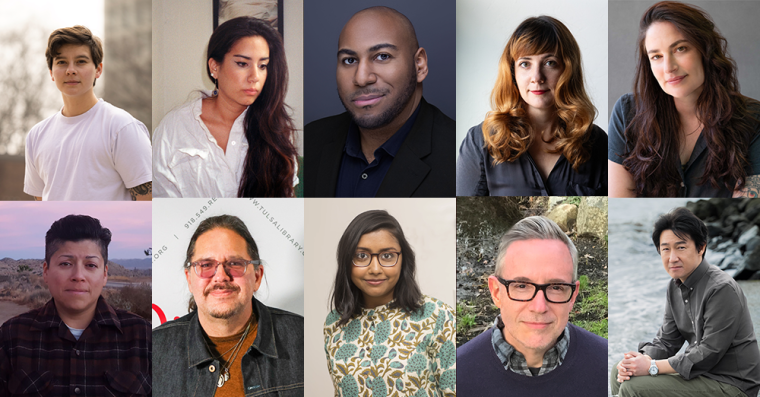
Clockwise from upper left: Kayleb Rae Candrilli, Aria Aber, Rickey Fayne, July Westhale, Shoshana von Blanckensee, Ed Park, Patrick Ryan, Megha Majumdar, Brandon Hobson, and Raquel Gutiérrez.
(Credit: Candrilli: Ryan Collerd; Aber: Natalie Aber; Fayne: Shalicia Johnson; Westhale: Rachel Marie Photography; Blanckensee: Chloe Sherman; Park: Beowulf Sheehan; Ryan: Fred Blair; Majumdar: Elena Siebert; Hobson: Connor Bock; Gutiérrez: Thea Quiray Tagle)1. I can’t remember when or where I was when I heard Mahogany L. Browne talk about daily writing practice. But her gist was to be more liberal in what you consider writing. Your e-mails are daily writings. Your grocery lists; your text messages; your poetry magnets on the fridge; your annotations in the margins of your books. Everything you read is part of your daily writing practice. Every photo-book cracked. Every video game played. Every album spun. Every film watched. All art you ever have or will consume is part of your writing practice. —Kayleb Rae Candrilli, author of Winter of Worship
2. Louise Glück once told me that living life well is as important as writing well—writing comes out of life. But I also cherish Rilke’s Letters to a Young Poet, which I often turn to when I feel blocked in my writing. He writes that one must regard one’s solitude as sacred, and that the past is an infinite fountain of inspiration: “And even if you found yourself in some prison, whose walls let in none of the world’s sounds—wouldn’t you still have your childhood, that jewel beyond all price, that treasure house of memories?” Yes, everyone can write, because everyone has had a childhood. —Aria Aber, author of Good Girl
3. Revise toward understanding rather than perfection; you’ll never achieve perfection, but you can always know more. This comes from Peter Ho Davies’s The Art of Revision: The Last Word (Graywolf Press, 2021). Also, retype each draft from start to finish. I’ve heard this advice from a few people, but it first came to me from Elizabeth McCracken. —Rickey Fayne, author of The Devil Three Times
4. I was once in a workshop with Carl Phillips, who managed to say many things that stuck over the course of four or five days. One thing he said is that if you are writing consistently over a period of time—say you’re writing every day for a month or every few days for a few months, or every week for a year—you will not necessarily need to impose a theme onto your work. The work will emerge with its own themes, because the things you are mulling over and working through during that time in your life will continue to show up, and the poems will “talk” to one another.
What a relaxing thought! As a person who has never really had any control over what my books are “about” it was great to know, in my interpretation of Carl’s words, that I didn’t actually need to worry about it terribly much. This advice has also helped me to write consistently, as a way of being in service of whatever theme is there, laying in wait for me. —July Westhale, author of moon moon
5. If you put the hours in, the work will work itself out. I don’t write to a word count or a set number of pages. I promise myself a specific number of butt-in-chair hours per week. This method means you don’t have to feel bad if you rework a single paragraph for four hours straight. It’s just work working itself out. —Shoshana von Blanckensee, author of Girls Girls Girls
6. If something’s not working—just delete it! Put it in a separate file, marked “scrap,” so you can fish it out if you need it again. Chances are, you won’t need it. —Ed Park, author of An Oral History of Atlantis
7. “Write the book you want to read.” Ann Patchett said that to me once, and I took it to heart. I’ve certainly had the experience of trying to write the book I thought I should be writing, or trying to write the book I thought would “sell.” Writing the book you want to read is the most honest approach you can take to a project you’re (hopefully) going to be pouring your heart into. —Patrick Ryan, author of Buckeye
8. Finish the draft. —Megha Majumdar, author of A Guardian and a Thief
9. N. Scott Momaday said to use fiction to reach a higher truth. How can we reach a higher truth in storytelling and art? At a time when there’s so much threat against funding for the arts in our country, making art right now feels more important than ever. —Brandon Hobson, author of The Devil Is a Southpaw
10. You have to learn to write when you don’t feel like it. —Raquel Gutiérrez, author of Southwest Reconstruction