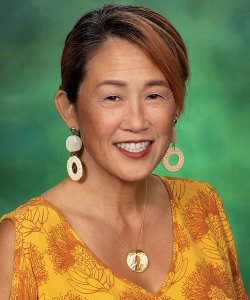
Q&A: Michelle Aielli Leads AWP
The new executive director of AWP discusses her path from publishing to arts administration and shares what gives her hope for the literary arts.
Jump to navigation Skip to content
Articles from Poet & Writers Magazine include material from the print edition plus exclusive online-only material.
The new executive director of AWP discusses her path from publishing to arts administration and shares what gives her hope for the literary arts.
Housed in the trunk of a 1984 Mercedes-Benz 380SL, AUTO Books travels throughout Los Angeles, bringing art, photography, and poetry titles, along with other rare and experimental literature, to neighborhoods across the city.
The translator of Ye Hui’s The Ruins highlights journals that embraced his translations, including Asymptote and Copihue Poetry.
Based in Grinnell, Iowa, and motivated by a mission to support reforestation, Green Linden Press publishes around six titles per year and donates a portion of its proceeds to environmental efforts.
The acclaimed fiction writer unpacks the art of the longer short story—a form with space for ambitious plot and rich characterization, with the pressure and punch of concision.
With a $100,000 grant from O’Shaughnessy Ventures, bookshop manager Charlie Becker is building an AI tool to help secondhand booksellers identify and catalogue titles.
New publishing lines, reading series, symposia, and magazine partnerships are springing up in Dallas with support from SMU’s Project Poëtica.
The first lines of a dozen noteworthy books, including The New Economy by Gabrielle Calvocoressi and Girls Play Dead: Acts of Self-Preservation by Jen Percy.
In spite of the pandemic and other challenges, executive director Andrew Proctor has steered Literary Arts in Oregon through a successful capital campaign, raising over $22 million at a time when the arts need it most.
“Becoming a mother, and feeling the ferocity of love that parents hold for their children, and doing the daily work of parenting, helped me find the emotional core of the book.” —Megha Majumdar, author of A Guardian and a Thief
“It should be possible to both write good and live good. Go see your friends. Be with your family. Taste something new. Fall in love with the world again and again while you still can.” —Joshua Wheeler, author of The High Heaven
The author of no swaddle (University of Iowa Press, 2025) reflects on approaching uncertainty on the page.
“I think I’m a natural maximalist, and I still enjoy orchestrating a complex, layered scene or sentence, but I often found myself paring down versus building up.” —Jade Chang, author of What a Time to Be Alive
The author of no swaddle (University of Iowa Press, 2025) considers the legacies and influences of authors engaged in similar forms and topics.
“I try to write every day, whether that’s generating new words or taking a walk to think about a revision problem.” —E. Y. Zhao, author of Underspin
The author of no swaddle (University of Iowa Press, 2025) considers the value of both engaging with and refuting a traditional form.
“I wish all writers the audiences they desire and the acclaim they deserve.” —Ashley M. Jones, author of Lullaby for the Grieving
During his term as poet laureate, Sze plans to have a special focus on poetry in translation.
“When an impediment arrives, I try writing about it. This helps me remain patient.” —Jeannie Vanasco, author of A Silent Treatment
The author of Indigo (Copper Canyon Press, 2020) reflects on the lessons Robert Frost offers us when writing about loss.
“Stop telling yourself you can’t do this.” —Patrick Ryan, author of Buckeye
“[Y]ou can’t edit something into being good before getting it down.” —Austyn Wohlers, author of Hothouse Bloom
The author of Indigo (Copper Canyon Press, 2020) recommends writers use coding when trying to describe loss.
Literary and arts organizations are left reeling after budget cuts at the NEA, NEH, and IMLS.
Faculty, program type, format, and size are just a few of factors to consider when finding a school that suits who you are as a writer.