Page One: Where New and Noteworthy Books Begin
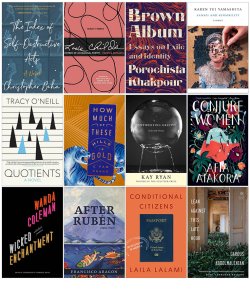
The first lines of a dozen noteworthy books, including Grand Union by Zadie Smith and Olive, Again by Elizabeth Strout.
Jump to navigation Skip to content
Articles from Poet & Writers Magazine include material from the print edition plus exclusive online-only material.
The first lines of a dozen noteworthy books, including Grand Union by Zadie Smith and Olive, Again by Elizabeth Strout.
Poet and journalist Alissa Quart is bringing documentary poetry to major media outlets.
In a tiny bookshop in London, writer A. N. Devers spotlights women’s writing by only stocking rare books and modern first editions by female authors.
Carlos Lozada, a Pulitzer Prize–winning critic at the Washington Post, on his reading process, the role of social media in his work, and more.
In our fourth annual installment of this series, five debut authors over the age of fifty—Julie Langsdorf, Valencia Robin, Timothy Brandoff, Margaret Renkl, and Peter Kaldheim—share excerpts from their first books.
A round-up of four new anthologies, including Burn It Down: Women Writing About Anger edited by Lilly Dancyger.
Reginald Dwayne Betts, whose latest poetry collection, Felon, is out now from Norton, sits down with poet and activist Mahogany L. Browne for a conversation about political poetry and the realities of the U.S. prison system.
Follow three Philadelphia writers as they join a community of more than three hundred thousand writers participating in NaNoWriMo, a challenge to write a fifty-thousand-word novel during the month of November.
“The process of writing a memoir can swallow you whole if you aren’t careful.” —Saeed Jones, author of How We Fight For Our Lives.
“Maybe we are all just a bit frazzled with the state of the world today, but it’s not always easy to sit and focus. When I do find time to write, it’s like I’m back to myself. I’m back home.” —Kimberly Reyes, author of Running to Stand Still
Friends gathered at the 92nd Street Y on the evening of September 23 to pay tribute to the esteemed poet Mary Oliver, who died in January at the age of eighty-three.
“I didn’t always feel like writing but I still made myself sit down and do it. I practiced discipline and worked towards inspiration.” —Maaza Mengiste, author of The Shadow King
“I had made a bargain with myself that if I lived, I would give a book of what I learned back to the world in return—an act of gratitude and sometimes vengeance—and I made it.” —Anne Boyer, author of The Undying
“Nearly everything about writing a book is hard. The hope is that it’s harder, in some way, not to.” —Oliver Baez Bendorf, author of Advantages of Being Evergreen

On September 4 hundreds of poets and writers will come together to raise funds for detained and formerly detained migrants in the United States.
“Sometimes the discourse on disability infringes on my imagination.” —Jillian Weise, author of Cyborg Detective
“I’ve learned that writing is not for the impatient.” —Crystal Hana Kim, author of If You Leave Me
“I ride a commuter train forty minutes each way to work. That’s when I write. Having to come to the page twice a day for short bursts gets me writing very fast; there’s very little wasted time. I’ve never been so productive in my life.” — Jonathan Vatner, author of Carnegie Hill
The first lines of a dozen noteworthy books, including Everything Inside by Edwidge Danticat and Make It Scream, Make It Burn by Leslie Jamison.
Contributors to the anthology Indelible in the Hippocampus discuss some of their thoughts on the current state of the #MeToo movement and their experiences writing on the topic.
Manuel Muñoz, the new director of the MFA program at the University of Arizona, discusses his new role, healthy creative environments, and common missteps he sees in applications.
The poet discusses the journals that published pieces from her sixth collection, Nightshade.
How do you handle research? How indebted do you feel to stick to the historical record? Two novelists discuss their experiences researching, imagining, and depicting earlier times.
The University of Cincinnati Press imprint publishes books of poetry and fiction that continue the successes of its affiliated literary journal, the Cincinnati Review.
Publishing insiders weigh in on the challenges facing the U.S. bookstore chain, which was sold to a hedge fund in June for $683 million.