



Ten Questions for Eshani Surya

“I’ve learned to be most interested in enjoying the process of making something emotionally true and honest.” —Ashani Surya, author of Ravishing
Tags:
Jump to navigation Skip to content
Articles from Poet & Writers Magazine include material from the print edition plus exclusive online-only material.
“I’ve learned to be most interested in enjoying the process of making something emotionally true and honest.” —Ashani Surya, author of Ravishing

“I think the creative process is unboundaried.” —Sarah Hall, author of Helm

The author of Bright Fear (Faber & Faber, 2023) and Flèche (Faber & Faber, 2019) explores what it means to write a self that “is in a perpetual state of becoming.”

“How can we reach a higher truth in storytelling and art?” —Brandon Hobson, author of The Devil Is a Southpaw

The author of Bright Fear (Faber & Faber, 2023) and Flèche (Faber & Faber, 2019) considers what it means to estrange a familiar motif in one’s writing.

“At a certain point, you just have to make that shift into the difficulty head-on. You have to hit it.” —Emily Wilson, author of Burnt Mountain

The author of Bright Fear (Faber & Faber, 2023) and Flèche(Faber & Faber, 2019) reflects on how queer traces in literature can open doorways of possibility.

Essays by debut authors Jennifer Eli Bowen, Princess Joy L. Perry, Yael Valencia Aldana, Vishwas R. Gaitonde, and Lauren K. Watel as well as excerpts from their books.
The editor of Diagram highlights five literary magazines with unexpected ambitions, including a celebration of sentence-long narratives and a journal dedicated to revenge.

Writers looking to place their prose and poetry chapbooks will find committed advocates and caring editors at indie publishers including Cooper Dillon Books and Black Lawrence Press.

An agent at Trellis Literary Management offers nuanced advice to writers on approaching literary magazine publication, including how much these credits matter in a query letter and which writers benefit most from such exposure.

Begin writing a series of poems in the epic tradition, a story with a frenetic narrative voice, or short reflections on animals.

The author of American Harvest: God, Country, and Farming in the Heartland identifies exemplary journals publishing nonfiction, where editors seek “a novel point of view, a voice willing to confront the true uncharted territory of the imagination.”
The author of the collection What We Fed to the Manticore highlights homes for short fiction that embrace new talent, spark dynamic conversations, and live the values of inclusion and representation.

The author of How to Submit: Getting Your Writing Published With Literary Magazines and Small Presses names top journals offering visibility, community, and meaningful pay to poets.

An author recommends strategies for organizing book events that give audience members a chance to connect with one another, opening up conversations rather than defaulting to the formal delivery of a static author reading.

A novelist lays out the reasons why writers should resist, but not necessarily reject, artificial intelligence and advocate for AI tools to be used to augment creativity rather than replace our humanity.
Since 2016, Poets & Writers Magazine has showcased authors who have made their literary debuts after the age of fifty in our annual 5 Over 50 series. These are the fifty writers and books that have been celebrated in our pages.
In her latest poetry collection, The Natural Order of Things, out now from Graywolf Press, Donika Kelly celebrates joy as a simple yet radical means of resisting despair.
The acclaimed fiction writer unpacks the art of the longer short story—a form with space for ambitious plot and rich characterization, with the pressure and punch of concision.

In spite of the pandemic and other challenges, executive director Andrew Proctor has steered Literary Arts in Oregon through a successful capital campaign, raising over $22 million at a time when the arts need it most.

The first lines of a dozen noteworthy books, including The New Economy by Gabrielle Calvocoressi and Girls Play Dead: Acts of Self-Preservation by Jen Percy.

New publishing lines, reading series, symposia, and magazine partnerships are springing up in Dallas with support from SMU’s Project Poëtica.
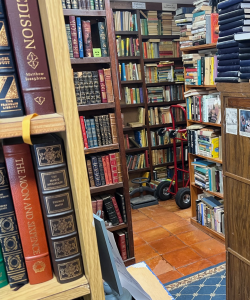
With a $100,000 grant from O’Shaughnessy Ventures, bookshop manager Charlie Becker is building an AI tool to help secondhand booksellers identify and catalogue titles.
