The Art of Reading John Berryman: Waking Up in The Dream Songs

A personal and in-depth look at the life and poetry of John Berryman, with particular focus on The Dream Songs.
Tags:
Jump to navigation Skip to content
Articles from Poet & Writers Magazine include material from the print edition plus exclusive online-only material.
A personal and in-depth look at the life and poetry of John Berryman, with particular focus on The Dream Songs.
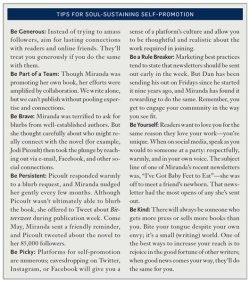
Through blogging, social media, newsletters, and book giveaways, a novelist teams up with the founder of WeGrowMedia to market her book—and show how making a personal connection with readers can go a long way towards making a book a best-seller.

In the inaugural installment of our new feature, Reviewers & Critics, New York Times book reviewer Dwight Garner talks about his experience as a critic—the required credentials (or lack thereof), how to cut through the hype, the role of negative reviews, and more.

In our tenth annual look at debut poets, we’ve asked the more than one hundred poets previously included in this feature to nominate their favorite debut collections of 2014. From that longlist of outstanding work, we’ve selected ten poets to feature here, who share their inspirations and influences, how their books began, and advice to those hoping to get their own books out into the world.

Innovations like the USB Typewriter, Hanx Writer, Hemingwrite, and Typing Writer are giving new life to the classic typewriter by updating it for the digital world.
With help from the Lannan Foundation, one of America’s most prestigious poetry prizes has survived the threat of shutting its doors, instead increasing its monetary award tenfold.
With so many good books being published every month, some literary titles worth exploring can get lost in the stacks. Page One offers the first lines of a dozen recently released books, including Edith Pearlman’s Honeydew and Rikki Ducornet’s The Deep Zoo, as the starting point for a closer look at these new and noteworthy titles.
Literary MagNet chronicles the start-ups and closures, successes and failures, anniversaries and accolades, changes of editorship and special issues—in short, the news and trends—of literary magazines in America. This issue’s MagNet features Ninth Letter, Gulf Coast, Gigantic, and Parallax.

Small Press Points highlights the innovation and can-do spirit of independent presses. This issue features the San Francisco–based Manic D Press, which publishes a broad array of books by authors who would otherwise be, as editor Jennifer Joseph says, “shunned by the traditional publishing establishment for their lack of commercial viability.”
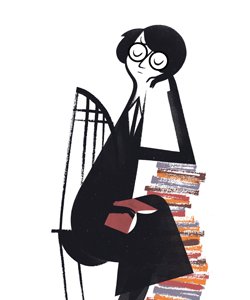
“My work is a lifelong celebration of futility.” Artist Roman Muradov, designer of this issue’s cover, discusses his various wells of inspiration, his relationship to the written word, and the importance of doing nothing.
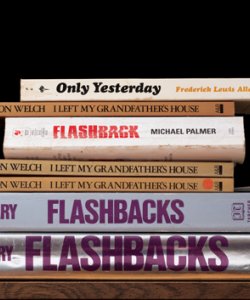
In her Sorted Books project, Nina Katchadourian arranges books from libraries—including William S. Burroughs’s personal collection, as well as those housed in museums and galleries across the country, to find a kind of poetry in the spines.
Amidst questions of racial diversity in the publishing industry, the Hurston/Wright foundation continues its outstanding support of African American writers, promising a brighter outlook for the state of writing in America.

A songwriter responds to literature—such as stories by Jonathan Lethem and George Saunders—with music, carrying the creative conversation across art forms.
Since appearing in our annual Debut Poets roundup, a number of the one hundred and twelve poets we’ve highlighted have gone on to create a wealth of interesting and important work. The following list includes each poet we’ve featured in the past ten years, his or her debut collection, and the many full-length books that followed.
Culled from our Writers Recommend series, the music and movies that inspire authors to keep writing, with recommendations from Sandra Beasley, Chloe Caldwell, Scott Cheshire, Joshua Henkin, and others.

When science author and NPR Math Guy Keith Devlin decided to cut a section from his soon-to-be published book on Fibonacci, he realized he had a unique opportunity—to self-publish the deleted content as an e-book alongside the hardcover book. We hear from Devlin, his agent Ted Weinstein, and publicist Amy Ferro on this uniquely challenging and exciting endeavor.
A writer learns that letting go of the need for perfectionism and allowing the creative impulse to guide the mind fluidly and freely can revitalize the practice of writing.

Louise Glück says a poet must be surprised by what the mind is capable of unveiling, which may explain why her twelfth book of poems, Faithful and Virtuous Night, published in September by Farrar, Straus and Giroux, feels so startlingly alive with the wonder of discovery.

Donald Hall may not be producing any more new poems, but the eighty-six-year-old author of more than fifty books is still revising; still polishing his prose, including the pieces in his new book, Essays After Eighty; and still reminiscing about a golden age of American poetry.

Artist and architect Matteo Pericoli pairs drawings of views from the desks of writers around the world with essays by those writers about where they write, what they see, and how their view informs their work
Recent restructuring at Alice James Books has allowed the forty-year-old press to strengthen its commitment to supporting the work of women poets.
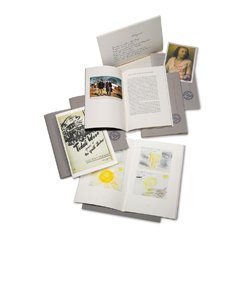
The Center for Humanities at the CUNY Graduate Center in New York City is making the ephemeral more tangible through its Lost & Found chapbook series.
A new anthology of short fiction from the University of Wisconsin Press explores the breadth of stories that women of color have to tell.