




Latino Poets Connect at CantoMundo
CantoMundo, a burgeoning Latino poets workshop in its second year, has become the third organization to make up an unofficial triad aimed at nurturing the work of American poets of color.
Tags:
Jump to navigation Skip to content
Articles from Poet & Writers Magazine include material from the print edition plus exclusive online-only material.
CantoMundo, a burgeoning Latino poets workshop in its second year, has become the third organization to make up an unofficial triad aimed at nurturing the work of American poets of color.
With so many good books being published every month, some literary titles worth exploring can get lost in the stacks. Page One offers the first lines of a dozen recently released books, including Aracelis Girmay’s Kingdom Animalia, and Tomaž Šalamun’s The Blue Tower, as the starting point for a closer look at these new and noteworthy titles.
Despite the average wired American’s tendency to downsize their character counts, the page counts of newly published books of translated fiction show that the rest of the global literary community may be beefing up.
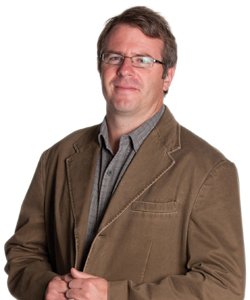
While working on his fourth issue as editor of Poetry Northwest, Kevin Craft, who succeeded David Biespiel in January 2010, discussed the importance of community, as well as a measured approach to editing, to the magazine’s success.
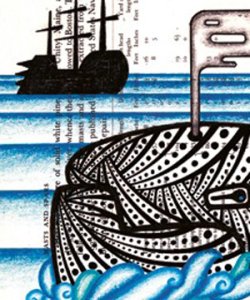
In this issue we offer a look at one of the 552 illustrations by Tim Kish, who created a picture a day for each page of Melville’s tome, featured in Moby-Dick in Pictures, published in October by Tin House Books.
Literary MagNet chronicles the start-ups and closures, successes and failures, anniversaries and accolades, changes of editorship and special issues—in short, the news and trends—of literary magazines in America. This issue’s MagNet features Memoir (and), Harvard Review, Huizache, the Coffin Factory, Monday Night, and Ploughshares.
While other social networking sites are useful for playful community-building, LinkedIn provides a place for professional writers to focus on sincerity when creating connections.
Small Press Points highlights the happenings of the small press players. This issue features Exterminating Angel Press, the six-year-old independent book publisher with a big mission: to challenge the received cultural narrative.

Sam Savage wrote for decades and eventually gave up completely before his debut novel was published when he was sixty-five. Now he’s an international best-selling author with a third novel, Glass, published by Coffee House Press, and one simple message for all of us: Art can save you.
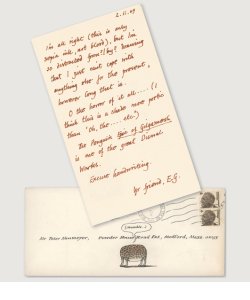
In this issue we offer a look at a note written in 1969 from Edward Gorey to Peter F. Neumeyer, included in the book Floating Worlds: The Letters of Edward Gorey and Peter F. Neumeyer, published by Pomegranate this month.
Literary MagNet chronicles the start-ups and closures, successes and failures, anniversaries and accolades, changes of editorship and special issues—in short, the news and trends—of literary magazines in America. This issue’s MagNet features the Lucky Peach, Hippocampus Magazine, Shenandoah, Granta, Calyx, and Passager.
Small Press Points highlights the happenings of the small press players. This issue features Arktoi Books, the five-year-old imprint of California-based Red Hen Press that was established in order to open a conversation among lesbian writers.
In this regular feature, we offer a few suggestions for podcasts, smartphone apps, Web tools, newsletters, museum shows, and gallery openings: a medley of literary curiosities that you might enjoy. This issue’s 3 for Free features the Poetry Foundation’s new app, Google’s online Art Project, and Project Gutenberg.
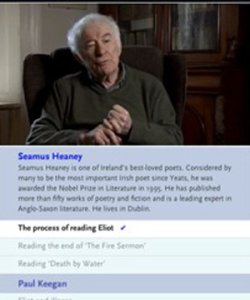
Recently released amplified editions of classics such as Jack Kerouac’s On the Road and T. S. Eliot’s The Waste Land indicate that the hybrid format may finally be coming into its own.
With so many good books being published every month, some literary titles worth exploring can get lost in the stacks. Page One offers the first lines of a dozen recently released books, including Terese Svoboda’s Bohemian Girl and Sven Birkerts's The Other Walk, as the starting point for a closer look at these new and noteworthy titles.
This summer W. W. Norton announced plans to resurrect Liveright & Company, the storied imprint that introduced American readers to early works by luminaries such as Hart Crane, E. E. Cummings, William Faulkner, and Ernest Hemingway.

A writer peddles his bike two thousand miles, from the headwaters of the Mississippi River down to New Orleans, following a trail cut by Mark Twain on the riverboat he piloted more than a hundred fifty years ago.
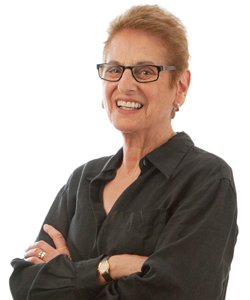
Newly settled into her position as editor of the Mary Burritt Christiansen Poetry Series at the University of New Mexico Press, Hilda Raz spoke about her hopes for the series.

The nation’s top fifty MFA programs based on popularity, funding, selectivity, fellowship-placement statistics, job-placement statistics, and student-faculty ratios, plus a look at other important program features, such as size, duration, cost of living, and foreign-language requirements.
Despite the recent collapse of book review sections in newspapers and magazines, the form is still thriving across a variety of venues, from web-savvy publications to local papers.
We’ve compiled this annual guide to graduate creative writing programs—which includes our rankings of the top full- and low-residency MFA programs (with honorable mentions) and, new to this year, doctoral programs—to provide a spark for the deep thinking and serious consideration that the process of choosing a program requires.
Attorney, poet, editor, and freelance journalist Seth Abramson explains the methodology used to compile the Poets & Writers Magazine 2012 rankings of postgraduate creative writing programs.
The top ten low-residency MFA programs in the United States, from Warren Wilson College in Swannanoa, North Carolina, to Goddard College in Plainfield, Vermont.
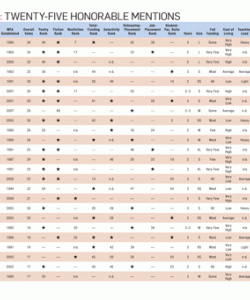
An additional twenty-five MFA programs in our annual rankings, from George Mason University in Fairfax, Virginia, to San Diego State University in California.
Answers to the most commonly asked questions about our rankings of full-residency, low-residency, and doctoral programs in creative writing.