Transformation

9.17.26

“To translate a book is to enter into a relationship with it, to approach and accompany it, to know it intimately, word by word, and to enjoy the comfort of its company in return,” says Jhumpa Lahiri in her 2021 Sebald Lecture “In Praise of Echo.” In the lecture, Lahiri invites readers to think of translation in broad terms, as not simply restating something in another language, but as a “miraculous transformation in which specific traits and elements are shed and others are newly obtained.” Spend time with this idea of translation as transformation and write a personal essay about an experience in which you metamorphosed an experience, an emotion, or yourself into a different “language.” This language might be a visual art form, music, a different genre of literature, or another form of expression.
Believable

9.16.26

In a 1981 interview published in the Paris Review, Gabriel García Márquez tells Peter Stone how his grandmother inspired the narrative voice in his novel One Hundred Years of Solitude, which tells the multi-generational story of the Buendía family and presents its fantastical elements with utter naturalness. Márquez wanted to write the novel’s magical narratives “with the same expression with which my grandmother told them: with a brick face.” Write a short story that incorporates mystical or supernatural elements while maintaining a tone based in reality, in which these elements are considered commonplace. What themes and truths about your characters are easier to express in this imagined world? As you write, consider what Márquez says about storytelling: “A novelist can do anything he wants so long as he makes people believe it.”

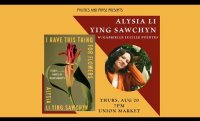
Alysia Li Ying Sawchyn: I Have This Thing for Flowers

Caption: 

In this Politics and Prose event, Alysia Li Ying Sawchyn reads from their second essay collection, I Have This Thing for Flowers: Essays on the Roots of Relationships (Flatiron Books, 2026), and discusses how researching and writing about flowers helped structure their personal experiences in a conversation with Gabrielle Lucille Fuentes. Sawchyn’s book is featured in Page One in the September/October 2026 issue of Poets & Writers Magazine.

Directives

9.15.26

In an interview published in Poetry Northwest, C. E. Janecek speaks with Asa Drake, author of Maybe the Body (Tin House, 2026), about language and its imprecision, and when it’s best to leave things unsaid. “In customer service one avoids negation because it often points to a conflict,” says Drake. “For example I might say ‘walk please’ instead of ‘no running’ and replace a rule with a directive. I’m really interested in why the command is less offensive than the rule.” Write a poem in which the speaker gives instructions to prohibit an act or behavior. Begin each stanza with an imperative verb and try avoiding negative words such as “don’t,” “no,” “never,” or “not.” How can you portray what is forbidden to a reader without explicitly naming the rules?

Mary Oliver: Saved By the Beauty of the World

Caption: 

Produced by PBS American Masters and directed by Sasha Waters, this documentary celebrates the life and career of Pulitzer Prize–winning poet Mary Oliver, and interviews Steve Buscemi, Stephen Colbert, Lucy Dacus, Nick Flynn, Donika Kelly, and other artists who have been influenced by her work.

Genre: 

Mix Tape

9.10.26

Music often has the ability to evoke a strong sense of nostalgia, whether it’s favorite songs played over and over during a certain phase of life or heard on the radio for a season. Songs can be introduced or recommended by loved ones, and lyrics might remind us of a particular person. Music could have even been sung along to during childhood road trips with family or become the perfect soundtrack for a specific town or city you’ve visited or lived in. Jot down a list of several songs that bring you back to a certain someone, someplace, or sometime. Write a personal essay composed of a series of vignettes about each song and the sense of nostalgia and associated memories that arise when you listen to the music. As you write, you might want to listen to the songs and incorporate lyrics into your essay.

Hieu Minh Nguyen, Lydi Conklin, and Ron Amato

Caption: 

In this Fine Arts Work Center event in Provincetown, Massachusetts, poet Hieu Minh Nguyen, writer Lydi Conklin, and photographer Ron Amato present their respective works. Nguyen reads a selection of poems from his third collection, Staying Still (Tin House, 2026), which is featured in Page One in the September/October 2026 issue of Poets & Writers Magazine.

Behind the Scenes

This week compose a short story arising out of a two-part exercise that illuminates a new side of the old “show, don’t tell” strategy. First, imagine that your main character has just experienced a significant change in their life, maybe something unexpected or even shocking: a sudden relationship breakup, news about a family member’s health getting worse, winning the lottery, or running into a long-lost love. Then write a short story that takes place the day after this revelation as they go about their day—whether looking out a window on a bus commute, walking in the neighborhood, or preparing a meal—but refrain from mentioning anything about what happened the day before. Instead, focus on how your character’s observations and feelings about their immediate surroundings might be colored by their current state of mind.

Inside Dialect

If familects are the unique words and phrases that are created within a family from inside jokes, shared experiences, and specific needs, then we can think of friendlects as the parallel for private languages created between close friends. These specific, social dialects bond a family and friend unit. What happens when the two languages meet? Write a poem that incorporates a word or phrase that is only used within your family and one that was created with a friend. In your poem, you might find yourself exploring themes of intimacy and the powers and shortcomings of language as a mode of expression and communication. You could also consider how communal bonds are built, ideas around belonging and unbelonging, and being an insider or an outsider. How do you bond with others through language?

Pages

Subscribe to Poets & Writers RSS