Q&A: Sze Named U.S. Poet Laureate

The newly appointed U.S. poet laureate discusses how he learned his craft as a literary translator and his plans for promoting poetry in translation.
Tags:
Jump to navigation Skip to content
The newly appointed U.S. poet laureate discusses how he learned his craft as a literary translator and his plans for promoting poetry in translation.
Ten debut poets, including Gbenga Adesina and Kalehua Kim, share the inspiration, advice, and writers block remedies that have sustained their literary practices.
Clunky metaphors, the use of em dashes and the verb “delve,” and the rule of threes. These are some telltale signs that you’re reading prose created by artificial intelligence systems like ChatGPT, according to a recent New York Times Magazine article titled “Why Does A.I. Write Like . . . That?” by Sam Kriss. AI creates a certain supposedly distinctive voice that is markedly strange, yet one which is foundationally based on how humans articulate themselves in language. This week write a poem from the persona of an AI bot that is commenting on its own algorithm and how it mines language from novels and textbooks to create what humans request through their prompts. Play with vocabulary, punctuation, and style to mimic the voice of AI. How does your AI persona’s own “consciousness” push it to create hallucinations?

Ten authors answer the tenth question in our Ten Questions series: What’s the best piece of writing advice you’ve ever received?
In this Beyond Baroque celebration of Teresa Dzieglewicz’s debut collection, Something Small of How to See a River (Tupelo Press, 2025), poets Jessica Abughattas, Meghann Plunkett, and Arumandhira Howard read their work exploring strength, care, and radical joy along with Dzieglewicz, whose collection is featured in Page One in the November/December issue of Poets & Writers Magazine.
The 2026 Neraki International Writers Workshops will be held from June 5 to June 14 at a seaside private home and seminar space in Katigiorgis, Greece. The workshop features craft classes, generative writing sessions, small-group workshops, individual meetings with mentors, unstructured time for writing, and various wellness activities for poets, fiction writers, and creative nonfiction writers. The faculty includes poet and fiction writer Paula Closson Buck and fiction and creative nonfiction writer Jim Buck.
Neraki International Writers Workshops, c/o Paula Closson Buck, 145 Jean Boulevard, Lewisburg, PA 17837. (570) 412-2366. Paula Closson Buck, Cofounder.
Writeaways offers a weeklong retreat from April 10 to April 17 to poets, fiction writers, and nonfiction writers (including creative nonfiction writers) at the 17th century Villa Cinci and Villa Casanova located in the Chianti region of Tuscany, Italy. Residents are provided with time and space to write, writing workshops, private writing consultations, and a cooking class. The faculty includes poet and fiction writer Mimi Herman and fiction and nonfiction writer John Yewell.
Writeaways, Writeaway in Italy, P.O. Box 62012, Durham, NC 27715. Mimi Herman and John Yewell, Codirectors.
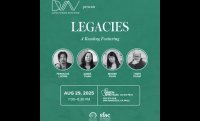
In this Green Apple Books event, the Diasporic Vietnamese Artists Network (DVAN) presents a night of readings featuring writers François Luong, Aimee Phan, Minnie Phan, and Thien Pham, sponsored by the San Francisco Public Library and San Francisco Arts Commission.
“It was happily free of theoretical ambitions, such as being avant-garde or radical or even funny,” writes Ron Padgett in the foreword to The Complete C Comics (New York Review Books, 2025), which collects the two issues of comic books created by Joe Brainard in collaboration with New York School poets in the 1960s. Brainard created the drawings and poets, such as Padgett, John Ashbery, Ted Berrigan, Barbara Guest, Kenneth Koch, Frank O’Hara, and Peter Schjeldahl, provided text for speech balloons and captions. This week experiment with the energy and humor of this illustrative format. Take inspiration from classic comic book icons and characters and write a poem that channels the childlike playfulness of comics, giving them your own “adult” spin, perhaps incorporating elements of surrealism or parody, or even accompanying your own doodles and sketches.
A prize of $500 and publication by Broadside Lotus Press is given annually for a poetry collection by an African American poet. Submit two copies of a manuscript of approximately 60 to 90 pages by March 15. There is no entry fee. Visit the website for complete guidelines.