Dear Readers, You Are Not Alone
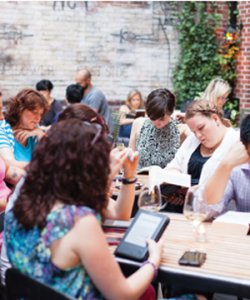
A new literary trend is gaining traction across the country: Silent Book Clubs, parties in which a group of people gather at a bar, library, or private home to read together silently.
Tags:
Jump to navigation Skip to content
A new literary trend is gaining traction across the country: Silent Book Clubs, parties in which a group of people gather at a bar, library, or private home to read together silently.
The National Endowment for the Arts has announced the thirty-seven recipients of its 2017 Creative Writing Fellowships in poetry. Each of the fellows will receive $25,000 for writing, research, travel, and general career advancement. The annual grants are given to emerging and established writers and alternate between poetry and prose.
The recipients, who hail from nineteen different states, are:
Hadara Bar-Nadav
Michael Bazzett
Josh Bell
Joshua Bennett
Emma Bolden
Jesús Ignacio Castillo
Darin Ciccotelli
Diana Marie Delgado
Jose Hernandez Diaz
Melanie Figg
Jennifer Elise Foerster
Landon Godfrey
Amorak Huey
James Kimbrell
Ruth Ellen Kocher
Edgar Kunz
Nick Lantz
Nancy Chen Long
Chris Martin
David Tomas Martinez
Ted Mathys
Matt Morton
Angel Nafis
Hieu Minh Nguyen
Kathryn Nuernberger
Morgan Parker
Emmy Perez
Hai-Dang Phan
Camille Rankine
Lauren Russell
Danez Smith
Patricia Smith
Monica Sok
Melissa Stein
Corey Van Landingham
Jeanann Verlee
Hope Wabuke
“The NEA has an excellent record of supporting writers who have gone on to have impressive literary careers,” said NEA Director of Literature Amy Stolls. “With their talent and diverse backgrounds, this year’s Creative Writing Fellows will add to our country’s rich literary history.” The fellows were selected from a pool of more than eighteen hundred applications.
The 2018 fellowships will be given to prose writers; the application deadline is March 8.
Austria’s fifty-two-letter word of the year; fiction inspired by real works of art; Minnesota health clinic incorporates poetry classes into wellness programs; and other news.
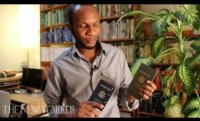
In this New Yorker video, Teju Cole, author of Known and Strange Things (Random House, 2016), reflects on his American citizenship and Nigerian upbringing from his home in Brooklyn. Cole is featured in the September/October issue of Poets & Writers Magazine.
In Iceland, to write poetry is considered “part of being an Icelander,” according to Icelandic literature professor Sveinn Yngvi Egilsson, and not a “specialist activity” but one that includes a variety of practitioners such as horse breeders, scientists, and politicians. Write a few ferskeytt poems, a popular Icelandic four-line verse form with alternating rhyme. Spend just ten minutes or so on each one, implementing the poem as a casual and functional way to inject some humor or wit into dealing with everyday duties, workday blues, or the oncoming winter.
PEN America has announced the longlists for its 2017 PEN America Literary Awards in fiction, creative nonfiction, and translation. Each year PEN awards more than $150,000 to writers of poetry, fiction, science writing, essays, sports writing, biography, children’s literature, translation, and drama.
PEN/Diamonstein-Spielvogel Award for the Art of the Essay ($10,000)
The semifinalists are The Art of Waiting: On Fertility, Medicine, and Motherhood (Graywolf) by Belle Boggs; Known and Strange Things (Random House) by Teju Cole; Against Everything (Pantheon) by Mark Greif; A Woman Looking at Men Looking at Women: Essays on Art, Sex, and the Mind (Simon & Schuster) by Siri Hustvedt; The Girls in My Town (University of New Mexico Press) by Angela Morales; Soul at the White Heat (Ecco) by Joyce Carol Oates; Becoming Earth (Red Hen) by Eva Saulitis; Ethics in the Real World (Princeton University Press) by Peter Singer; Far and Away: Reporting From the Brink of Change (Scribner) by Andrew Solomon; and Hungry Heart (Atria) by Jennifer Weiner.
PEN/Robert W. Bingham Prize for Debut Fiction ($25,000)
The semifinalists are Insurrections (University Press of Kentucky) by Rion Amilcar Scott; We Show What We Have Learned (Lookout) by Clare Beams; The Mothers (Riverhead) by Brit Bennett; The Wangs vs. the World (Houghton Mifflin Harcourt) by Jade Chang; When Watched (Penguin) by Leopoldine Core; Hide (Bloomsbury) by Matthew Griffin; Homegoing (Knopf) by Yaa Gyasi; Tuesday Nights in 1980 (Gallery) by Molly Prentiss; Hurt People (Farrar, Straus & Giroux) by Cote Smith; and Wreck and Order (Hogarth/Crown Publishing) by Hannah Tennant-Moore.
PEN Open Book Award for a book in any genre by a writer of color ($5,000)
The semifinalists are Blackass (Graywolf) by A. Igoni Barrett; Chronicle of a Last Summer: A Novel of Egypt (Tim Duggan) by Yasmine El Rashidi; The Book of Memory (Farrar, Straus & Giroux) by Petina Gappah; The Big Book of Exit Strategies (Alice James) by Jamaal May; Behold the Dreamers (Random House) by Imbolo Mbue; What Is Not Yours Is Not Yours (Riverhead) by Helen Oyeyemi; Look (Graywolf) by Solmaz Sharif; Problems (Coffee House) by Jade Sharma; Cannibal (University of Nebraska Press) by Safiya Sinclair; and Blackacre (Graywolf) by Monica Youn.
The finalists in several categories will be announced on January 18, and the winners will be announced February 22. The debut fiction and essay awards, as well as the PEN/Jean Stein Book Award and the PEN/Nabokov Award, will be announced live at the PEN Literary Awards Ceremony on March 27 in New York City.
For the complete list of semifinalists, including those in the categories of poetry and prose in translation, visit the PEN America website.
Leslie Shipman is a poet whose work has appeared in BOMB Magazine, the Kenyon Review, Tinderbox, Mid-American Review, Laurel Review, Cosmonauts Avenue, and elsewhere. She has been nominated for a Pushcart Prize and anthologized in Best New Poets. Formerly the assistant director of the National Book Foundation, she is now a freelance consultant specializing in project and event management for arts and literature nonprofits.

The F train takes about an hour to get from my home in Red Hook, Brooklyn to the Kew Gardens Community Center in Queens, site of a long-running, multigenre creative writing workshop for seniors, sponsored by Poets & Writers. Kew Gardens, like most neighborhoods in Queens, is a vibrant community of Latinos, Asian Americans, and an aging population of Jewish refugees who fled Germany after World War II and settled in this middle-class area. The hour on the train is useful. I anticipate the work my students will bring, and think about what craft element I want to introduce.
I work with a small group of ten or so women, ranging in age from mid-sixties to mid-eighties, who are writing poetry, fiction, and memoir. They’re good writers. Serious writers. Writers who are interested in an honest critical response to their work, and ways they might improve it. The range of life experience in this classroom is breathtaking, and I frequently feel more like a student than a teacher, as I read their stories and learn about their lives.
At the end of every class, I give them a writing prompt to help generate new work between classes. Usually it’s a simple exercise that asks them to describe something. The twist is that they can’t describe it from their own point of view, they have to describe it from, say, their mother’s point of view, or their childhood best friend’s point of view. I do this to help them separate themselves from their narrator, so they can feel what it’s like to create a voice that’s distinct from their own, to create a narrative persona, even in memoir.
I also emphasize thinking about sentences. In a class where the students are working in different genres, sentences are what unite us. Words are the building blocks, but sentences, in all their structural complexities, are our raw material. We talk about syntax, and delay of information. We talk about how to create drama and tension, and how syntax can heighten these crucial elements of a poem or story.
With this in mind, I asked them to create a persona to describe their childhood bedrooms. All of their responses to this exercise were fascinating. One writer lingered over the way the light played on her ceiling. I asked if she was familiar with the magic lantern scene in Swann’s Way by Marcel Proust. She wasn’t, but she managed to evoke a similar magic in her own description of the interior light of her bedroom as a child, evoking nostalgia, love, and a difficult relationship with her sister.
The gratitude I feel in working with these older writers is sustaining. I’m the lucky one, privileged to be a small part of their development as writers, to witness their lives in words, and to help shepherd their stories into the world.
Photo: Leslie Shipman. Photo credit: Elena Alexander.
Support for the Readings & Workshops Program in New York City is provided, in part, by public funds from the New York State Council on the Arts, and the New York City Department of Cultural Affairs, with additional support from the Louis and Anne Abrons Foundation, the Axe-Houghton Foundation, the A.K. Starr Charitable Trust, and Friends of Poets & Writers.
A consideration of sustainable funding for poets; Ha Jin on his new novel; Jeff VanderMeer funds full year of the Octavia Project; and other news.
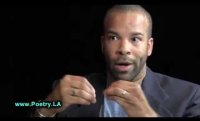
“The best kind of fire that we can hope to be able to spark is one that creates light and also creates heat.” In this interview with Mariano Zaro for the Poetry.LA series, Douglas Kearney discusses performative typography, his play with language and sound, and how he came to poetry.
Guardian to form partnership with Vice; on Patti Smith, Bob Dylan, and the Nobel Prize; Terry McDonnell on his new memoir; and other news.