



The Molino by Melani Martinez
Melani Martinez reads from her memoir, The Molino, published by University of Arizona Press in September 2024.
Jump to navigation Skip to content

The Odesa Poetry Studio is a free program that creates space for children to gather, write poems, and share their work with one another, validating their voices and feelings as they live through ongoing war.
In this 2020 video hosted by Philip Brady, Johnny Temple, publisher and editor-in-chief of Akashic Books, and Ibrahim Ahmad, the press’s former editorial director, discuss a day in the life of a small press and offer insights on the publishing process. Ahmad, currently an executive editor at Viking, is featured in Agents & Editors in the September/October issue of Poets & Writers Magazine.
Is it science fiction or simply the state of advanced, contemporary science? Hiromi Kawakami’s latest novel, Under the Eye of the Big Bird, forthcoming from Soft Skull Press in September and translated from the Japanese by Asa Yoneda, takes place thousands of years in the future when humans are near extinction. Children are created in factories from the cells of animals including cows, dolphins, horses, and mice. Kawakami’s magical realism blends scientific advancements with real-life phenomena such as population aging, as well as the existing technologies of cloning and xenotransplantation. Using an idea or a concept derived from scientific studies or your own research, write a speculative fiction story that builds on existing technology to achieve the fantastic. In your invented future what fundamental issues of ethics, traditions, and mortality arise?
In this Center for Fiction event, Padma Viswanathan, author of Like Every Form of Love: A Memoir of Friendship and True Crime (7.13 Books, 2024), and Tracy O’Neill, author of Woman of Interest (HarperOne, 2024), discuss their memoirs and how they broke genre conventions to craft their stories.
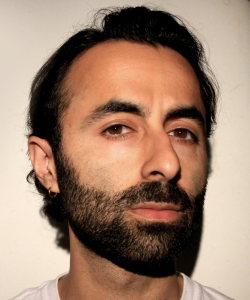
“I thrive in the blur between my waking world and my invented worlds.” —Navid Sinaki, author of Medusa of the Roses
William Carlos Williams’s multi-volume, mid-twentieth-century poem Paterson is purportedly inspired by the works of his contemporaries: James Joyce’s Ulysses, Ezra Pound’s The Cantos, T. S. Eliot’s The Waste Land, and Hart Crane’s The Bridge. Through his subject—the former mill town of Paterson, New Jersey—Williams provides a voice for American industrial communities. A launching pad for other artists’ work, the book inspired Jim Jarmusch’s 2016 film Paterson, about a bus driver and poet named Paterson in the city of the same name, and Robert Fitterman’s book Creve Coeur (Winter Editions, 2024), set in the segregated suburbs of his eponymous Missouri hometown—an illustration of contemporary America that mirrors the structure of Williams’s postwar epic. Write a poem that draws on specific observations of your neighborhood to express a wider perspective on life in the twenty-first century. Incorporate street names, local landmarks, and history as well as tidbits of everyday conversation.
In this Penguin Random House video, China Miéville and Keanu Reeves answer questions from readers about the writing process and inspiration for their collaborative novel, The Book of Elsewhere (Del Rey, 2024), based on the comic book series BRZRKR.

The author of Freedom Is a Feast examines the inspirational power of real-life events.
“At the heart of it, it’s all about making things.” In this Ride Channel video, Bret Anthony Johnston, author most recently of the novel We Burn Daylight (Random House, 2024), talks about the link between skateboarding and writing, and how they are both “a way to escape yourself” and “give yourself over to something much bigger than you.” For more from Johnston, read his installment of our Ten Questions series.


