Breaking the Panel: Women Reshaping the Comic Universe

Caption: 

In this New York Public Library event, comic book writers and artists Amy Chu, Arielle Jovellanos, Soo Lee, and Amy Reeder talk about character development and the diverse and influential roles women play in shaping the world of comics at the Stavros Niarchos Foundation Library in New York.

Genre: 

I Witness

7.23.24

In the twentieth anniversary edition of Don’t Let Me Be Lonely: An American Lyric, Claudia Rankine writes in the preface about her use of the first-person voice “to bear witness to the witness” and provide emotion while maintaining an intimacy within the text. “Anybody could embody the first person and be our guide through the text,” writes Rankine. “For me, at the time, this was a liberating mechanism for getting at the ineffable affective disorder of the moment without disconnecting from the people affected by it.” Write a poem about an event currently unfolding in the world, either locally or on a global scale. Deploy the first-person “I” as a tool to guide the reader through what’s being witnessed. Are there multiple emotional truths at play? How can you give them shape?

Summer Book Report 2024

Caption: 

In this CBS Sunday Morning video, Washington Post book critic Ron Charles recommends books for the summer, including the novels Godwin by Joseph O’Neill (Pantheon, 2024), Same as It Ever Was (Doubleday, 2024) by Claire Lombardo, and Bear (Hogarth, 2024) by Julia Phillips, who is profiled in the July/August issue of Poets & Writers Magazine.

Genre: 

Seeing Yourself

7.18.24

“I have known brilliant writers who could size people up in minutes with alarming accuracy.... And yet for all their ability to understand people, to see them, to capture them as characters, these writers could not see themselves,” writes Literary Hub editor-in-chief Jonny Diamond in a piece reflecting on a recent op-ed written by the daughter of Nobel laureate Alice Munro, Andrea Skinner, about her mother’s failure to protect her from sexual abuse by her stepfather. Write a personal essay that traces your self-awareness through several phases of your life, contemplating on how your understanding and perception of yourself has transformed through the years. Can you reconcile the differing points of view that various people in your life hold about you? Are there blind spots that, even if you can’t or don’t want to articulate, you wish to acknowledge?

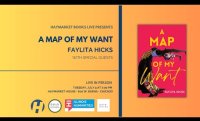
Faylita Hicks: A Map of My Want

Caption: 

In this Haymarket Books event, Faylita Hicks reads from her second poetry collection, A Map of My Want (Haymarket Books, 2024), which is featured in Page One in the July/August issue of Poets & Writers Magazine. The event includes an introduction by Aricka Foreman and readings by Andrea Change, Billy Tuggle, Carmendy Tuggle, and Ruben Quesada.

Genre: 

Ghost Story

7.17.24

Ghosting, the social practice of suddenly cutting off communication without explanation by no longer accepting or responding to calls or messages, is often associated with dating but can also extend to other arenas of interpersonal communication and socializing, such as the interview process for a new job or with friends and family. Write a short story that revolves around two people, one of whom ghosts the other. What are the dynamics of communication that lead up to the ghosting, and what is the fallout? Are excuses made or is hindsight twenty-twenty? Consider how much of each party’s point of view to reveal prior to and after the ghosting.

First Fiction 2024 Virtual Reading

Caption: 

In this virtual reading and conversation, Poets & Writers Magazine features editor India Lena González introduces the five debut authors featured in “First Fiction 2024”: ’Pemi Aguda, author of Ghostroots (Norton, 2024); Jiaming Tang, author of Cinema Love (Dutton, 2024); Michael Deagler, author of Early Sobrieties (Astra House, 2024); Yasmin Zaher, author of The Coin (Catapult, 2024); and Gina María Balibrera, author of The Volcano Lovers (Pantheon, 2024).

Genre: 

States of Matter

7.16.24

In medieval European cathedrals, some of the panes of the beautiful stained glass windows are thicker at the bottom than at the top, creating misconceptions that the seemingly solid glass has melted over time. According to an article published in Scientific American, glass is an amorphous solid, a state that is neither solid nor liquid but something in between disproving the theory of melted glass. The differences in thickness of old glass windows is merely a product of the manufacturing process, giving them a melted look. This week write a poem inspired by the idea of something, or even someone, existing in an in-between state. Consider playing with the line breaks and white space of your page to mirror or contrast with your chosen subject.

Pages

Subscribe to Poets & Writers RSS