Speak Now Series: Claudia Rankine

Caption: 

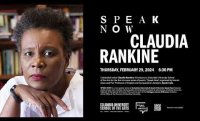
“If the only thing we can give to each other is ourselves, we better do it. Now.” In this inaugural Speak Now series event hosted by Columbia University School of the Arts, Claudia Rankine reads from her work-in-progress “Triage” and discusses political censorship in higher education and the importance of literature in crises in a conversation with Sarah Cole.

Penny-Pinching

“Most pennies produced by the U.S. Mint are given out as change but never spent; this creates an incessant demand for new pennies to replace them,” writes Caity Weaver in an article published in the New York Times Magazine about the wasteful production of pennies. “A conservative estimate holds that there are 240 billion pennies lying around the United States…enough to hand two pennies to every bewildered human born since the dawn of man.” Write a short story that imagines a different life for the copper-plated coin, perhaps a universe in which all dormant pennies are suddenly used or an attempt to collect and dispose of them is put into place. What would propel your characters to care about the worth of a penny?

Rentrée

The French expression, à la rentrée, literally means “at the return” and can be translated as “see you in the fall” to refer to the time of year when students return back to school after the summer break and vacationers return to the city and to work after out-of-town trips—a time to start anew feeling reenergized with a refreshed and rested perspective on everyday routines. Think about the projects, personal goals, or relationships that you’d like to approach with a fresh start this autumn season. To celebrate la rentrée, write a poem that revolves around a familiar relationship, duty, or obligation. How might it be approached from a different angle or seen in a new light?

Juli Min: Shanghailanders

Caption: 

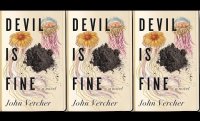
“The book is, in many ways, about expectations and change.” In this Fane Productions event, Juli Min reads from her debut novel, Shanghailanders (Spiegel & Grau, 2024), and discusses her choice to begin the novel in the future in Shanghai and how the diverse and multifaceted city is its own character in a conversation with author Rowan Hisayo Buchanan.

Genre: 

New York Times’ Top 100 Books

Caption: 

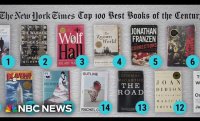
In this NBC News video, New York Times Book Review editor Gilbert Cruz talks about assembling the newspaper’s recently released list of top 100 books of the twenty-first century with the help of a panel of novelists, nonfiction writers, poets, critics, and book lovers.

Evan Friss: The Bookshop

Caption: 

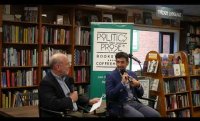
“It’s not, I don’t think, hyperbolic to say that books can and have changed people’s lives, and how we find books matters a great deal.” In this conversation with Politics and Prose Bookstore co-owner Bradley Graham, author Evan Friss talks about his book The Bookshop: A History of the American Bookstore (Viking, 2024) and how bookstores serve as important spaces that foster community and culture in America.

All at Once

8.29.24

“The writing comes not with the then and then and then of narrative time driven by the hierarchy of information that plot demands, but with the and and and and and of parataxis. Everything is equal all together and all at once,” writes Jennifer Kabat in her debut memoir, The Eighth Moon: A Memoir of Belonging and Rebellion (Milkweed Editions, 2024), which combines the author’s musings on her relocation to the rural Catskills in New York with historical documents and research about the Anti-Rent War between tenant farmers and landowners that took place in the region in the early nineteenth century. Take a deep dive into a historical event that took place where you live and write an essay that attempts to bridge your own experiences and memories of your locale with the past. Inspired by Kabat, experiment with alternating back and forth through different time periods, point of view, and verb tense for a sense of simultaneity.

The Sound of Things

8.28.24

French director and screenwriter Tran Anh Hung’s Oscar-nominated film The Taste of Things, adapted from a 1924 novel by Swiss author Marcel Rouff, opens with a scene that takes place in the ground-floor kitchen of a late-nineteenth-century estate in France. The scene, which lasts for nearly forty minutes and contains little dialogue, consists primarily of shots of a chef and his cooks preparing a sumptuous feast as they maneuver around one another, handling and arranging various ingredients for each dish. The camera zooms in on the pots and pans, and precise sounds of sizzling, sauteing, crackling, rinsing, stirring, bubbling, and steaming are captured. Write a scene or portion of a short story that focuses in on the sounds of a particular room in your setting. When you subtract human voices, does a chronicle of meticulous details emerge?


Pages

Subscribe to Poets & Writers RSS