




Return From Silence: An Interview With Norman Dubie

After a 10-year hiatus from publishing, Norman Dubie has returned with an award-winning volume of collected and new poetry, a 400-page sci-fi poem, and his latest, Ordinary Mornings of a Coliseum.
Jump to navigation Skip to content
Articles from Poet & Writers Magazine include material from the print edition plus exclusive online-only material.
After a 10-year hiatus from publishing, Norman Dubie has returned with an award-winning volume of collected and new poetry, a 400-page sci-fi poem, and his latest, Ordinary Mornings of a Coliseum.
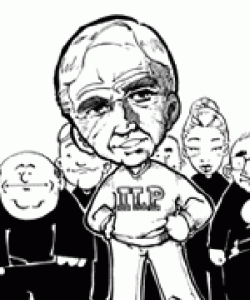
No entry fee? Little chance of rejection? Any poet worth her iamb has reason to be suspicious. And, indeed, the International Library of Poetry and its affiliates—the International Society of Poets, Watermark Press, poetry.com, and so on appears on several Internet-based contest-scam watch lists. Still ILP education director Len Roberts argues that the organization has its purpose and is taking steps to redeem its reputation.
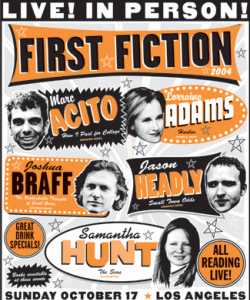
Cindy Dach, the events and marketing manager of Changing Hands Bookstore in Tempe, Arizona, recently launched First Fiction Tour, a program that she hopes will heighten the public image of the first-time author. But it’s not what you might expect: She isn’t packing customers into the bookstore, she’s inviting them to the bar.
"I believe I control the world with my mind," Augusten Burroughs writes in the title essay of his new collection, Magical Thinking: True Stories. And who’s to say he doesn’t? Having survived a tumultuous childhood and an early career as an advertising copywriter while struggling with alcoholism, Burroughs—now a bestselling author—has indeed controlled his world. Magical Thinking is his fourth book in as many years, taking its place alongside Sellevision, his satirical novel about cable television’s home shopping networks, and his memoirs, Running With Scissors and Dry.

Every year, musicians, movie stars, filmmakers, and politicos share billing with creative writers at the New Yorker Festival, held every autumn at various New York City venues. Now in its fifth year, the literary event has turned into a pop-culture phenomenon.
Literary MagNet chronicles the start-ups and closures, successes and failures, anniversaries and accolades, changes of editorship and special issues—in short, the news and trends—of literary magazines in America. This issue's MagNet features Granta, the Indiana Review, Black Warrior Review, Court Green, Columbia Poetry Review, Absinthe Literary Review, Minima, Wild Strawberries, and Cue.
Page One features a sample of titles we think you'll want to
explore. With this installment, we offer excerpts from A Reading Diary: A Passionate Reader’s Reflections 0n a Year of Books by Alberto Manguel, The Secret Goldfish by David Means, and A Complicated Kindness by Miriam Toews.
Is it against the law for an American literary journal editor to publish a translation of a poem by a member of a terrorist organization? Is it illegal to translate it? Learn what writers need to know about the Patriot Act.

Richard Howard will turn 75 in October, the same month that Farrar, Straus and Giroux will publish Inner Voices: Selected Poems 1963–2003 and Paper Trail: Selected Prose 1965–2003, and he seems more eager than ever to share his unique perspectives.
A recent headline in the New York Times Book Review declared, “Books Make You a Boring Person.” Many would disagree with that statement, but few would go as far as the folks in the marketing department at Penguin UK. The London-based arm of the venerable publishing house has begun to advertise its books as dating aids. According to Penguin, you’re not good looking—or Good Booking—unless you’re holding a book.

For nearly two years, WordTech Communications was one of the growing number of small presses using the contest model in which entry fees fund prize monies as well as the publication and promotion of winning books. Some would even say the Cincinnati-based press was gung ho about it, holding a different poetry contest every month. But in June, WordTech announced it was discontinuing its contest program and replacing it with an open-submissions policy, stating that there was more money to be made without contests.

Vladimir Nabokov once wrote, “Does there not exist a high ridge where the mountainside of ‘scientific’ information joins the opposite slope of ‘artistic’ imagination?” This was, of course, a rhetorical question, but Nabokov’s own life proved that this connection indeed exists. A dedicated lepidopterist (one who studies moths and butterflies), Nabokov not only held a post at the Museum of Comparative Zoology at Harvard University, he also wrote Lolita, a classic of 20th-century literature. I was recently reminded of Nabokov’s butterflies in, of all places, a dead man’s apartment in Boston.
Small Press Points highlights the happenings of the small press players. This issue features Future Tense Books, Manic D Press, Akashic Books, Nightboat Books, and Autumn House Press.
For the past fourteen years, Hank Stuever, a two-time Pulitzer Prize finalist, has published his unique brand of creative nonfiction in the form of newspaper articles in the Albuquerque Tribune, Austin American-Statesman, and the Washington Post. The subjects of his articles—haunted waterbed stores, plastic lawn chairs, beauty pageants, and discount funeral homes among them—hardly seem fodder for probing essays on the American psyche. But what might fall into the realm of light comedy for many writers takes on a lyrical profundity in Stuever’s work.
Next month, Norton will publish Stephen Dunn’s thirteenth book of poetry, The Insistence of Beauty, his second offering since his Different Hours won the 2001 Pulitzer Prize. In a writing career that has spanned three decades, Dunn has also been honored with the Academy Award for Literature from the American Academy of Arts & Letters, the James Wright Prize from the Mid-American Review, and the Levinson Award from Poetry magazine, as well as fellowships from the National Endowment for the Arts, the New Jersey State Council on the Arts, and the Guggenheim Foundation. He divides his time between Frostburg, Maryland, and Pomona, New Jersey, where he teaches creative writing at Richard Stockton College.
Richard Howard is rarely at a loss for words. The poet, essayist, translator, editor, and professor is a tireless conversationalist who is always willing to supply a strong opinion on the many subjects to which he has applied his talents during a career that spans four decades.
In his introduction to The Anchor Book of New American Short Stories, editor Ben Marcus writers, "If we are made by what we read, if language truly builds people into what they are, how they think, the depth with which they feel, then these stories are, to me, premium material for that construction project. You could build a civilization with them." The 473-page anthology includes stories by George Saunders, David Foster Wallace, Anthony Doerr, Jhumpa Lahiri, Anne Carson, Gary Lutz, and more than 20 others.
Ballantine Books recently published You Remind Me of Me, Dan Chaon's long awaited debut novel about a pregnant teenager who gives up her child for adoption in 1966. In a review in the New York Times Sunday Book Review, Sara Mosley wrote that the novel "more than fulfills the promise of his story collection Among the Missing, which was a finalist for a National Book Award in 2001." Chaon is also the author of Fitting Ends, originally published by Triquarterly Books in 1995. A revised edition of the short story collection was published by Ballantine last year. Chaon teaches at Oberlin College and lives with his wife and two sons in Cleveland, Ohio.
While the literary community tries to gauge the influence of academia on the state of contemporary fiction, Frederick Reiken, whose two critically acclaimed novels have been translated into several languages, is gently riding out the wave of debate. A graduate of Princeton and the University of California at Irvine's MFA program, Reiken teaches writing in the graduate program at Emerson College. His first novel, The Odd Sea (Harcourt, 1998), won the Hackney Literary Award for First Fiction and was selected by both Booklist and Library Journal as one of the best first novels of the year. This was followed by a more ambitious novel, The Lost Legends of New Jersey (Harcourt, 2000), which became a bestseller and is described by Charles Baxter as "a miraculous balancing of tone and theme."

Appearing in someone else’s memoir is like appearing in someone else’s dream. Your role is scripted according to the vagaries of the author’s memory and subjected to the Rorschach test of the heart. This utter lack of editorial control is the second thought I have on learning, in the pages of the New York Times Book Review, that the son of my late ex-husband has published a memoir of his father, the poet William Matthews.
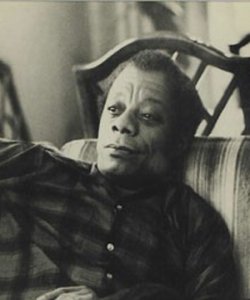
Notes of a Native Son, James Baldwin’s best-known book, was published in 1955 by Beacon Press. Baldwin’s editor then was Sol Stein, whom he’d known since high school. This essay is an excerpt from Stein’s Introduction to Native Sons by Baldwin and Stein, which will be published by One World, an imprint of Random House, next month. The book includes correspondence between Stein and Baldwin that produced Notes of a Native Son.
Page One features a sample of titles we think you'll want to explore. With this installment, we offer excerpts from Invisible Bride by Tony Tost and Coin of the Realm by Carl Phillips.
Small Press Points highlights the happenings of the small press players. This issue features Green Integer, Coffee House Press, Verse Press, Fiction Collective Two, and Kelsey St. Press.
In April the National Endowment for the Arts launched Operation Homecoming, a program of creative writing workshops for soldiers returning from combat in Iraq and Afghanistan.
