Wislawa Szymborska

Caption: 

"Nothing can ever happen twice." Listen to a selection of poems by Nobel laureate Wislawa Szymborska, read by her translator Clare Cavanagh, as well as poets Charles Simic and Krystyna Dabrowska, at a celebration of her life and work hosted by the 92nd Street Y. The event also celebrated the publication of Szymborska's posthumous collection, Map: Collected and Last Poems (Houghton Mifflin Harcourt, 2015).

Genre: 

En Route

5.19.16

Last month, a team of field research scientists discovered a new desert line drawing, or geoglyph, of “an animal sticking out the tongue” in the Nazca region of Peru, believed to be located on an ancient pilgrimage path to a ceremonial center. Think about the markers that guide you on your own often-traveled routes: physical signposts that you pass on the way to a favorite restaurant, a loved one’s home, place of worship, or perhaps a natural lookout or meditation spot. Write a personal essay exploring how these markers may be a significant element of the journey to your destinations.

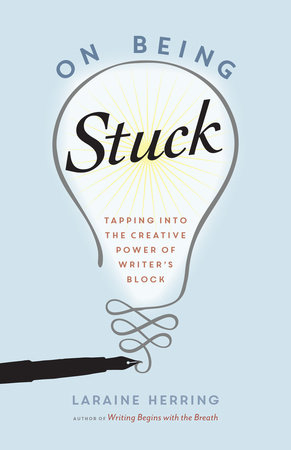
On Being Stuck: Tapping Into the Creative Power of Writer's Block

by
Author: 
Laraine Herring
Published in 2016
by Shambhala Publications

"Instead of reacting to the block, I encourage you to stop and look at it. Listen to it. Touch it. Find out what its gifts are, what it's offering you." Laraine Herring presents a new perspective of writer's block, sharing strategies for transforming the feeling of being stuck into an opportunity to challenge oneself. Herring encourages writers to take a closer look at the writing process, channel creative energy through meditation and breathing exercises, and provides innovative writing techniques and prompts.

Emotional Truth

5.18.16

In “The Deepest Place” by Kevin Nance in the May/June issue of Poets & Writers Magazine, Adam Haslett says of his new novel, Imagine Me Gone (Little, Brown, 2016), “it’s the most autobiographical thing I’ve ever written,” referring to the intensity of the emotional truth laid bare on the page. Choose an emotional event from your past and transmute it into a fictional scene. Create new, imagined consequences that nonetheless reflect the true anguish of the moment. How can turning fact into fiction construct a distance between the life and the work that offers a new take on an intense situation?

Han Kang Wins Man Booker International Prize

South Korean author Han Kang has won the Man Booker International Prize for her novel The Vegetarian. The £50,000 prize, announced on Monday at a ceremony in London, will be split between the author and her translator, Deborah Smith. This is the first year that the prize was given for a single work of fiction, and was open to writers of any language whose books have been translated into English.

Han Kang beat out an impressive and diverse shortlist for the prize, which included Italian author Elena Ferrante for The Story of the Lost Child, the fourth and final volume of her Neapolitan Novels; José Eduardo Agualusa of Angola for A General Theory of Oblivion, which was written in Portuguese; Turkish Nobel laureate Orhan Pamuk for A Strangeness in My Mind; Robert Seethaler of Austria for A Whole Life; and Yan Lianke of China for The Four Books.
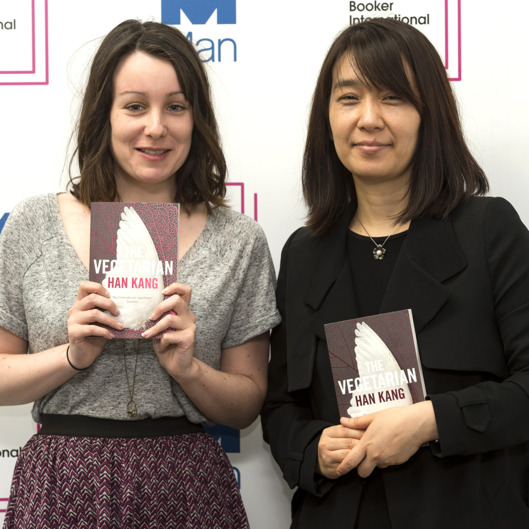
The Vegetarian, Han’s first book to be translated into English, is a dark novel about a woman who stops eating meat and wants to become a tree. From the Man Booker International website: “Fraught, disturbing, and beautiful, The Vegetarian is a novel about modern day South Korea, but also a novel about shame, desire, and our faltering attempts to understand others, from one imprisoned body to another.”

Han Kang is the author of two novels, The Vegetarian and Human Acts, both published in the UK by Portobello Books, in 2015 and 2016, respectively. Han was born in Gwangju, South Korea, and moved to Seoul at age ten. Her writing has won the Yi Sang Literary Prize, the Today’s Young Artist Award, and the Korean Literature Novel Award. She currently teaches creative writing at the Seoul Institute of the Arts.

British translator Deborah Smith began studying Korean in 2010. Her other translations include Kang’s second book, Human Acts, and Bae Suah’s The Essayist’s Desk and The Low Hills of Seoul. Smith recently founded Tilted Axis Press, a nonprofit publishing house focused on translations from Asia and Africa.

The Man Booker International Prize was created in 2005 to highlight “one writer's overall contribution to fiction on the world stage.” Until this year, the award was given biennially to a living author for a body of work published either originally in English or available widely in translation. The prize is now awarded annually for a single work of fiction, translated from any language into English and published in the UK.

Photo: Deborah Smith (left) and Han Kang (right) at the Man Booker International Prize ceremony in London. Anadolu Agency/Getty Images


The Removals

Caption: 

"The idea of The Removals being both a physical and a spiritual or psychological removal really haunted me and intrigued me." Writer and director Nicholas Rombes speaks about an old manuscript by a Puritan woman from the 1680s, which inspired his new film, The Removals, the second feature film produced by Two Dollar Radio. Rombes is the author of the novel, The Absolution of Roberto Acestes Laing (Two Dollar Radio, 2014).

Pages

Subscribe to Poets & Writers RSS