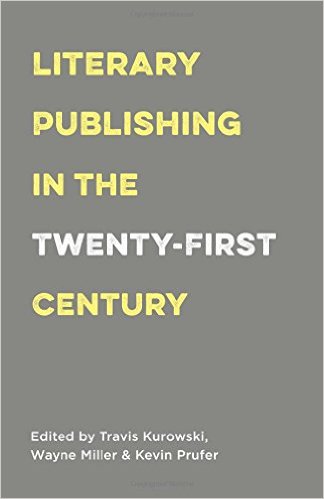
Literary Publishing in the Twenty-First Century

by
Author: 
Travis Kurowski, Wayne Miller, and Kevin Prufer, editors
Published in 2016
by Milkweed Editions

Thirty-six years after Bill Henderson's The Art of Literary Publishing: Editors on Their Craft (Pushcart Press, 1980) shared the insights of some of the most successful editors of the last century, such as Maxwell Perkins, John Farrar, James Laughlin, and Theodore Solotaroff, this new anthology showcases an even wider range of perspectives on the current state of literary publishing, attempting to answer some of the questions raised by Henderson's classic volume. From industry veterans to digital mavericks, including agents, editors, authors, and reviewers such as Erin Belieu, Sven Birkerts, Jessa Crispin, Gerald Howard, Richard Nash, Chris Parris-Lamb, and Daniel Slager, the voices collected in Literary Publishing in the Twenty-First Century offer a discussion of the role of books, bookselling, and literary publishing for the future.


Mothers and Fathers

5.31.16

"Children begin by loving their parents; as they grow older they judge them; sometimes they forgive them," writes Oscar Wilde in his 1891 novel, The Picture of Dorian Gray. Drawing upon your own experiences with parents, guardians, mother or father figures—or your personal history as a parent yourself—compile a short list of specific memories and observations divided into three categories: love, judgment, and forgiveness. Would you agree with Wilde that children's love for and judgment of parents are inevitable, but forgiveness of them may be less so? How might you see forgiveness as a more conscious component of a parent-child relationship? Write a three-part poem that explores the many nuances of a parent-child relationship as it evolves with age.

826 Valencia

Caption: 

"When I was little, I would always be inspired by books that my mom gave me and I always wanted to be a writer. And that dream has come true, at a really young age!" Students, volunteers, and cofounders Nínive Calegari and Dave Eggers of 826 Valencia talk about the opening of a second branch in the Tenderloin district in San Francisco. The center will offer free creative writing and tutoring programs for young writers.

End of May Contest Roundup

As the month of May winds down, the deadlines for several book contests in poetry and fiction are quickly approaching. Each prize compiled below offers at least $1,000 and publication of the winning manuscript.

For fiction writers, the BOA Editions Short Fiction Prize and the University of Georgia Press Flannery O’Connor Short Fiction Award both offer a prize of $1,000 and publication for a short story collection. Peter Conners will judge the BOA Short Fiction Prize, while Lee K. Abbott will judge the Flannery O’Connor Short Fiction Award. The deadline for both contests is May 31.

Meanwhile, the Elixir Press Fiction Award offers $2,000 and publication for a short story collection or novel. The press’s editors will judge; the deadline is May 31. The annual Gival Press Novel Award offers publication and $3,000 for a novel; the judge is anonymous and the deadline is May 30.

On the poetry side, three contests—the Anhinga Press Anhinga–Robert Dana Prize for Poetry, the Backwaters Press Backwaters Prize, and the Oberlin College Press FIELD Poetry Prize—each offer publication of a full-length poetry manuscript. Evie Shockley will judge the $2,000 Anhinga­–Robert Dana Prize for Poetry; the deadline is May 30. Henri Cole will judge the $2,000 Backwaters Prize, and the editors of Oberlin College Press will judge the $1,000 FIELD Poetry Prize; the deadline for both contests is May 31.

For a look at more writing contests with upcoming deadlines, visit our Grants & Awards database and submission calendar. Full submission details, including eligibility guidelines, manuscript length requirements, and entry fees, are available on the contest websites.

On Elizabeth Bishop

by
Author: 
Colm Tóibín
Published in 2015
by Princeton University Press

In this book, novelist Colm Tóibín's close readings chisel down Elizabeth Bishop’s almost monolithic masterpieces to their personal cores. Moreover, readers will see, poem to poem, how much Bishop’s gift for restraint and observation have impacted Tóibín’s writing. The result is not only a valuable study of a master poet, but a testament to how one writer can become a compass, and an engine, for another.

Pages

Subscribe to Poets & Writers RSS