Solmaz Sharif on War Poetics, Underrated American Poems, and More
Flaubert’s travel diary up for auction; sixteen books that explain this year’s election; PEN reports on missing Hong Kong booksellers; and other news.
Tags:
Jump to navigation Skip to content
Flaubert’s travel diary up for auction; sixteen books that explain this year’s election; PEN reports on missing Hong Kong booksellers; and other news.
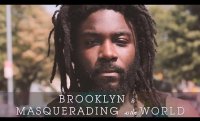
“When I think about what I’m going to write next, I’m like, where do we not exist?” Jason Reynolds, who won the Kirkus Prize for young readers’ literature for his novel As Brave As You (Caitlyn Dlouhy, 2016), speaks about growing up in Brooklyn and not seeing characters like himself in literature as a child.
Last night at a ceremony in Austin, Texas, Kirkus Reviews announced the winners of the third annual Kirkus Prize. Three awards of $50,000 each are given for a book of fiction, nonfiction, and young readers’ literature published in the previous year.
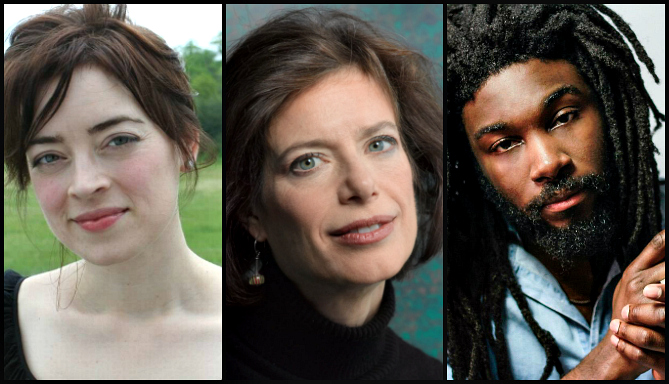
C. E. Morgan won the fiction award for her second novel, The Sport of Kings (Farrar, Straus and Giroux). Fiction writer Claire Messud, bookseller Annie Philbrick, and Kirkus Reviews critic Gene Seymour judged.
Pulitzer Prize–winning journalist Susan Faludi took home the nonfiction prize for In the Darkroom (Metropolitan). Writer Jim Piechota, bookseller Chris Schoppa, and journalist and novelist Héctor Tobar judged.
Jason Reynolds won the young readers’ literature prize for his novel As Brave As You (Caitlyn Dlouhy). Bookseller and author Elizabeth Bluemle, Kirkus critic and librarian Deborah D. Taylor, and National Book Award–winning author Jacqueline Woodson judged.
The winners were selected from 1,154 titles that received a Kirkus starred review between November 1, 2015, and October 31, 2016, for fiction and nonfiction, and between October 1, 2015, and September 30, 2016, for young readers’ literature.
One of the world’s richest literary awards, the Kirkus Prize was established in 2014 to honor the eighty-first anniversary of Kirkus Reviews, a publication that today provides review coverage of more than seven thousand commercially published books, as well as more than three thousand self-published books, each year. For more information about the prize, as well as a list of finalists in each category, visit the Kirkus Reviews website.
(Photos from left: C. E. Morgan, Susan Faludi, Jason Reynolds)
The challenges of digitizing ancient manuscripts; an interview with Alexandra Kleeman; U.K. students who write outside of school in decline; and other news.
“I didn’t understand that I had to be ruthless. I didn’t understand that my job as a writer wasn’t to coddle my characters and create these fairy tales for them to live.” At Brown University's Center for the Study of Race and Ethnicity in America, Jesmyn Ward and Edwidge Danticat discuss writing about their homes and the power of place.
James Merrill House designated National Landmark; a profile of BuzzFeed’s Saeed Jones; ten books to read in November; and other news.
“We harness a wildness in the ‘I’ of our poems.” In this 2013 video at the Library of Congress, Dorothea Lasky delivers the Bagley Wright Lecture on Poetry and explores how poetry makes us human. Lasky interviews the late Max Ritvo about his poetry and process in “The World Beyond: A Last Interview With Max Ritvo” in the November/December issue of Poets & Writers Magazine.
“Sometimes the humor is a way to mask all that, so the reader won’t know that what I’m writing about is me, or figure out what side of the argument I stand on. Then there’s a risk in just trying to say what you mean to say…. Writing is a risk no matter what.” In a 2015 interview with Chris Jackson for the Paris Review, Paul Beatty, who was awarded the 2016 Man Booker Prize for his novel The Sellout last week, speaks about the risks of criticizing and including heated topics in his writing. Think of a topic or stance you are personally drawn to—but also afraid of—writing about. Write a personal essay in which you gradually expose this risky issue or opinion in a humorous way. How can offbeat humor, satire, or a generally funny approach allow you to tackle difficult subjects in a more oblique way?
The deadline approaches for the International Dylan Thomas Prize, given annually for a book of poetry or fiction published in English in the previous year by an author between the ages of 18 and 39. The winner will receive £30,000.
Publishers may submit ten copies of a book published between January 1, 2016, and December 31, 2016, along with the required entry form, by Friday, November 4. Entries should be mailed to the International Dylan Thomas Prize, c/o Dr. Elaine Canning, Research Institute for Arts and Humanities, Keir Hardie Building, Room 405c, Swansea University, Singleton Park, Swansea SA2 8PP, UK.
There is no entry fee. Translations and self-published books are ineligible. E-mail or visit the website for complete guidelines.
The International Dylan Thomas Prize was established in 2006 in honor of Dylan Thomas, who, according to the website, was: “the quintessential adolescent writer, ideally suited to serve as an inspiration to young writers everywhere. The freshness and immediacy of his writing were qualities that he never lost. The Prize seeks to ensure that readers today will have the chance to savour the vitality and sparkle of a new generation of young writers.”
Recent winners of the prize include Max Porter for his novel, Grief Is a Thing With Feathers (Graywolf, 2016), Joshua Ferris for his novel To Rise Again at a Decent Hour (Little, Brown, 2014), and Claire Vaye Watkins for her story collection Battleborn (Riverhead, 2012).
The 2017 winner will be announced at an awards ceremony in Swansea, Wales, in May.
NaNoWriMo advice; contemporary novelists on recreating the the 1980s; Murakami on embracing one’s inner darkness; and other news.