First Kiss by Tim Seibles

Caption: 

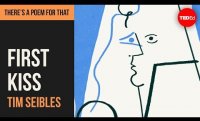
“My mouth / had been a helmet forever / greased with secrets…” Tim Seibles narrates his poem “First Kiss” from his collection Buffalo Head Solos (Cleveland State University Poetry Center, 2004) for this TED-Ed animated short film directed by Hannah Jacobs, part of the “There’s a Poem for That” series.

Genre: 

Kevin Young on Claude McKay

Caption: 

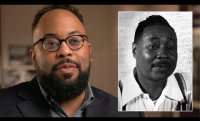
In this Library of America video, Kevin Young discusses Claude McKay’s 1919 poem “If We Must Die,” the rhymes and the collective voice in lines such as, “Though far outnumbered let us show us brave.” This poem is included in African American Poetry: 250 Years of Struggle & Song, an anthology edited by Young and published by the Library of America, which is featured in The Anthologist in the November/December issue of Poets & Writers Magazine.

Genre: 

Celebrating the Twenty-Fifth Anniversary of NOMMO

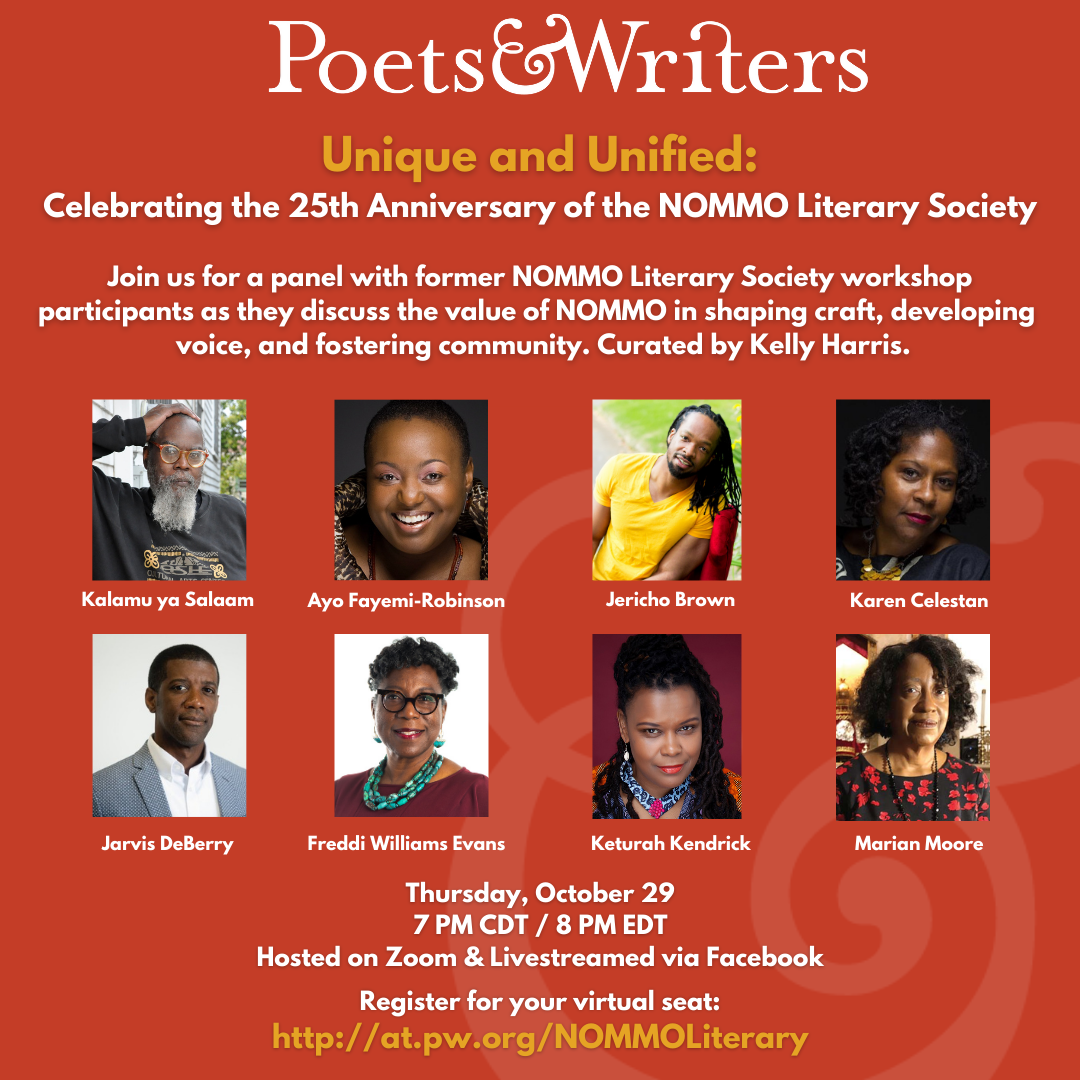
If you enjoyed our Hurricane Katrina Anniversary virtual event, join us on Thursday, October 29 as we celebrate the twenty-fifth anniversary of the NOMMO Literary Society of New Orleans with a Facebook Live event.

NOMMO began as a workshop for Black writers in 1994 led by Kalamu ya Salaam in New Orleans. The workshop had high profile writing guests including Amiri Baraka, Toi Derricotte, and Terrance Hayes. Many consider it the foundation for similar writers workshops that would come soon after, such as Cave Canem and VONA. NOMMO dismantled formally after Hurricane Katrina but many of the participants continue their writing pursuits with success. Pulitzer Prize–winning author Jericho Brown was one of NOMMO’s early participants.

The upcoming virtual event will include Jericho Brown, Karen Celestan, Jarvis DeBerry, Freddi Williams Evans, Ayo Fayemi-Robinson, Keturah Kendrick, Marian Moore, and Kalamu ya Salaam. The panel will discuss the need for building community as writers, the cultural impact of New Orleans, and the lessons learned from Hurricane Katrina and how it is applicable to our current pandemic.

Register for Unique and Unified: Celebrating the Twenty-Fifth Anniversary of the NOMMO Literary Society here!

To learn more about NOMMO, read my previous post about its history.

Photo: NOMMO Literary Society anniversary event flyer.
 
Kelly Harris is the literary outreach coordinator for Poets & Writers in New Orleans. Contact her at [email protected] or on Twitter, @NOLApworg.


Sheila Heti’s First Time

Caption: 

“I really was thinking like I have to work harder than any other writer in the world. I just wanted so badly to figure this out, to figure out how to write.” In this installment of the Paris Review’s “My First Time,” Sheila Heti discusses writing her first book, The Middle Stories (McSweeney’s, 2001), and how she came to write short stories after quitting theater school.

Genre: 

Daily Records

10.22.20

Weight of the Earth: The Tape Journals of David Wojnarowicz edited by Lisa Darms and David O'Neill collects the recorded diaries of the artist, activist, and writer from 1981 through 1989 examining his life, art, and dreams. The cassettes hold a string of different modes of speaking through ideas in real time—going from stream of consciousness, to searing argument, to meditations on death, to divagations between poems and phone calls—producing a record of a singular artist’s mind in a crucial moment in history. Record yourself for two minutes each day this week and untether your thoughts in real time. How do your ideas unfold without the stop-and-go of composing the right sentence? At the end of the week, transcribe and arrange your recordings into an essay of fragments surrounding a theme.

Ngũgĩ wa Thiong’o at the African Literature Festival

Caption: 

“In Kenya, we have many peoples who make up the Kenyan nation. Please note: I am not using the word tribe. I do not use the word tribe to describe anybody.” In this African Literature Festival video, Ngũgĩ wa Thiong’o speaks with hosts Samuel Ndogo and Mingqing Yuan about writing his first novel in verse, The Perfect Nine: The Epic of Gĩkũyũ and Mũmbi (New Press, 2020), which is featured in Page One in the November/December issue of Poets & Writers Magazine.

Genre: 

COVID Vivid Self Interview Part II

Hey mi gente, I will get right to the point. This series of interviews has been enlightening and inspirational these last few months and so what was supposed to be only five entries will now be extended. So far, you have heard from Katherine Hoerth, Daniel Peña, Melissa Studdard, and Jonathan Moody. Although I have answered already, I am in a new place (as I’m sure we all are each day of this pandemic) and will again answer the question I’ve been asking other writers:

What have you been doing since the pandemic started?

“I am adding myself as a double entry for one very brutal reason: I know what the pandemic has cost me. My mother died from complications due to COVID-19 earlier this month on October 1. She died at the age of eighty-six.

What have I been doing since the pandemic started? Trying to do all the things I said I was doing in the last post but more importantly, trying my damnedest to keep my family alive and well. I have to admit, a part of me feels like I have failed. In truth, there are so many feelings about this pandemic and how it has treated my family and many people of color.

I spent the last month or so, from August 25 to the start of October, in such distress. We were dealing/planning for the possibility of two storms in the Gulf of Mexico (my heart and candles are lit for folks in Lake Charles and to Kelly Harris, our literary outreach coordinator in New Orleans, as always staying in “hurricane mode” can wear on you), and my parents telling me they had a cold, which later turned out to be COVID-19. To this day, I don’t know how my father got it. He took care as much as he could (especially in the third most Republican county in Texas, where I have witnessed people not following social distancing measures with full care), but to no avail, my mother caught it.

I have spent time thinking. I have spent time thinking about how COVID-19 affects families. As this double storm was a thing, I think about the last conversation I had with my mother on August 25. I called to convince my folks to come up to Houston after Galveston initiated a voluntary evacuation. My mother told me, “no mijo, we will stay here, I don’t know if I have this thing and if I do, I don’t want to give it to you or Jasminne or mija.” My mom knew my wife is immunocompromised and she couldn’t think of even giving it to her two-year-old granddaughter. So they stayed home. She got worse. She went to the ER. She was treated. It didn’t work and she died.

I have spent time writing. The day we found out that she was being admitted to the hospital, they told us she tested positive. My father and I were stunned. We spent three hours together in a waiting room and so I had to rush to get him tested. He tested positive and we had to quarantine for two weeks. To keep from going crazy, I was posting daily updates on Twitter and on Facebook. I was writing curriculum for my day job. Now that my mother is gone, I have had to take notes about how to transfer information for bills, insurance policies, contact numbers, etc.—all the process of laying someone to rest. I even wrote my mother’s obituary.

I honestly don’t know what else I will do during the pandemic. I mean, I know I will do what I can do to try to stay alive, but so far, all I can really see is managing things one day at a time. I know I will take care of my father who has been shattered at the guilt of infecting his partner of forty-six years (even after I explain how transmission is a community thing) and try my best to find peace for my wife and child.

What am I doing during the pandemic? Trying to find light and pass it on to others, just like my mom taught me to do.”

Lupe Mendez is the literary outreach coordinator for Poets & Writers in Houston. Contact him at [email protected] or on Twitter, @houstonpworg.

The Underground Railroad: Preamble

Caption: 

Director Barry Jenkins has released a teaser trailer for the upcoming television adaptation of Colson Whitehead’s Pulitzer Prize–winning historical fiction novel, The Underground Railroad (Doubleday, 2016). The limited Amazon series stars Thuso Mbedu as Cora, a woman who escapes a plantation in Georgia and finds the Underground Railroad, an actual train system transporting runaways to the north.

Genre: 

Tracing Your Name

10.20.20

In Airea D. Matthews’s “etymology,” she writes to explore the meaning of her name and its pronunciation. Published by the Academy of American Poets’ Poem-a-Day in 2019, Matthews explains the origin for the poem and how she would use a nickname during open mics to make it easier for hosts to pronounce her name: “I realize now it was one of the many ways I’d learned to make myself smaller in space, less pronounced.” What is the personal history of your name? How has it been encountered in different spaces? Write a poem that seeks to trace the etymology and personal history of your name.

Pages

Subscribe to Poets & Writers RSS