Ten Questions for Cicely Belle Blain
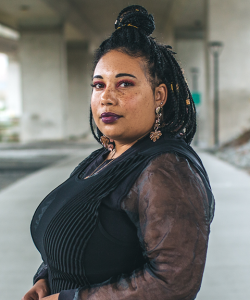
“Write with yourself and your own healing in mind, before you think of anyone else.” —Cicely Belle Blain, author of Burning Sugar
Tags:
Jump to navigation Skip to content
“Write with yourself and your own healing in mind, before you think of anyone else.” —Cicely Belle Blain, author of Burning Sugar
“Six boys, a calf’s tongue each, one task…” Dom Bury’s poem “The Opened Field,” which won the 2017 National Poetry Competition, is interpreted by filmmaker Helmie Stil for this Motionpoems film created in collaboration with the Poetry Society.
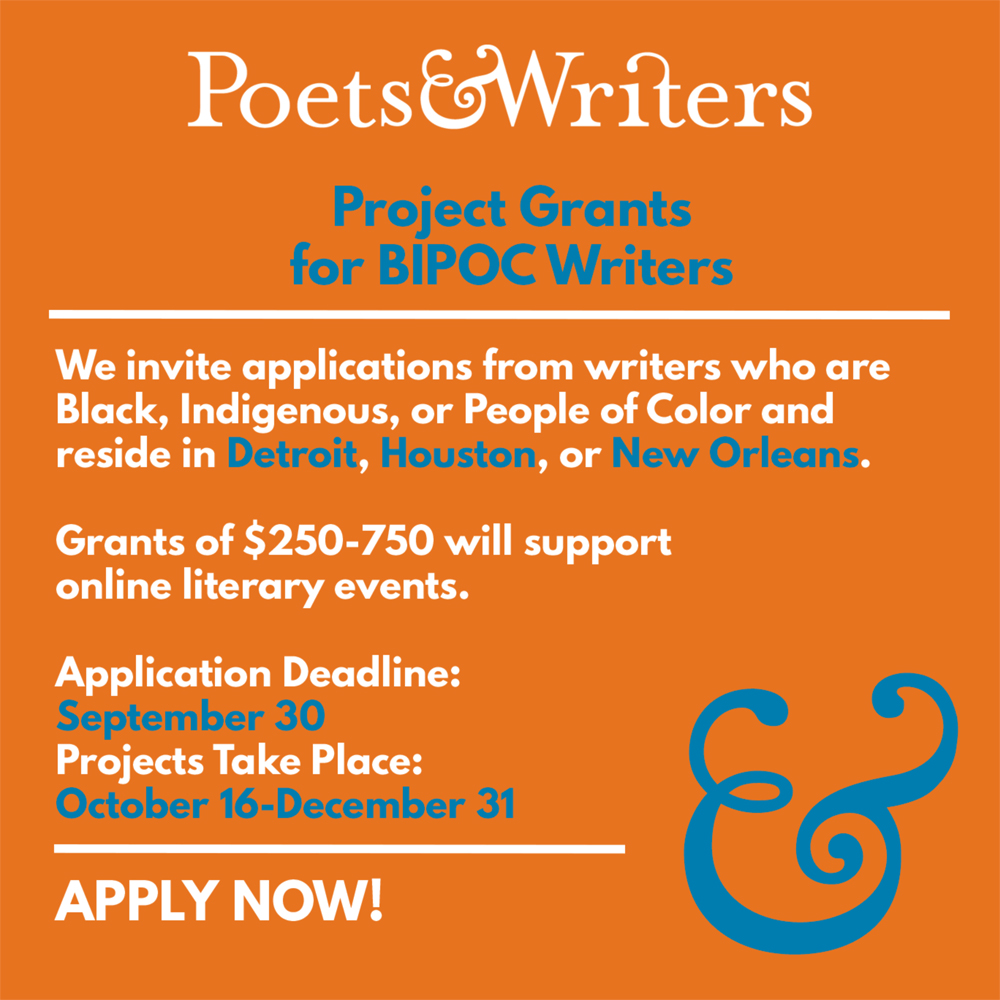
We interrupt our regularly scheduled United States of Writing Blog content to remind writers in Detroit, Houston, and New Orleans that applications for Project Grants for BIPOC Writers are due this Wednesday, September 30!
Grants range from $250 to $750 and can be used to pay for costs related to coordinating online literary events in the genres of poetry, fiction, or creative nonfiction. In addition, projects must take place between October 16 and December 31.
To be eligible, applicants must:
So for example, if you were a Black fiction writer living in Houston who wants to coordinate a fiction reading that will be live-streamed to the public, and you want to compensate yourself and other writers who will give readings for the event, you would be a great candidate for a project grant!
Of course, not all projects need to fit the mold above: We are also interested in supporting other literary projects that will engage the communities of these cities, such as workshops, panels, discussions, town halls, or Q&As.
Writers interested in applying can find the guidelines and link to the application form here.
We can’t wait to read your project ideas!
“Unnatural cycles seemed to be / establishing themselves, without regard to our lives.” In this reading and conversation hosted by Green Apple Books, Henri Cole reads from his latest poetry collection, Blizzard (Farrar, Straus and Giroux, 2020), and speaks to Pulitzer Prize–winning author Forrest Gander about inspiration and the writing process.
Brian Blanchfield’s Proxies: Essays Near Knowing (Nightboat Books, 2016) is an essay collection that experiments with memory. Each single-subject essay—on topics such as foot washing, dossiers, house-sitting, and Br’er Rabbit—is based on what the author has read and remembers (or misremembers) and was written without the internet or any kind of research. The book ends with “Corrections,” which fact-checks the claims in the essays, cataloguing Blanchfield’s errors and what his memory has altered. Write a series of flash essays on a variety of subjects that relies exclusively on your memory, then write a catalogue of corrections that fact-checks your claims. How does the experience of relying on your memory change your relationship to fact and truth?
In Tobias Wolff’s “Bullet in the Brain,” the short story starts with the protagonist Anders, an ill-tempered and cynical book critic, caught in the middle of a bank heist interacting with fellow customers and the robbers. In the second half of the story, Anders is shot by one of the bank robbers and the story suddenly swerves into a retelling of his memories and private desires, leaving the linear plot of the story and allowing readers in on some of his backstory. Write a short story that is affected by a major event and causes a shift in the direction of the narrative. How can you dig further into a character’s inner life after a momentous event?
In this virtual event for Quail Ridge Books in Raleigh, North Carolina, the late Randall Kenan, author of the story collection If I Had Two Wings (Norton, 2020), and Ron Rash, author of In the Valley: Stories and a Novella Based on Serena (Doubleday, 2020), read from their books and discuss growing up in the South and their writing. Kenan’s If I Had Two Wings is longlisted for the 2020 National Book Award in fiction.
In Yusef Komunyakaa’s poem “Anodyne,” he writes an ode to his body and its survival, and catalogues the parts of his body that make it his own with lines such as: “I love my crooked feet / shaped by vanity & work” and “The white moons / on my fingernails.” As the poem progresses, the images transform and expand to mythological proportions: “this spleen floating / like a compass needle inside / nighttime, always divining / West Africa’s dusty horizon.” Write an ode to your body that starts with the crooked parts and continues by going past the physical into the mythological.
“Would you agree it’s possible to be both enlightened and in the dark?” For the 2019 Blaney Lecture, an annual lecture on contemporary poetry and poetics created by the Academy of American Poets, Terrance Hayes presents “Survey of an American Century” and reflects on the last century of poetry at the Lillian Vernon Creative Writers House in New York.
Watch the trailer for the highly anticipated adaptation of Frank Herbert’s 1965 science fiction novel Dune. Directed by Denis Velleneuve, the film stars Josh Brolin, Timothée Chalamet, Rebecca Ferguson, Oscar Isaac, and Zendaya.