Joshua Bennett on the Spoken Word Tradition
Caption: 

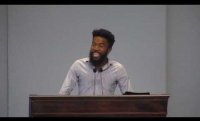
“Say it. / That every day is a toast / to living. An ode to the way we / made resilience an art...” In this lecture for the Chautauqua Institution, Joshua Bennett reads a selection of his poems and meditates on his father’s life and the history of the spoken word tradition. Bennett speaks about his latest poetry collection, Owed (Penguin Poets, 2020), in an installment of Ten Questions.

Jukebox

In a recent essay for FSG’s Work in Progress, Andrew Martin breaks down the experience of putting a collection of stories together and how he gleaned inspiration from listening to his favorite albums. Martin writes about how Neil Young is “famous for his idiosyncratic approach to assembling and releasing albums. A song recorded a decade earlier will suddenly find itself sharing space with a collection wildly different in tone and style.” He continues by comparing punk albums that “get in and get out quickly” to more sprawling albums like Fleetwood Mac’s Tusk and Notorious BIG’s Life After Death. Choose a favorite album and listen to how the songs react to one another and the importance of their order. Then, write a story with the structure, language, or character development inspired by this musical trajectory.

The BreakBeat Poets: LatiNext

Caption: 

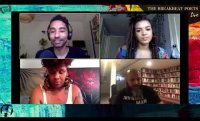
In this video, the Root Slam, an open mic and poetry slam in Oakland, hosts an all-Black Latinx virtual reading featuring Elizabeth Acevedo, Jennifer Falú, John Murillo, Julian Randall, and Nicole Sealey to celebrate the publication of The BreakBeat Poets Vol. 4: LatiNext (Haymarket Books, 2020).

Genre: 

Alphabetical Order

The abecedarian is a poetic form in which the first letter of each line or stanza follows sequentially through the English alphabet. Poets such as Natalie Diaz, Carolyn Forché, and Harryette Mullen have used the form to tackle the historical subjugation of a people and the inadequacy of language when faced with great disaster. The controlled form builds a visual structure that calls attention to the poem’s subject matter. Write an abecedarian poem that reflects on the English language and your place in it. Read Natalie Diaz’s “Abecedarian Requiring Further Examination of Anglikan Seraphym Subjugation of a Wild Indian Rezervation” for inspiration.

LIT With Safiya Sinclair

Caption: 

“The tepid / American I sank with my old shoes over the jaws of the Atlantic / could never understand the hard clamor of my laugh…” Safiya Sinclair reads from her debut collection, Cannibal (University of Nebraska Press, 2016), and speaks about poetry as the “language of an impolite body” in this episode of LIT hosted by Yahdon Israel.

Genre: 

Expressions and Gestures

8.27.20

Whether it’s a nod that means “yes,” or a pointed finger that says, “over there,” we all likely express some form of nonverbal language in our day-to-day lives. But just how specific can we be with our body language? Think about how you communicate nonverbally to those around you. Are there certain gestures or facial expressions that only certain friends or family members understand? In a personal essay, reflect on when you use these actions and behaviors, where you learned them, and how they differ culturally and within particular social circles.

Variation on a Theme of Genetics

Caption: 

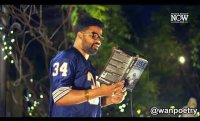
“In the dregs of August I watch the birds sprint,” begins Julian Randall in this reading of “Variation on a Theme of Genetics” from his debut collection, Refuse (University of Pittsburgh Press, 2018), for the Write About Now Poetry reading series in Houston. A Q&A with Nate Marshall by Randall is featured in the September/October issue of Poets & Writers Magazine. 

Genre: 

Show and Tell

8.26.20

At the start of John Cheever’s short story “Goodbye, My Brother,” three paragraphs are dedicated to introducing the Pommeroy family before the plot begins. Although the section seems to go against the classic writing rule to “show, don’t tell,” it cleverly helps the reader understand the narrator’s personality, as well as learn details about the individual lives of each member of the family. The introduction’s final sentence also sets up the conflict: “We had disliked Lawrence, but we looked forward to his return with a mixture of apprehension and loyalty, with some of the joy and delight of reclaiming a brother.” Write a story in first person that uses an opening section to characterize your narrator and create tension. What subtext can we glean from what’s revealed in these first sentences?

The Impolite Body

8.25.20

In an interview with Yahdon Israel for the LIT video series, Whiting Award–winning poet Safiya Sinclair describes poetry as the “language of an impolite body.” Sinclair considers “wildness” and “madness” while writing and engages with the task of decolonizing the English language as a Jamaican writer. Consider your own relationship with the English language and write a poem that presents any complications or disturbances as an impolite body. Play with word choice or form to go against the grain of learned rules. For guidance, read Sinclair’s poem “In Childhood, Certain Skies Refined My Seeing” from her collection, Cannibal (University of Nebraska Press, 2016).

Pages

Subscribe to Poets & Writers RSS