Beginner’s Mind

11.5.20

“Craft is not simply technical. If we take our craft seriously, or even if we want to play, we must realize that what we bring to craft is the world that crafted us,” writes Joy Priest in an installment of Craft Capsules published in July. “The way we work, our technique, holds all of our subconscious anxieties and desires.” What was the world like that shaped you, and how does it manifest in your writing? Write an essay describing how your childhood shaped the way you think and the choices you make as a writer. Consider the questions that Priest poses throughout her essay, such as, “What are you avoiding? What are you leaving out? What is uninterrogated?”

Writing in Detroit Virtual Reading

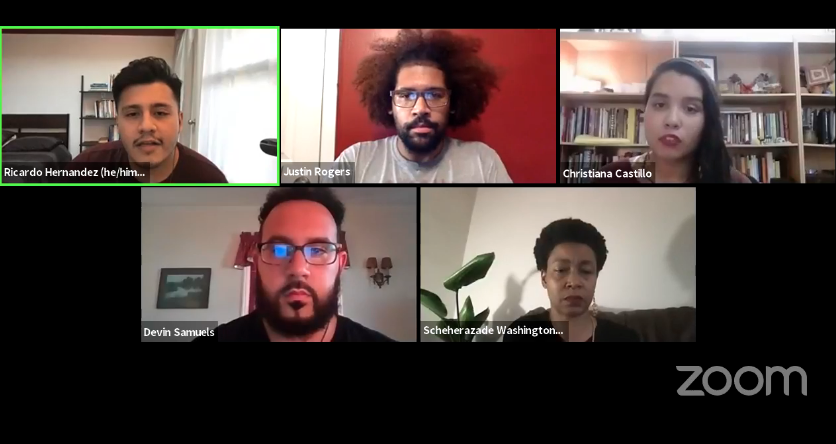
On Friday, October 23, I had the privilege of hosting Writing in Detroit: A Virtual Reading featuring Christiana Castillo, Scheherazade Washington Parrish, and Devin Samuels. All three artists shared stunning work and responded to the question, “How has Detroit influenced your writing?”

Not only did I find myself blown away by the writing shared by our guests, but their responses to what I thought was a simple question opened a door for complex perspectives on the city that each expressed a deep love for.

Samuels, a Providence, Rhode Island native who recently moved to Detroit, spoke about his gratitude for the city’s writing community and his ongoing exploration of literary resources and the various historic narratives reflected in the work of local writers. “I can’t sing the praises of Detroit’s writing community enough,” said Samuels. “Being in a place like that will change you.”

Washington Parrish expressed how “Detroit is home, and so Detroit influences my writing the way home influences everything.” I identified deeply with this response as someone who has also reflected on how the city influences my work. At times we talk about how Detroit is different from other cities or mysterious. This answer identified Detroit clearly and simply as another home. Washington Parrish continued by saying what we all feel about our respective hometowns: “You have to have a particular sight to see and appreciate what is happening here.”

Castillo closed out our discussion by speaking about her family, who have spent four generations in Detroit. “To me that’s just a lot of ancestral knowledge I can tap into,” said Castillo. She also praised the writing community and how special it feels to be a writer in Detroit. “There’s never been a moment I haven’t felt held and supported in Detroit’s community,” said Castillo. “I can’t imagine writing anywhere else.”

I was struck by all of the thoughtful answers our guests brought to the table. You can watch the reading and discussion on Poets & Writers’ Facebook page now!

Justin Rogers is the literary outreach coordinator for Poets & Writers in Detroit. Contact him at [email protected] or on Twitter, @Detroitpworg.

Remember

Caption: 

“Remember all is in motion, is growing, is you. / Remember language comes from this.”​ In this video from the Academy of American Poets, Joy Harjo reads her poem “Remember” from her 1983 collection, She Had Some Horses. Harjo has been appointed to serve a second term as poet laureate of the United States and is the first Native American to hold the post.

Genre: 

Self-Made

11.3.20

Self-portraits are often associated with visual artists, but poets have also experimented with this art form. In Gregory Pardlo’s “Written by Himself” he writes, “I was born in minutes in a roadside kitchen a skillet / whispering my name.” Pardlo uses the anaphora, “I was born,” throughout the poem to include the lives that made his life possible. In “Self-Portrait,” Adam Zagajewski employs declarative statements, “I like deep sleep, when I cease to exist,” to invite the reader to learn more about his life. Inspired by these two poems, write a self-portrait poem that seeks to tell the story of how you came to be. Try starting with a list of the things you like and love as a way to enter the poem.

Julie Andrews and Stephen Colbert Exchange Limericks

Caption: 

In this clip from The Late Show With Stephen Colbert, Julie Andrews speaks about her latest book, Home Work: A Memoir of My Hollywood Years (Hachette Books, 2019), which is cowritten by her daughter Emma Walton Hamilton, and exchanges personalized limericks with the host.

The Haunting of Bly Manor

Caption: 

Looking for something eerie to watch? The Haunting of Bly Manor is a supernatural horror drama loosely based on Henry James’s The Turn of the Screw. The Netflix series created by Mike Flanagan stars Carla Gugino, Oliver Jackson-Cohen, T’Nia Miller, Victoria Pedretti, Kate Siegel, and Henry Thomas.

Genre: 

Makeover

10.29.20

In Wesley Morris’s essay “My Mustache, My Self,” published in the New York Times earlier this month, he explores how growing a mustache during quarantine led him to deeply consider his identity as a Black man. After a friend describes him as looking like “a lawyer for the N.A.A.C.P. Legal Defense Fund,” Morris meditates on how this friend “had identified a mighty American tradition and placed [his] face within it.” Either recently or in your past, has a subtle or dramatic stylistic choice in your presentation affected the way you see yourself? Write an essay that considers how a new look can alter how you view yourself, or how others perceive you.

Winter Stars by Arthur Sze

Caption: 

In this Asian American Writers’ Workshop video, Arthur Sze reads and discusses the origin of his poem “Winter Stars,” featured in The Best American Poetry 2020 anthology guest edited by Paisley Rekdal. Sze won the 2019 National Book Award in poetry for his collection Sight Lines (Copper Canyon Press, 2019).

Genre: 

Dreaming

10.28.20

“I dreamed a short story last night, even down to its name, which was ‘Sun and Moon,’” writes Katherine Mansfield on February 10, 1918, in her book Letters and Journals, about having dreamt one of her widely anthologized stories. “I got up at 6:30 and wrote a note or two because I knew it would fade.” The story, which features two children hanging around their house while a party is being prepared, reads without a set structure and follows modernist conventions using several narrative shifts. Inspired by Mansfield’s experience, keep a dream journal for the week, whether the dreams are your own or from friends. Use images, lines of dialogue, or narrative swerves from the dream to write a short story. How does mining the surrealism of dreams change the conventional ways we tend to tell stories?

Pages

Subscribe to Poets & Writers RSS