




Page One: Where New and Noteworthy Books Begin
This installment of Page One features excerpts from Parallel Play by Stephen Burt and The Thin Place by Kathryn Davis.
Tags:
Jump to navigation Skip to content
Articles from Poet & Writers Magazine include material from the print edition plus exclusive online-only material.
This installment of Page One features excerpts from Parallel Play by Stephen Burt and The Thin Place by Kathryn Davis.
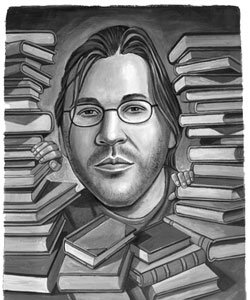
Whether it’s a thousand-page novel, a single-paragraph story, or a footnoted essay, the elusive author always offers a complicated—and sometimes maddening—reading experience. But is there more to David Foster Wallace than words on a page?
During a recent trip to New York City, Joseph Bednarik, the marketing director of Copper Canyon Press, noticed something while riding the subway that got him thinking about the ways in which poetry is distributed.
Literary MagNet chronicles the start-ups and closures, successes and failures, anniversaries and accolades, changes of editorship and special issues—in short, the news and trends—of literary magazines in America. This issue's MagNet features Poetry Northwest, the Alaska Quarterly Review, Fence, Black Clock, Ninth Letter, and Eleven Eleven.
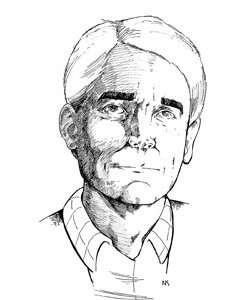
Fueled by allegations of unfairness, Bin Ramke announces his retirement after twenty-two years as editor of the Contemporary Poetry Series.

As long as there has been war, there have been writers trying to understand it, turning battlefield horrors into narrative, trying to make something useful out of its debris, but in recent months an unusually high number of soldier memoirs have been released by American publishers.

Images from a new collection of graphic art by Chip Kidd, an associate art director at Knopf, who has designed nearly eight hundred book jackets for the publishing house during the last twenty years.
The eighteen poets featured here represent only a fraction of the debut books published in 2005, yet they are emblematic of the diverse community of poets who have recently forged their own paths to publication.
Page One features a sample of titles we think you'll want to explore. With this installment, we offer excerpts from The Jungle Law by Victoria Vinton and Mother’s Milk by Edward St. Aubyn.
Small Press Points highlights the happenings of the small press players. This issue features Other Voices Books, Soho Press, Paris Press, Curbstone Press, Limberlost Press, Aralia Press, Ugly Ducking Presse, A Rest Press, and Atelos.
In August, Amazon.com launched a program that offers customers short stories and essays in a digital format for forty-nine cents each.
Fifty years later, a number of organizations are planning special events on October 7 to commemorate the anniversary of Ginsberg's legendary reading.
Page One features a sample of titles we think you'll want to explore. With this installment, we offer excerpts from Water’s Leaves and Other Poems by Geoffrey Nutter and Pieces of Air in the Epic by Brenda Hillman.
This month the Library of America, the nonprofit publisher founded in 1979 to “preserve our nation’s literary heritage,” will release the first two installments of a planned eight-volume edition of Philip Roth’s collected fiction.
Literary MagNet chronicles the start-ups and closures, successes and failures, anniversaries and accolades, changes of editorship and special issues—in short, the news and trends—of literary magazines in America. This issue's MagNet features Verb, the Relay Project, From the Fishouse, Sonora Review, Bridge, Columbia, Failbetter, and Versal.

Much has been written about some judges rewarding friends and former students, and I worry that a few questionable practices have detracted from the hundreds of contests that bring recognition to so many well-deserving writers. Nevertheless, there are steps that all of us—editors, judges, and writers—can take to help keep contests clean.
Small Press Points highlights the happenings of the small press players. This issue features Borealis Books, Passager Books, and Gorsky Press.
During the last three years, some of America’s most respected poets—Richard Wilbur, Mark Strand, and the late Anthony Hecht, among others—have published British editions of their books with Waywiser Press, a virtually unknown publisher based in London.

From the Paris Review’s new offices in lower Manhattan, Philip Gourevitch spoke about the past and future of what Time called “the biggest ‘little magazine’ in history.”
At no time on my book tour did I jump up and down, wave my fists, and scream, “It’s a novel! That means fiction!” At least I don’t think I did. It’s hard to be sure, because, in my head, I had that tantrum about three times daily as I traveled from town to town in southern Michigan, reading, signing books, and attending the Ann Arbor Book Festival. You see, my novel, Flight, was set in that region, where I had lived during my high school and college years.

C. Michael Curtis, a senior editor at the Atlantic Monthly, who is known not only for selecting award-winning short stories but also for his considerate and sensible letters of rejection to the thousands of submissions he’s read over the years, spoke about the magazine’s new approach to publishing fiction.
Page One features a sample of titles we think you'll want to explore. With this installment, we offer excerpts from Evening Ferry by Katherine Towler and Little Beauties by Kim Addonizio.
Small Press Points highlights the happenings of the small press players. This issue features McSweeney’s Books, Believer Books, Tell Tale Press, and Wings Press.
In case anyone was wondering, the four most frequently used words in T.S. Eliot’s 1943 collection Four Quartets are “time,” “past,” “fire,” and “end.” It is this kind of information that can be found by using one of several new features recently added to Amazon.com’s “Search Inside the Book” function, launched in October 2003.
Perhaps because many writers and their adherents are poorly paid and often go unrecognized, they cultivate a variety of myths—some about the creative process, others about the profession itself—to justify what they do, to cheer themselves up, to inhabit a mystique.