Lessons From Cinema: How Scriptwriting Saved My Novel

The author of Amphibian (Ig Publishing, October 2024) contemplates how lessons in screenwriting can be applied to fiction.
Tags:
Jump to navigation Skip to content
The author of Amphibian (Ig Publishing, October 2024) contemplates how lessons in screenwriting can be applied to fiction.
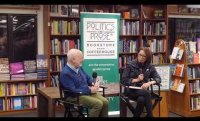
In this Politics and Prose Bookstore event, André Aciman reads from his memoir Roman Year (Farrar, Straus and Giroux, 2024) and talks about the loss he experienced during his adolescence in Rome and how writing has helped him come to terms with his identity in a conversation with Marie Arana. Roman Year is featured in Page One in the November/December issue of Poets & Writers Magazine.
“It was the end of the world and no one was coming to get you if you made a mistake.” If you’re looking for some spooky spirit on Halloween, watch this animated video based on a true story produced by Jezebel for their annual Scary Story contest. Read this fiction prompt from The Time Is Now for inspiration to write your own terrifying tale.
In the 1990 film Arachnophobia directed by Frank Marshall, a family doctor, his wife, and their two young children move from San Francisco to a small town in rural California that is soon overtaken by deadly spiders. Dr. Ross Jennings suffers from arachnophobia, an overwhelmingly intense fear of spiders, stemming from a traumatic childhood incident when he witnessed a spider crawling up his bed and over his body and was too paralyzed with terror to move. Write a personal essay that examines the origins of one of your own fears—either serious, silly, or somewhere in-between. Are there elements of your reaction to this object of fear that seem reasonable or irrational? How have you countered, enabled, or worked to coexist with this fear?
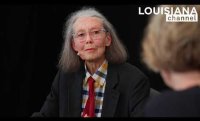
“Your mind wants to move, and the best thing a work of art can do is take your mind with it, moving somewhere you never expected to move.” Anne Carson talks about the artists and philosophers who inspire her to create and think, and how boxing has helped her in the wake of her recent diagnosis of Parkinson’s disease in a conversation with Norwegian author Linn Ullmann for this Louisiana Channel event.
“‘It isn’t fair, it isn’t right,’ Mrs Hutchinson screamed, and then they were upon her.” The final sentence of Shirley Jackson’s classic short story “The Lottery” is included in a short list of “The Best Last Lines in Books” on Penguin Random House UK’s website, along with selections from a range of books by authors such as Ralph Ellison, Zora Neale Hurston, Franz Kafka, Ira Levin, and Virginia Woolf. Many of these lines are powerfully evocative and open-ended, whether darkly humorous, straight-up horrifying, or daringly hopeful. Jot down a list of your favorite last lines and use one of them as a prompt to provide either the first sentence of a new short story or to inspire a plot. How do the emotions, weight, and mood of this final sentence affect the way you use it in your own piece?
In early September, mysterious white blobs began washing ashore on the beaches of Newfoundland in Canada, described as sticky, spongy, and doughy. Beachcombers and scientists alike were confounded—were the blobs of animal or plant origins? Were they toxic or innocuous, or created from industrial waste? As scientists continue to collect samples and run tests on these mysterious blobs, take this period of uncertainty to write a poem about a blob: these beach blobs, a blob inspired by science fiction, an explicitly frightening or comedic blob, or perhaps an experience that simply feels blob-like. How does the slipperiness of this concept lend itself to metaphors in your poem? Consider experimenting with the shape of your text, creating a concrete, yet blobby, poem.
“I wanted to write something that dealt with Brexit and our relation to Europe, but in a very oblique way.” In this Waterstones interview, English author Alan Hollinghurst talks about the challenges in developing the gay, biracial protagonist in his latest novel, Our Evenings (Random House, 2024), and reflects on Britain’s changing nature across the book’s half century of time.
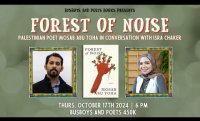
“When we die, our souls leave our bodies, / take with them everything they loved.... In Gaza, our bodies and rooms get crushed. / Nothing remains for the soul.” In this Busboys and Poets event, Mosab Abu Toha reads from his collection Forest of Noise (Knopf, 2024), and discusses his recent experiences in Gaza in a conversation with Isra Chaker. An interview with Abu Toha by Destiny O. Birdsong appears in the November/December issue of Poets & Writers Magazine.
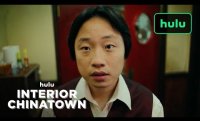
Watch the trailer for the television series adaptation of Charles Yu’s novel Interior Chinatown (Pantheon Books, 2020). Created by Yu, the series stars Jimmy O. Yang as Willis Wu, Ronny Chieng as Fatty Choi, and Chloe Bennet as Detective Lana Lee.