Ode to the Mud in Corona Park

Caption: 

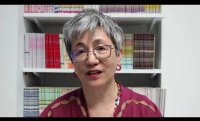
In this video for the Poetry Society of America’s Storefront Poems series, Kimiko Hahn reads her poem “Ode to the Mud in Corona Park,” which appears in her collection The Ghost Forest: New and Selected Poems (Norton, 2024). For more from Hahn, read her installation of our Ten Questions series.

Genre: 

Election

10.24.24

In a 2019 New York Times essay revisiting Alexander Payne’s 1999 film, Election—based on Tom Perrotta’s novel of the same name about a high school student-body election showdown between overachiever Tracy Flick and a social studies teacher—critic A.O. Scott reconsiders his understanding of the movie’s hero and villain twenty years later. “Payne’s film exposes the casual misogyny baked into the structures of civic and scholastic life,” writes Scott. “How despicably does a man have to behave before he forfeits our sympathy? How much does a woman—a teenage girl—have to suffer before she earns it?” Look back on previous presidential election years and reflect on major events that may have occurred in your personal life during those times. Were there heroes and villains who you might cast in a different light now?

Poured Over: Richard Powers on Playground

Caption: 

In this episode of Poured Over: The Barnes & Noble Podcast with guest host Chris Gillespie, award-winning author Richard Powers discusses how the issues of environmental exploitation and artificial intelligence inspired his new novel, Playground (Norton, 2024), which is set on the island of Makatea in French Polynesia.

Genre: 

From the Start

10.23.24

In the title story of Saeed Teebi’s 2022 debut collection, Her First Palestinian (House of Anansi Press), a new romance begins with the main character, Abed, acknowledging what is involved in getting to know another person: “Not long after the first joys of finding each other had settled, Nadia asked me if I would teach her about my country. It was inevitable. The walls of my Toronto apartment were conspicuously covered with Palestinian artifacts, and donation brochures featuring Gazan children were often lying around.” With the story’s title and this opening, Teebi invites the reader to consider and reflect on their own expectations of how this relationship will develop. Write a short story that charts the progression of a relationship, from somewhere near the beginning to somewhere near the end. What character details do you explicitly put into place, and what assumptions do you rely on to create a sense of expectation?

Left Undone

10.22.24

In Rae Armantrout’s poem “Unbidden,” which appears in her collection Versed (Wesleyan University Press, 2009), the poet’s use of short lines in conjunction with enjambment contribute to a sense of disjointedness. “The ghosts swarm. / They speak as one / person. Each / loves you. Each / has left something / undone,” writes Armantrout. This week compose a poem that revolves around a feeling of inconclusiveness. For your subject matter, consider a situation or relationship from your past that feels unfinished, one that continues to haunt you with questions. Deploy enjambment strategically—splitting up specific phrases and ending lines with significantly weighted words—to create a sense of discontinuity and unknowability.

Ta-Nehisi Coates: The Message

Caption: 

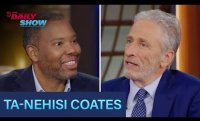
“It is a blessing to feel like what I write actually matters in the world. It gives me meaning and purpose.” In this Daily Show interview with host Jon Stewart, author Ta-Nehisi Coates talks about how his recent travels to Senegal and Palestine informed his understanding of power and oppression, and inspired his new book, The Message (One World, 2024).

Season of the Swamp: Yuri Herrera and Lisa Dillman

Caption: 

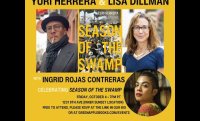
In this event presented by Green Apple Books and the Center for the Art of Translation celebrating the launch of Yuri Herrera’s novel Season of the Swamp (Graywolf Press, 2024), translated from the Spanish by Lisa Dillman, Herrera and Dillman read from the book and discuss their collaborative approach to translation in a conversation with Ingrid Rojas Contreras.

Weather Report

10.17.24

From 2006 to 2010, and again from 2020 to 2022, filmmaker David Lynch recorded daily morning weather reports that were broadcast from Los Angeles-based radio stations, his own website, and on YouTube. In some episodes, the weather report included just the date, temperature, and a couple of words describing what Lynch saw out of his window. Other times, reports included short observations or thoughts about his or others’ creative projects, and what he planned on having for lunch later in the day. “It’s a Saturday. Here in L.A., a sunny morning, a pretty strong breeze blowing right now. 52 degrees Fahrenheit, around 11 degrees Celsius,” says Lynch in a 2022 entry. Write a personal essay that begins with a weather report and then launches into what you’ve been thinking about recently, perhaps in conjunction with a book, film, or other piece of art you’ve encountered. How does a weather report set the tone?


Science Fiction Editor Judy-Lynn del Rey

Caption: 

In this installment of the PBS American Masters documentary series Renegades, which highlights the cultural contributions of little-known historical figures with disabilities, the series spotlights the life and career of editor Judy-Lynn del Rey who revolutionized the world of science fiction by editing and publishing books from writers such as Arthur C. Clarke, Isaac Asimov, Philip K. Dick, and George Lucas.

Genre: 

Pages

Subscribe to Poets & Writers RSS