Catching the “Chune”

The author of Ocean of Clouds (Knopf, 2025) reflects on the practice of poetry as one of both composition and listening.
Tags:
Jump to navigation Skip to content
The author of Ocean of Clouds (Knopf, 2025) reflects on the practice of poetry as one of both composition and listening.
“Avoid movement on roofs, between buildings, and near windows. / Do not stand where you will stand out.” In Carolyn Forché’s poem “On Being Watched From Above,” published in the New Yorker and forthcoming in the anthology I Witness: An Anthology of Documentary Poetry (Wesleyan University Press, 2026) edited by Kwoya Fagin Maples and Erin Murphy, she draws from official Territorial Defense text to write a documentary poem that, void of specific names and places, reflects the horrors of contemporary warfare and surveillance technology. Taking a cue from the imperative and direct language in Forché’s poem, write your own poem that expresses sentiments around society’s increasing use of surveillance and monitoring. In an era in which these modes are oftentimes presented as serving a greater good, what might be overlooked about the costs to our ways of life?
In this virtual reading and celebration, Poets & Writers Magazine features editor India Lena González introduces the 2025 cohort of “5 Over 50” debut authors: Princess Joy L. Perry, author of This Here Is Love (Norton, 2025); Vishwas R. Gaitonde, author of On Earth as It Is in Heaven (Orison Books, 2025); Yael Valencia Aldana, author of Black Mestiza (University Press of Kentucky, 2025); Lauren K. Watel, author of Book of Potions (Sarabande Books, 2025); and Jennifer Eli Bowen, author of The Book of Kin: On Absence, Love, and Being There (Milkweed Editions, 2025).
In this episode of the Fashion Neurosis podcast hosted by Bella Freud, Ocean Vuong speaks about how the Japanese concept of negative space, ma, influences his approach to the line in both prose and poetry, and why he wants to write eight books in total by the end of his career.
“When does the box of a story—a painting, a sonnet, a name—limit, and when does it free? Can it do both? What do I tell, and what do I obscure?” asks Anne Marie Rooney in a brief description of her poem “Abstraction,” published in the Academy of American Poets’ Poem-a-Day series. This week, consider the parameters of a poem—the space on the page and the length of the line, the language, the type of poetic form—and write a poem whose subject matter interrogates the limitations of your chosen form. How can you play with freedom within the confines of this “box of a story?”

The author of Bright Fear (Faber & Faber, 2023) and Flèche (Faber & Faber, 2019) explores what it means to write a self that “is in a perpetual state of becoming.”
In this event hosted by the Society for Integrative and Comparative Biology, poet and biologist Brandon Kilbourne talks about the relationship between scientific inquiry and poetics which manifests in his debut poetry collection, Natural History (Graywolf Press, 2025), and reads a selection of poems. Kilbourne’s collection is featured in Page One in the November/December issue of Poets & Writers Magazine.
According to a recent article in Psychology Today, while most people’s earliest memories are remembered like silent films—rich with imagery but largely void of sound—for a select few who have an auditory first memory, they may also have a “sound-minded” orientation in life, in which the “sensory modality of hearing is inseparable from their way of being.” This week, taking inspiration from these two possibilities, compose a pair of poems with contrasting takes on sound. Choose one childhood memory and write one sound-filled version and one silent version. Take some time to think about the various ways in which sound can be conveyed through stylistic decisions involving alliteration and consonance, typography and punctuation, and rhythm. How might line breaks and spacing on the page contribute to a sense of silence?
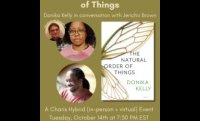
“I was little and lost / the season I learned to be still...” In this Charis Circle event, Donika Kelly reads poems from her new collection, The Natural Order of Things (Graywolf Press, 2025), and speaks with Jericho Brown about family, home, and her writing process. Read a profile of Kelly by Brian Gresko in the November/December issue of Poets & Writers Magazine.

The author of Bright Fear (Faber & Faber, 2023) and Flèche (Faber & Faber, 2019) considers what it means to estrange a familiar motif in one’s writing.