Hometown Landmarks

For the past several decades, artist Gordon Henderson, also known as Nib Geebles, has created yearly calendars featuring pen-and-paint illustrations of unremarkable yet distinctive buildings that he and his partner Abira Ali see on their everyday walks around their local Los Angeles neighborhoods. Hand-painted signage, unpolished and derelict storefronts, strip-mall parking lots, powerlines, and graffiti are all celebrated in this year’s “Unknown Landmarks” calendar. Brainstorm and jot down a list of some of your favorite storefronts and facades that make up the landscape where you live or work. Write a lyric essay that details a handful of these sights, reflecting on how they create a vivid portrait of your local atmosphere. What are the small, distinguishing or idiosyncratic features that give these locales an “unknown landmark” status?
Build Coffee & Books

Caption: 

In this episode of the New Social Environment series hosted by the Brooklyn Rail, poets Eve L. Ewing and Andrea Faye Hart read a selection of their poems and join journalist trina reynolds-tyler to discuss how they became co-owners of Build Coffee & Books, a community-centered bookstore and coffee shop in Chicago.

Desire Paths

Whether created due to convenience or to traverse through mounds of snow, desire paths are made when people diverge from official walkways to get to their desired destination, and others follow along. It might be a trail of worn grass beside a concrete walkway or a narrow, squiggly line through unplowed snow. “Desire lines are inherently subversive. They remind us that we have a choice, and that we can veer away from what was laid out for us. And the paths are personal, uneven and meandering,” writes Anna Kodé in a recent New York Times article. Write a short series of vignettes that imagines the first person who created a certain desire path, and the subsequent users of that pathway. What are the motivations of the characters who go off the beaten path?

Seeing This World

Alison McAlpine’s fifteen-minute-long documentary, perfectly a strangeness, follows a posse of three donkeys as they traverse the barren landscape of the Atacama Desert in Chile and happen upon an astronomical observatory on top of a mountain. While there is no dialogue, the movements of the donkeys, their expressive ears, and the mechanized motions of the observatory satellites, combined with the setting sun giving way to a night sky, offer an expansive range of interpretations and discovery. McAlpine, who was a poet before she was a filmmaker, says in an interview for Deadline, “Seeing these donkeys grazing besides these billion-dollar beasts, these metallic domes, I asked a question, how do they see this world?” Write a narrative poem without human presence that attempts to convey the perspective of an animal, or other living thing, discovering the universe for the first time. What diction seems most effective at producing the wonder you wish to evoke?

Megan Falley and Tig Notaro on Come See Me in the Good Light

Caption: 

In this Amanpour and Company segment, Hari Sreenivasan speaks with poet Megan Falley and comedian Tig Notaro about their Oscar-nominated documentary film Come See Me in the Good Light, which follows Colorado poet laureate Andrea Gibson’s journey with terminal cancer.

Tayari Jones on the Power of History and Writing

Caption: 

Tayari Jones discusses her new novel, Kin (Knopf, 2026), and the history she uncovered in her research for the book in a conversation with Jill Cox-Cordova, former Library Journal editor, for this virtual event of the Penguin Random House Winter Book and Author Festival. For more from Jones, read her installment of our Ten Questions series.

Genre: 

Hey Jealousy

2.26.26

Scientists studying chacma baboons in Namibia have recently reported findings that seem to demonstrate young baboons expressing feelings of jealousy, particularly in situations where they encounter their mothers grooming a younger sibling. One researcher observed a jealous baboon’s use of trickery, luring her sister away from her mother by pretending to play with her and then taking her spot in her mother’s arms. Think back to an incident in your own life when you felt jealous because attention was being paid to someone else. Write a personal essay that reflects on your emotions at the time and your relationships with each of the people involved. You might meditate on more general ideas of jealousy as well—are there possible benefits of it from an evolutionary standpoint?

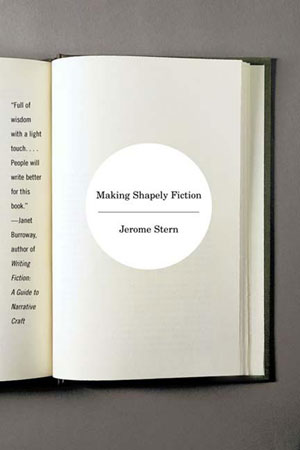
Making Shapely Fiction

by
Author: 
Jerome Stern
Published in 1991
by Norton

​In this comprehensive volume, Jerome Stern breaks down and reconstructs the component parts that come together to shape a work of fiction. Stern focuses on straightforward insights, exercises, techniques, and a list of don’ts that will help writers of all levels of experience enliven their work with new tension, immediacy, and momentum. There is even an Alphabet for Writers included with helpful terms ranging from accuracy to cliffhangers to irony. ​“The shapes of fiction inspire by presenting ways to embody your experiences, memories, and imaginings,” says Stern. 

Surprising Connections

2.25.26

In a 2016 interview for the Film Stage, French director Mia Hansen-Løve, known for her philosophical drama films that revolve around familial and romantic relationships and loss, talks about an unexpected connection between her own works and Michael Mann’s 1995 blockbuster crime drama Heat, starring Al Pacino and Robert DeNiro. She recognizes that the film about a detective and a career thief is actually about “action vs. melancholy and self-destruction—action becoming self-destruction,” themes Hansen-Løve sees in her own films “except in a very different way, in a very different world.” Think of a favorite film of yours with a genre that is, at least on the surface, extremely different from the type of fiction you tend to write. Consider the larger themes that are investigated in that work and write a short story that explores these themes in your own way, and in your own world.

Pages

Subscribe to Poets & Writers RSS