Details and Images

“If the dandelion on the sidewalk is / mere detail, the dandelion inked on a friend’s bicep / is an image because it moves when her body does,” writes Rick Barot in his poem “The Wooden Overcoat,” published in Poetry magazine in 2012. The speaker of the poem draws a distinction between a “detail” and an “image” defining the latter as something connected to a larger context and personal history that is “activated in the reader’s senses beyond mere fact.” Compose a poem that experiments with this distinction, perhaps incorporating both a “detail” and an “image” so that each functions in an intentional way. You could consider beginning with an item and slowly shifting the reader’s understanding of its significance as the poem progresses. Look to Barot’s poem for inspiration on form and use of space.

Kristen Arnett on Clowning

Caption: 

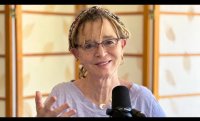
In this Creative Writing Series event at the University of Notre Dame, Kristen Arnett reads from her novel Stop Me If You’ve Heard This One (Riverhead Books, 2025) and talks about how she played with form by using different typefaces for “funny” and “not funny,” and her process to ensure that each joke lands.

Genre: 

Kerouac’s Road: The Beat of a Nation

Caption: 

Directed by Ebs Burnough, this documentary explores the influence that Jack Kerouac’s 1957 novel, On the Road, has had on writers, actors, storytellers and artists, and follows the lives of Americans who set off on their own journeys in the footsteps of the famous author, who died in 1969 at the age of forty-seven.

Revisiting

7.31.25

“The Chelsea was like a doll’s house in the Twilight Zone, with a hundred rooms, each a small universe. I wandered the halls seeking its spirits, dead or alive,” writes Patti Smith in her award-winning 2010 memoir, Just Kids, recounting her time living in the Chelsea Hotel in New York City during the golden, gritty chaos of her youth. Inspired by this image, write an essay about returning to a place that once held deep meaning for you. It might be a childhood home, a first apartment, a rehearsal space, or a street corner that once felt like the center of your world. Explore what it feels like to stand in a space that is both familiar and changed. How does memory overlay reality? Do ghosts of your former self or others linger in the corners?

Through Other Eyes

7.30.25

Hanya Yanagihara’s 2015 novel, A Little Life, centers on the complex relationships between four college friends: Jude, Willem, JB, and Malcolm. JB, a painter, begins a new series of portraits based on his friends, working from memory. When he paints Jude, his enigmatic friend with whom he’s grown distant, he claims it’s a tribute. However, the portrait depicts Jude mid-stumble, highlighting the distinctive walk caused by his lifelong injuries and trauma, and the image is widely seen as exploitative by their friends. This moment marks a betrayal and demonstrates how attempting to capture another person’s essence, even someone you love, can sometimes be dangerous. Write a story about a narrator trying to understand someone they were once close with, perhaps a sibling, friend, or lover. What image do they want to believe? What truths remain unseen?

First Fiction 2025 Virtual Reading

Caption: 

In this virtual reading and conversation, Poets & Writers Magazine features editor India Lena González introduces the five debut authors featured in “First Fiction 2025”: Sarah Yahm, author of Unfinished Acts of Wild Creation (Dzanc Books, 2025); Jon Hickey, author of Big Chief (Simon & Schuster, 2025); Carrie R. Moore, author of Make Your Way Home (Tin House Books, 2025); Aaron John Curtis, author of Old School Indian (Hillman Grad Books, 2025); and Jemimah Wei, author of The Original Daughter (Doubleday, 2025).

Genre: 

Ordinary Devotion

7.29.25

Many poems are written in the heat of falling in love with someone or something, with descriptions of desire, first touches, and breathless beginnings. But what happens after the crescendo when routine replaces urgency, when glances no longer surprise, and when love becomes less about being seen and more about staying? Write a poem about what it feels like to love someone or something after the rush. You could write about a partner, a city, a craft, or a version of yourself. Focus on the quiet gestures, the dailiness, and the things you no longer say out loud. How does love change when it no longer needs to perform?

Pages

Subscribe to Poets & Writers RSS