Jason Reynolds on Young People’s Literature

Caption: 

Jason Reynolds speaks about his appointment by the Library of Congress as the seventh National Ambassador for Young People’s Literature, the importance of young readers, and the danger of banning books in this interview on The Late Show With Stephen Colbert.

Genre: 

Last Name

12.7.21

“The name means ‘odd.’ / The name means ‘queer.’ / It can denote an ‘odd fish,’” writes Mark Wunderlich in his poem “Wunderlich.” The poem serves as an exploration of the poet’s last name, interlacing a historical overview of his family’s ancestry with suggestive definitions that compound and contradict. “The name means ‘electric organ maestro.’ / The name means ‘famous botanical illustrator.’” This week write a poem inspired by your last name. Allow yourself to get carried away with fact and fable, letting your imagination spin a new history for your family name.

J. Jennifer Espinoza Reads “My Trans Body”

Caption: 

“I pick up the phone and send you some words / about my trans body,” reads J. Jennifer Espinoza from her poem “My Trans Body,” included in her collection Outside of the Body There Is Something Like Hope (Big Lucks, 2018), in this installment of Ours Poetica, a video series produced by the Poetry Foundation in collaboration with Complexly.

Genre: 

River

12.2.21

“Traveling in this way, and trading in stories, is inevitably a journey of selection—it was not lost on me that for each voice I heard, many others would be left out,” writes Jordan Salama in Every Day the River Changes: Four Weeks Down the Magdalena (Catapult, 2021), an exhaustive travelogue in which the author follows the 950-mile length of the Magdalena River, from its source in the Andean highlands to the Caribbean coast, and recounts the legends and stories of the people he meets along the way. Write an essay about a river, or body of water, that is significant to you. How does its history intersect with your own?

Farah Bashir in Conversation With Madhuri Vijay

Caption: 

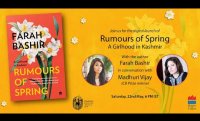
“The opening and closing of windows really meant a thin line between life and death,” says Farah Bashir, author of Rumours of Spring: A Girlhood in Kashmir (HarperCollins India, 2021), in this reading and conversation with Madhuri Vijay for Champaca Books.

Navigation

12.1.21

In this week’s Craft Capsule essay, Julia Sanches discusses using Google Maps as a resource while translating books set in places far from her home in Providence, and how this research has opened up her exploration. “Working on these translations hasn’t exactly given me wings, as the cliché goes, though it has forced me to navigate the geographical makeup of real places I’d never laid eyes on before, whose streets I’d never felt beneath my feet,” she writes. This week, use Google Maps to explore a city or place you’re never physically visited, perhaps the setting from one of your favorite books. Write down details from your research as a starting point for a short story.

December

11.30.21

“It is December and we must be brave,” writes Natalie Diaz in “Manhattan is a Lenape Word,” a poem from her Pulitzer Prize–winning collection, Postcolonial Love Poem (Graywolf Press, 2020). Diaz sets the scene by describing the sounds and colors of New York City: “The ambulance’s rose of light / blooming against the window.” Then she moves from the exterior to the interior: “I’m the only Native American / on the 8th floor of this hotel or any...” Inspired by Diaz, and the onset of winter, write a poem that starts with the line: “It is December and we must be brave.” Let this first line carry you into sensuous descriptions about the world outside, as well as inside.

Pages

Subscribe to Poets & Writers RSS