My Career in Writing: Bernardine Evaristo
Caption: 

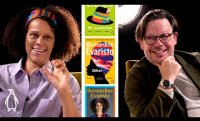
“A lot of my life has been unconventional, but it has led to this point and I wouldn’t have reached this point if I’d given up.” In this Penguin Books UK video, Booker Prize–winning author Bernardine Evaristo speaks with her longtime editor Simon Prosser about her writing career and books, including her new memoir, Manifesto: On Never Giving Up (Grove Press, 2022).
Secret Box

Edgar Gomez’s debut memoir, High-Risk Homosexual (Soft Skull Press, 2022), begins with a secret: “Moments after I was born at the Mount Sinai Medical Center of Greater Miami, my parents were handed a document, which I stumbled upon years later, curled and yellow at the edges, inside of a shoebox in a corner of my closet.” The book’s first sentence sets up the tension between the narrator and his family as Gomez recounts coming of age as a gay, Latinx man. Write a story that begins with a character finding a secret object—whether it be a hidden note, a photograph, or an unopened box. Who does the object belong to, and what feeling does this discovery conjure in your protagonist?

The New Year

“i am running into a new year / and the old years blow back / like a wind,” writes Lucille Clifton in her poem “i am running into a new year,” which is included in The Collected Poems of Lucille Clifton 1965-2010 edited by Kevin Young and Michael S. Glaser (BOA Editions, 2015). In this popular poem, Clifton writes about encountering her past as she moves into the future: “it will be hard to let go / of what i said to myself / about myself / when i was sixteen and / twenty-six and thirty-six.” Write a poem about the feeling you get when entering a new year. What are you taking with you, and what are you leaving behind? For further inspiration, read this Washington Post article by Stephanie Burt about the tradition of greeting a new year with poetry.

Tongo Eisen-Martin and Sonia Sanchez

Caption: 

“All street life to a certain extent starts fair // Sometimes with a spiritual memory even,” reads Tongo Eisen-Martin from his poem “Kick Drum Only” in this virtual reading with poet, activist, and icon Sonia Sanchez celebrating the ninetieth anniversary of the Woodberry Poetry Room at Harvard University.

Genre: 

Tales of the Future

12.30.21

“The future is the land of our expectations, hopes, fantasies, and projections, which is to say the future is a fiction,” writes Siri Hustvedt in “The Future of Literature,” an essay from her book Mothers, Fathers, and Others, published in December by Simon & Schuster. “In truth, the only certainty we have about the future is that it holds the secret to our mortality.” In her essay Hustvedt argues that our brains have evolved for prediction and references scientific studies, novels, and philosophy to create her own portrait of the future of literature. Write an essay that contemplates the role storytelling has had in your life. Consider how storytelling has changed for you as the years have passed, and try to reckon, as Hustvedt does, with the complicated nature of envisioning what is to come.

Blair Hurley on Imaginative Empathy

Caption: 

“The more that I wrote I discovered that writing in a pretty way actually wasn’t the goal,” says Blair Hurley about breaking down good writing and prioritizing writing clearly with characters that feel real in this interview with Junia Doan. Hurley’s essay “Tiny Doable Things” is featured in the January/February issue of Poets & Writers Magazine.

Genre: 

Resolutions

12.29.21

Go to the gym. Read more books. Save more money. Eat better. Wake up earlier. New Year’s resolutions begin as good intentions meant to introduce positive change in one’s life, but of course they can be difficult to sustain. Often characterized by vowing to continue healthy practices, change an undesired trait, or accomplish a new goal, resolutions bring with them hope but often turn to disappointment as these once-a-year aspirations fade with each passing day of the new year. Write a story about a character who is at a crossroads and makes an urgent resolution to change their ways. What are the circumstances that necessitate a need for change? How does your character go about accomplishing—or failing to meet—this pressing goal?

Devon Walker-Figueroa Reads “Noise Cancelling”

Caption: 

“To think I’ve gone / to all this trouble / just to lose / my looks & mind.” In this Poetry Society of America video, Devon Walker-Figueroa reads her poem “Noise Cancelling,” which was selected by Amit Majmudar as the winner of the 2021 Lucille Medwick Memorial Award. Walker-Figueroa speaks about her debut collection, Philomath (Milkweed Editions, 2021), in “A Freeing Space: Our Seventeenth Annual Look at Debut Poets” in the January/February issue of Poets & Writers Magazine.

Genre: 

Pages

Subscribe to Poets & Writers RSS