Literary Magazines That Pay
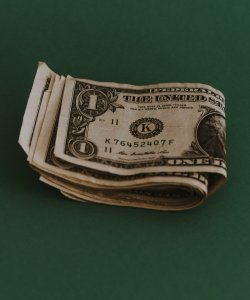
A curated list of twenty-two literary magazines that pay writers cash for their creative contributions.
Tags:
Jump to navigation Skip to content
A curated list of twenty-two literary magazines that pay writers cash for their creative contributions.
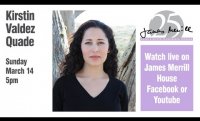
“This year Amadeo Padilla is Jesus. The hermanos have been preparing in the dirt yard behind the morada,” reads Kirstin Valdez Quade from her award-winning debut novel, The Five Wounds (Norton, 2021), in this 2021 virtual reading for the James Merrill House’s Writer-in-Residence reading series.
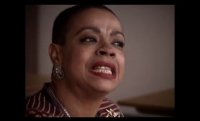
“Black of pure tint, I cry and laugh / the vibration of being a black statue; / a chunk of night, in which my white / teeth are lightning.” In this video for the Favorite Poem Project, bilingual special education teacher Glaisma Pérez-Silva reads Julia de Burgos’s poem “Ay, Ay, Ay, de la Grifa Negra,” translated from the Spanish by Jack Agüeros.
“These New York City Pigeons / cooing in the air shaft / are responsible for me.” Timothy Liu reads Jayne Cortez’s poem “These New York City Pigeons” and two poems from his latest book, Let It Ride (Saturnalia Books, 2019), for the Poets House Hard Hat Reading series.
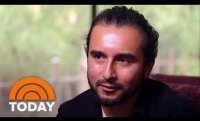
“Everything happens fast. Handcuffs on Chino. Uniforms do the same to the others who didn’t run fast enough.” In this video, Javier Zamora speaks with Today Show’s Jenna Bush about his three-thousand-mile journey alone as a nine-year-old from El Salvador to the United States which he recounts in his memoir, Solito (Hogarth, 2022).
What can we learn from a single conversation? In Richard Bausch’s short story “Aren’t You Happy for Me?” the protagonist Ballinger speaks to his daughter Melanie over the phone. The conversation, which increases in stakes and tension as it progresses, centers around both parties needing to share life-altering news: Melanie is pregnant and planning to marry an older man while Ballinger and his wife are planning to separate. The story is told with very little narration and is almost entirely written in dialogue. This week try writing a story that takes place over the course of a phone call. Consider what is said and unsaid in the dialogue and how this creates tension between your characters.
In Derrick Austin’s poem “Jesus Year,” he creates a portrait of his life on the occasion of his thirty-third birthday. Instead of leaning toward the more familiar images of birthday cakes or candles, Austin begins by describing his immediate surroundings: “My clogged sink coughs up foul water. / My skeletal philodendron,” he writes. The poem then offers more about his life; family members, a cerulean sweater worn through a winter without work, memories of the last time he smoked a cigarette. Taking inspiration from Austin, write a poem that paints a portrait of your life. Try to color the poem with unexpected images to offer a complete picture.
“I spent most of my life trying to blend in. / Try to fade into the background. / Try not to be noticed.” Abby Orbeta reads their poem “Chameleon” (“Hunyango”), which has been translated into Filipino, for this Ours Poetica video, sponsored by Complexly and the Poetry Foundation.
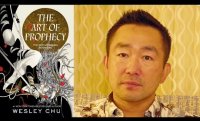
“It took me a long time, a lot of books under my belt before I could finally sit down and say, I am now skilled enough and experienced enough and confident enough to write The Art of Prophecy.” In this video, Wesley Chu speaks about his love of fantasy and Wuxia, and combining these genres in his new novel, The Art of Prophecy (Del Rey, 2022), the book he’s always wanted to write.
“You were not always just a You. I was whole—a symbiotic relationship between my best and worst parts—and then, in one sense of the definition, I was cleaved.” In this reading at the Kelly Writers House in 2020, Carmen Maria Machado reads from her debut memoir, In the Dream House (Graywolf Press, 2019).