Art Made of Words

10.18.22

In his essay “The Medium of the English Language,” published in Poetry magazine in 2014, the poet and critic James Longenbach, who died in July at the age of sixty-two, wrote about the ways in which the English language was his medium, the way that “the medium of Giorgione’s Tempest is ‘oil on canvas.’” Longenbach wrote: “How can art be something made of words, the same words used for newspapers and parking tickets? Unlike the media most commonly associated with visual and sonic artistry, words are harnessed by most people during almost every waking moment of their lives.” Taking inspiration from Longenbach’s essay, write a poem that reflects on how your everyday language becomes the medium for your poetry. Do you see a link between how you use language to communicate in your daily life and how you use it to communicate in a poem?
Erika T. Wurth on Revision

Caption: 

“I think I always accepted revision as what you have to do as a writer,” says Erika T. Wurth on the revision process for her stories and novels in this Lighthouse Writers Workshop interview with Rachel Weaver. Wurth’s third novel, White Horse (Flatiron Books, 2022), is featured in Page One in the November/December issue of Poets & Writers Magazine.

Genre: 

The Art of Stars

Caption: 

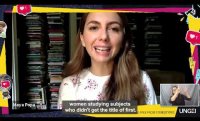
“What the history books neglect / is that the first astronomers / were women gazing up at depths / and wishing for a different planet.” In this video for the United Nations Girls’ Education Initiative, Maya C. Popa reads her poem “The Art of Stars,” which she dedicates to Maria Mitchell, the first U.S. female astronomer. Popa’s collection Wound Is the Origin of Wonder (Norton, 2022) is featured in Page One in the November/December issue of Poets & Writers Magazine.

Genre: 

Joshua Whitehead on Making Love With the Land

Caption: 

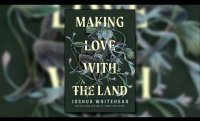
“What better way can I help myself and my community than standing on stage and taking off the mask of character,” says Joshua Whitehead about his first essay collection, Making Love With the Land (University of Minnesota Press, 2022), and his transition from writing fiction to nonfiction in this interview for CHCH Morning Live in Canada. Whitehead’s book is featured in Page One in the November/December issue of Poets & Writers Magazine.

The Time-Before

10.13.22

The Nobel Prize in Literature for 2022 was awarded to French author Annie Ernaux for what the Nobel Committee calls “the courage and clinical acuity with which she uncovers the roots, estrangements, and collective restraints of personal memory.” This skill is exemplified in her book The Years as she tells her life story spanning over sixty years in an unconventional manner, using the choral “we” and sometimes shifting into the third person. Reflecting on the voice of her book, Ernaux writes: “There is no ‘I’ in what she views as a sort of impersonal autobiography. There is only ‘one’ and ‘we,’ as if now it were her time to tell the story of the time-before.” Write an essay in the third person that focuses on a span of time in your life. How does this formal choice affect how you consider writing personally and collectively?

In Reverse

10.12.22

Have you ever tried to tell a story in reverse order? In the latest installment of our Ten Questions series, E. M. Tran discusses the challenges she faced while writing her debut novel, Daughters of the New Year (Hanover Square Press, 2022), which moves backward in time. “I had to shift my mindset,” says Tran. “Tension and narrative movement can still accumulate when you go backward. It just looked different, and I had to really get comfortable with that when I was writing.” This week, write a story that moves backward in time. Start with the ending and guide the reader back to the origins of your character’s journey.

Pages

Subscribe to Poets & Writers RSS