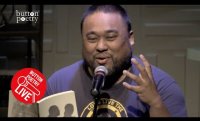
Kein/Muenchen by Jason Bayani
“Maybe when we say love, we mean a safe place to fall apart.” Jason Bayani reads his poem “Kein/Muenchen,” which appears in his collection Locus (Omnidawn, 2019), in this Button Poetry Live reading in 2019.
Jump to navigation Skip to content
“Maybe when we say love, we mean a safe place to fall apart.” Jason Bayani reads his poem “Kein/Muenchen,” which appears in his collection Locus (Omnidawn, 2019), in this Button Poetry Live reading in 2019.
The Venice International Film Festival in Italy is the world’s oldest film festival and is a marker for the year’s most celebrated accomplishments in cinema. There is always glitz and glamour on the red carpet, but this year the media focused on rumors of tension between the costars of the film Don’t Worry Darling, harkening back to old Hollywood and the gossip and alleged rivalry between stars such as Joan Crawford, Bette Davis, and Marilyn Monroe. This week write a short story in which gossip creates tension between your characters. How will your characters react once they become the talk of the town?
Elamin Abdelmahmoud discusses his debut memoir, Son of Elsewhere: A Memoir in Pieces (Ballantine Books, 2022), with writer Sarah Hagi in this video for Toronto Reference Library’s Appel Salon series. Abdelmahmoud is featured in “The New Nonfiction 2022” in the September/October issue of Poets & Writers Magazine.
In this week’s installment of our Craft Capsule series, Gregory Orr writes about the use of sounds and sound patterns in poems to produce a textural sonic experience. The essay begins by discussing four lines from Theodore Roethke’s poem “Root Cellar,” which Orr uses to exemplify how sound can “create a dense composition that is the sonic equivalent of intense odors and textures.” This week write a poem that illustrates through sound the smells, noises, and tactile experiences of a place from your childhood. Follow Orr’s advice to find what brings you pleasure in the music of words and use it in your poem.
In this video, Raymond Antrobus discusses and reads his poem “Plantation Paint,” which appears in his collection All the Names Given (Tin House/Picador, 2021), for which he was shortlisted for the 2021 T. S. Eliot Prize.
All Quiet on the Western Front is a Netflix film adaptation of the acclaimed 1929 novel of the same name by German author Erich Maria Remarque. Directed by Edward Berger, the German-language film stars Felix Kammerer, Daniel Brühl, Aaron Hilmer, and Albrecht Schuch.
“There’s something in people that is naturally story-like. You’re taking all this unformed, chaotic stuff and making sense of it.” Award-winning novelist and poet Peter Straub speaks about creating characters and his love of writing horror stories in this 2012 Open Road Media interview. Straub, who received the 2008 Barnes & Noble Writers for Writers Award for his generosity to the literary community, died at the age of seventy-nine on September 4, 2022.
On August 29, 1952, American composer and music theorist John Cage premiered his most famous and controversial piece 4’33”, a three-movement piece written for any instrument or combination of instruments in which the score instructs silence for four minutes and thirty-three seconds. In an interview that appears in Richard Kostelanetz’s 1988 book Conversing With Cage, Cage says of the audience for this first performance: “There’s no such thing as silence. What they thought was silence, because they didn’t know how to listen, was full of accidental sounds. You could hear the wind stirring outside during the first movement.” Write an essay inspired by this iconic piece of music. Try listening to the natural and ambient sounds of your writing environment and explore the moments in your life in which silence has been meaningful.
“To feel signs depends on how & why / the singer’s song puckers the mouth.” Yusef Komunyakaa reads his poem “A World of Daughters,” which appears in his collection Everyday Mojo Songs of Earth: New and Selected Poems, 2001-2021 (Farrar, Straus and Giroux, 2021), among other selections in this 2020 virtual reading for UC Berkeley’s Lunch Poems series.
This year marks the fiftieth anniversary of the first United Nations Educational, Scientific and Cultural Organization (UNESCO) World Heritage Convention, in which natural and cultural sites around the world are considered and added to a list to protect and preserve their heritage. There are currently over one thousand legally protected sites, which include the Great Barrier Reef in Australia, Mount Fuji in Japan, Canaima National Park in Venezuela, and Victoria Falls in Zambia. Explore the UNESCO World Heritage list and write a story that takes place at one of these protected sites. Read through the site’s history for ideas on how to weave this setting into your story.