Shelfie With CJ Hauser

Caption: 

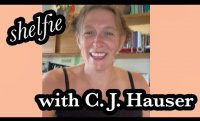
In this Waterstones video, CJ Hauser, author of The Crane Wife: A Memoir in Essays (Doubleday, 2022), talks about the books that have inspired them as a writer, which include Sing, Unburied, Sing by Jesmyn Ward; I Love You But I’ve Chosen Darkness by Claire Vaye Watkins; and Detransition, Baby by Torrey Peters.

Start With Loss

“Start with loss. Lose everything. Then lose it all again,” writes John Murillo in his poem “Variations on a Theme by Elizabeth Bishop,” which appears in his collection Kontemporary Amerikan Poetry (Four Way Books, 2020), in which he directly quotes from and expands upon Elizabeth Bishop’s poem “One Art.” Using his own perspective, Murillo explores the theme of loss and uses intimate life details to make each event feel distinct, sometimes measuring one against the other as Bishop does in her poem. He writes: “Measure a father’s coffin against a cousin’s / crashing T-cells. Kiss your sister through prison glass.” This week, write a poem that directly responds to a favorite poem of yours. Try writing a variation of a line or directly quoting from the poem to get started.

Deadline Nears for Diode Editions’ Poetry Book Contest

There is still time to submit to Diode Editions’ poetry book contest! Offered annually for a full-length manuscript, the competition awards the winner with a prize of $1,500, publication by Diode Editions, and 20 author copies of the published collection. The winner will also have select poems from their book published in Diode Poetry Journal.

To submit, e-mail a manuscript of 55 to 100 pages to Diode Editions with a receipt of payment of the $20 reading fee by September 30. Hybrid works, prose poetry, translations, and collaborative works are eligible. Visit the website for complete guidelines.

An independent press based in Doha, Qatar, and Richmond, Virginia, Diode Editions was founded by editor in chief Patty Paine in 2012 as an extension of Diode Poetry Journal. The press publishes full-length poetry collections, chapbooks, and poetry-related nonfiction works. Diode’s mission is “to beautifully craft our books, and to fanatically support our authors.”

Author Talk With Geraldine Brooks

Caption: 

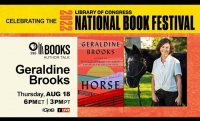
Geraldine Brooks speaks about her “ridiculous optimism” for new writing projects, the connection she has with her characters, and her new novel, Horse (Viking, 2022), with librarian Rebekah Scarborough in this virtual event, hosted by PBS Books in collaboration with Georgia Public Broadcasting celebrating the 2022 Library of Congress National Book Festival.

Genre: 

In Three Hundred Words

In the anthology Nonwhite and Woman: 131 Micro Essays on Being in the World (Woodhall Press, 2022) edited by Darien Hsu Gee and Carla Crujido, which is featured in the September/October issue of Poets & Writers Magazine, writers express the many facets of being a woman of color in poems and essays, all of which are three hundred words or less. The pieces navigate topics ranging from immigration, colorism, and financial struggles to family, food, and friendship. Inspired by these themes, write a micro essay that illustrates how your identity affects the way you move in the world. What creative approaches will you use to compress your thoughts into three hundred words or less?

A Conversation With Ariel Levy

Caption: 

“The best writing advice I ever got was, don’t give up and you can be a writer, if you work really hard and don’t stop writing.” In this Audible interview, New Yorker staff writer and author Ariel Levy speaks about finding her voice, writing about women’s lives, her experience with maternal grief, and her memoir, The Rules Do Not Apply (Random House, 2017).

Awkward Words

8.31.22

In a recent thread on Twitter, author Rebecca Makkai begins a discussion on words that make prose awkward in fiction, starting with the use of “as” in a sentence such as: “‘Hey there,’ I said as I got up as I turned on the lights.’” Other awkward words Makkai lists include “temporal hinge words” like “after” and “while,” the overuse of “that” in a sentence, and the use of gerunds, especially as dialogue modifiers. The last tip Makkai offers is a useful one: “I promise you, if you control + F through your work just on the words ‘as’ and ‘that’ and take out 90% of them, you’ll be so happy.” Try using this advice to revise a draft of a short story you’re working on. Remove some of the narrative devices listed in Makkai’s tweets and see how the rhythm of your story’s language changes.

Simone White at the Creative Capital Artist Retreat

Caption: 

“The first time I tried reading any of these poems aloud, I discovered that they had effectively broken my writing practice.” In this virtual lecture for the 2021 Creative Capital Artist Retreat, Simone White talks about the writing process for her latest poetry collection, or, on being the other woman (Duke University Press, 2022), which is featured in Page One in the September/October issue of Poets & Writers Magazine.

Genre: 

Skew Dice

8.30.22

“Up late scrolling / for distraction, love, hope, / I discovered skew dice. // In the promotional video / you see only a mathematician’s hands, / like the hands of god,” writes Catherine Barnett in “2020,” a poem published in the Academy of American Poets’ Poem-a-Day series. As a way of illustrating the loneliness felt during the early days of the pandemic, the poem focuses on the central image of skew dice, a set of irregularly shaped dice that are mirror images of each other. Write a poem that revolves around one central object. Try to be detailed about its uses and origins. Let the poem guide what the image of this object represents for you.

Pages

Subscribe to Poets & Writers RSS