Genre: Fiction

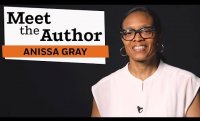
Anissa Gray

Caption: 

“It’s important to be a reader because it can help make you a better person.” Anissa Gray, author of The Care and Feeding of Ravenously Hungry Girls (Berkley, 2019), talks about the importance of reading, offers advice to aspiring writers, and explains why she does not loan out books in this interview for Penguin Random House.

Genre: 

Hypnosis, Leeches, Magnetic Therapy

3.13.19

Ancient Greek and Egyptian texts dating back two thousand years have recorded the use of leeches to treat everything from headaches to ear infections to hemorrhoids. More recently, magnetic therapy has been marketed in the form of magnetic jewelry, belts, and blankets to help alleviate pain, depression, and even boost energy. Write a short story in which a character makes the decision to seek out an unusual or unorthodox form of treatment. Is it an unexpected choice or does it seem to align with personality, circumstances, and setting? What has led your character to this unconventional option and how do loved ones react to this decision? 

Ingrid Rojas Contreras

Caption: 

“I was very lucky to have family members who are all very outgoing and love to hear people talk about them.” On Late Night With Seth Meyers, Ingrid Rojas Contreras talks about how her family and childhood in Colombia inspired her first novel, Fruit of the Drunken Tree (Doubleday, 2018).

Genre: 

Ten Questions for Ed Pavlić

by Staff
3.12.19

“I’d love the community of contemporary writers to read each other with the freedom and rigor (vigor) we bring to hearing the music we love the most.” —Ed Pavlić

Ron Charles Reviews Helen Oyeyemi’s Gingerbread

Caption: 

Washington Post book critic Ron Charles takes a humorous look at Helen Oyeyemi’s sixth novel, Gingerbread (Riverhead Books, 2019), for his Totally Hip Video Book Review series. Oyeyemi answers questions about her new novel in a recent installment of our online series Ten Questions.

Genre: 

Mariana Enriquez and Guadalupe Nettel

Caption: 

Argentinean author Mariana Enriquez and Mexican author Guadalupe Nettel discuss their shared passion for dark and sordid aesthetics, writing about the body, blurred realities, and writers including Charles Baudelaire, Mircea Cărtărescu, and Philip Roth. Enriquez is the author of Things We Lost in the Fire (Hogarth, 2017), translated from the Spanish by Megan McDowell, and Nettel is the author of After the Winter (Coffee House Press, 2018), translated from the Spanish by Rosalind Harvey.

Genre: 

Lammy Finalists Announced

Lambda Literary has announced the finalists for the thirty-first Lambda Literary Awards. Established in 1989, the annual awards—also known as the “Lammys”—recognize and honor books published during the previous year by lesbian, gay, bisexual, and transgender writers. The winners will be announced at an awards ceremony on June 3 at the NYU Skirball Center for the Performing Arts in New York City. Special awards will also be given to recognize writers who “have left an indelible mark on LGBTQ literature.”

“In the ongoing work of LGBTQ equality, literature plays a distinct and powerful role—offering roadmaps for loving, fighting, and thriving,” says Sue Landers, executive director of Lambda Literary. “We are thrilled to announce [this year’s] finalists, which reflect our community’s vast and continually evolving brilliance.”

This year Lambda Literary will give out awards in twenty-four categories, including a new award for Bisexual Poetry. Other categories include fiction, mystery, horror, memoir/biography, drama, anthologies, and LGBTQ Studies, A panel of more than sixty judges selected the finalists from a group of over a thousand books. Visit the website for the complete list of finalists.

Winners last year included Carmen Maria Machado’s Her Body and Other Parties (Graywolf Press) for Lesbian Fiction, CAConrad’s While Standing in Line for Death (Wave Books) for Gay Poetry, and C. Riley Snorton’s Black on Both Sides: A Racial History of Trans Identity (University of Minnesota Press) for Transgender Nonfiction.

Based in Los Angeles, the Lambda Literary Foundation has been a resource for LGBTQ writers since 1987. With a mission to “nurture and advocate for LGBTQ writers,” the organization hosts an annual writing retreat and literary festival, publishes an online magazine, and runs educational programs, among other initiatives.

Read more about the organization in Jonathan Vatner’s article “Lambda Literary Looks to the Future” from the September/October 2018 issue of Poets & Writers Magazine.


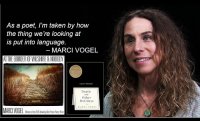
Marci Vogel

Caption: 

“I would read out loud and tried to check in my own breath, in my own body how the sentence was feeling and what kind of experience it was giving me as the first reader.” Marci Vogel reads from her books At the Border of Wilshire & Nobody (Howling Bird Press, 2015) and Death and Other Holidays (Melville House, 2018) and discusses her writing process both with poetry and prose in this Poetry.LA interview with Mariano Zaro.

How to Tell the Story

“Children force parents to go out looking for...the right way of telling the story, knowing that stories don’t fix anything or save anyone but maybe make the world both more complex and more tolerable,” writes Valeria Luiselli in her fourth novel, Lost Children Archive (Knopf, 2019), which she speaks about in the March/April issue of Poets & Writers Magazine. Write a short story in which a parent or guardian character must figure out “the right way” to tell a child some difficult news, perhaps in a moment of particular uncertainty, danger, or crisis. Describe the conflicts in deciding what to tell and not tell in an effort to make the world feel more tolerable. How does the child react to what’s been told?

Akwaeke Emezi

Caption: 

“She wasn’t sure if we were real, but nothing about us felt false.” Akwaeke Emezi, a 2018 National Book Foundation 5 Under 35 honoree nominated by Carmen Maria Machado, reads from their debut novel, Freshwater (Grove Press, 2018). The novel has been longlisted for the 2019 Baileys Women’s Prize for Fiction.

Genre: 

Pages

Subscribe to Fiction