Genre: Fiction

Writers at the Eyrie

A residency of two weeks or one month in November is offered to a poet, a fiction writer, or a nonfiction writer at a private apartment in Brooklyn, New York. The resident is provided with some meals. Writers over the age of 24 who are not residents of New York City are eligible. Submit via postal mail a writing sample of 7 to 10 poems or one to two stories or essays of up to 30 pages, a project description, a brief bio, and a résumé with a $10 application fee by August 30. Visit the website for complete guidelines.

Type: 
RESIDENCY
Ignore Event Date Field?: 
yes
Event Date: 
April 9, 2026
Rolling Admissions: 
ignore
Application Deadline: 
April 9, 2026
Financial Aid?: 
no
Financial Aid Application Deadline: 
April 9, 2026
Free Admission: 
yes
Contact Information: 

Writers at the Eyrie, 118 North Ninth Street, Brooklyn, NY 11249. Margot Farrington, Director.

Contact City: 
Brooklyn
Contact State: 
NY
Country: 
US

Whiting Award Winners Announced

At a ceremony tonight in New York City, the Whiting Foundation announced the recipients of its 2019 Whiting Awards. The annual $50,000 awards are given to emerging poets, fiction writers, nonfiction writers, and dramatists on the basis of “early-career achievement and the promise of superior literary work to come.”

The ten winners are poets Kayleb Rae Candrilli, Tyree Daye, and Vanessa Angélica Villarreal; fiction writers Hernan Diaz, Nafissa Thompson-Spires, and Merritt Tierce; nonfiction writers Terese Marie Mailhot and Nadia Owusu; and dramatists Michael R. Jackson and Lauren Yee. Find out more about the winners at the Whiting Foundation website, and read excerpts of their work at the Paris Review.

Since establishing the awards in 1985, the Whiting Foundation has awarded $8 million to 340 emerging writers. Previous winners include poets Terrance Hayes and Jorie Graham and fiction writers Colson Whitehead and Denis Johnson. Last year’s winners included poets Anne Boyer and Tommy Pico, fiction writers Patty Yumi Cottrell and Weike Wang, and nonfiction writer Esmé Weijun Wang.

The annual awards are not open to submissions. A group of writers, professors, editors, agents, critics, booksellers, and other literary professionals nominate writers; a smaller panel of writers, scholars, and editors select the winners. In addition to the Whiting Awards, the Whiting Foundation administers grants to creative nonfiction writers, scholars in the humanities, literary magazines, and people who work “to preserve, document, and disseminate the timeless cultural heritage that is under threat around the world.”

Photos clockwise from top left: Kayleb Rae Candrilli, Tyree Daye, and Vanessa Angélica Villarreal; fiction writers Hernan Diaz, Nafissa Thompson-Spires, Lauren Yee, Michael R. Jackson, Nadia Owusu, Terese Marie Mailhot, and Merritt Tierce.

Strange Hankerings

3.20.19

Does common sense go out the window when you go grocery shopping on an empty stomach? Last fall scientists published findings in Science Advances that even snails start making questionable food choices when they’ve gone too long without eating. Extreme hunger alters the brain’s perception of stimuli in a way that makes otherwise unappealing nourishment seem worthy of the risk, which explains why you might find yourself walking out of a grocery store with bizarre food combinations. Write a short story in which your main character makes an unusual choice while in the throes of hunger. Does it turn out to be merely a comic interlude or are there irreversible consequences?

Ten Questions for Bryan Washington

by Staff
3.19.19

“It’d be nice if the American literary community’s obsession with signal-boosting the optics of diversity were solidified into a tangible, fiscally remunerative reality for minority writers.” —Bryan Washington

Masterpiece of the Day: Write Treatment Workshops

Maryann DeLeo is a filmmaker and writer. She has been attending the Write Treatment Workshops at Mount Sinai Beth Israel in New York led by Emily Rubin for more than two years.
I was listening to a talk and the speaker said, “Are your days masterpieces? Make every day a masterpiece.” I thought of my days, and my first reaction was, No, my days are not masterpieces. Then I had a flash of Wednesdays at the writing workshop! Those days—they are masterpieces.

And it’s not just for the writing. It’s because of Emily Rubin, who leads the P&W–supported Write Treatment Workshops at Mount Sinai Cancer Centers. A fellow writer, Emily brings her love of literature, art, dance, theater, and music to the class. Her enthusiasm for the arts is evident with her weekly show-and-tell—holding up a catalogue from the latest exhibition she’s seen, or the playbill from a recent theater experience. She bursts into the room at Mount Sinai with so much to tell us about what’s happening in the world. I want to go to everything she tells us about. One student says to her, “You know about everything.”

Then Emily gets down to business: writing. She brings prompts that give us a way in to the writing or not. We can jump off from there, or we can go it alone writing about anything that comes up in our minds.

Each Wednesday she patiently unpacks our stories, one by one. She only looks slightly askance when a writer hems and haws about their “masterpiece” of the day. She wants each of us to stand tall and read with confidence.

I don’t know how she does it but she always finds something in the story that’s good storytelling, good writing. She takes the pages we write in our blue notebooks to heart. “You’re publishing your writing when you read it here,” she says. I breathe that in. If Emily says so, it is so. So we read, we publish, we get to be heard, by our own ears and by a dozen others.

We have created something, and Emily loves it into existence. It’s not that every piece will go on to loftier goals but for those minutes we read, we have Emily’s attention and all the other writers (although there is one writer who groans when he sees all I’ve written telling me, “You’ve written a novel!”). We have managed to get on our conference table soapbox and express who we are this day, this afternoon, these few hours. This is no small gift.

When I was in treatment for my cancer, I spent many afternoons lying on my bed, too weary to get myself up and out. Then I saw a flyer for one of Emily’s workshops. I didn’t go the first time I saw the flyer, but a seed was planted that maybe, someday, I could go. It was something to aspire to. When I get my energy back, I’m going, I told myself.

While still in treatment and fed up with lying about, there was that first Wednesday I got myself to the conference room at West Fifteenth Street. I was a bit shy but as soon as I saw Emily smiling, welcoming me into the room, the jitters went away. I became a regular. I’ve been attending the workshops for more than two years. I’m hooked. When I don’t go, I feel my day is not a masterpiece, something is missing from Wednesday.

I’ve filled many blue notebooks. I’m always startled at what comes out during the hours I’m writing. I didn’t know I thought that. Where did that come from? Some of my notebook writings move on, progress, and expand. And some I file away, to be continued.

I never just fling anything I write on Wednesday away. It’s all for something, even if it’s just for me to reflect on a part of my life I haven’t looked at before. It’s all part of my story.

There’s a quote Emily gave us by Natalie Goldberg that stays with me: “We are important and our lives are important, magnificent really, and their details are worthy to be recorded.... We were here; we are human beings; this is how we lived.”

Support for the Readings & Workshops Program in New York City is provided, in part, by public funds from the New York State Council on the Arts, and the New York City Department of Cultural Affairs, with additional support from the Frances Abbey Endowment, the Cowles Charitable Trust, and the Friends of Poets & Writers.

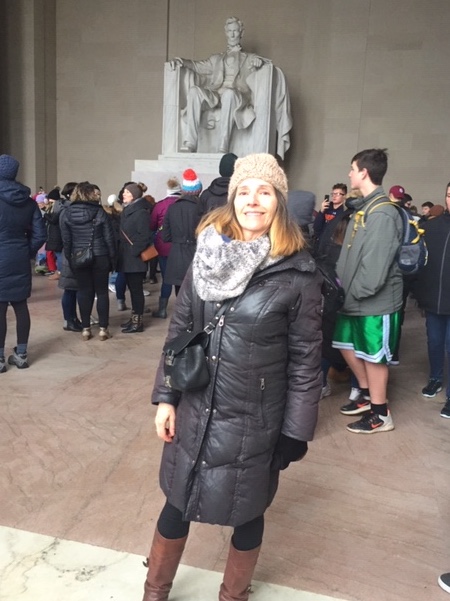
Photo: Maryann DeLeo at the 2019 Womens March in Washington, D.C. (Credit: Eileen Kenny).

2019 Man Booker International Prize Longlist

Caption: 

“We have found books that have challenged our notions of what fiction is and how to imagine the world,” says Elnathan John, one of five judges on the panel for the 2019 Man Booker International Prize, about the thirteen novels in contention for the prize. The list includes Celestial Bodies (Sandstone Press, 2018) by Jokha Alharthi, translated from Arabic by Marilyn Booth, and Drive Your Plow Over the Bones of the Dead (Fitzcarraldo Editions, 2018) by Olga Tokarczuk, translated from Polish by Antonia Lloyd-Jones.

Genre: 

Anissa Gray

Caption: 

“It’s important to be a reader because it can help make you a better person.” Anissa Gray, author of The Care and Feeding of Ravenously Hungry Girls (Berkley, 2019), talks about the importance of reading, offers advice to aspiring writers, and explains why she does not loan out books in this interview for Penguin Random House.

Genre: 

Hypnosis, Leeches, Magnetic Therapy

3.13.19

Ancient Greek and Egyptian texts dating back two thousand years have recorded the use of leeches to treat everything from headaches to ear infections to hemorrhoids. More recently, magnetic therapy has been marketed in the form of magnetic jewelry, belts, and blankets to help alleviate pain, depression, and even boost energy. Write a short story in which a character makes the decision to seek out an unusual or unorthodox form of treatment. Is it an unexpected choice or does it seem to align with personality, circumstances, and setting? What has led your character to this unconventional option and how do loved ones react to this decision? 

Ingrid Rojas Contreras

Caption: 

“I was very lucky to have family members who are all very outgoing and love to hear people talk about them.” On Late Night With Seth Meyers, Ingrid Rojas Contreras talks about how her family and childhood in Colombia inspired her first novel, Fruit of the Drunken Tree (Doubleday, 2018).

Genre: 

Ten Questions for Ed Pavlić

by Staff
3.12.19

“I’d love the community of contemporary writers to read each other with the freedom and rigor (vigor) we bring to hearing the music we love the most.” —Ed Pavlić

Pages

Subscribe to Fiction