Genre: Creative Nonfiction

Shelf Life

5.27.21

On Elle.com’s books column Shelf Life, Ling Ma, author of Severance (Picador, 2019), answers a questionnaire about her favorite books, including the one that made her weep (A Sorrow Beyond Dreams by Peter Handke), the one she would pass on to a kid (Jesus’s Son by Denis Johnson), and the one she considers literary comfort food (Kitchen by Banana Yoshimoto, among others). This week, answer the questionnaire for yourself, then write an essay that focuses on one of these questions and the book you recommended. What was happening in your life when you read this book and why are you still so deeply connected to it?

Goodbye to All That

Caption: 

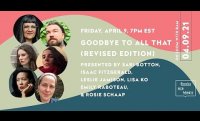
“There’s always going to be something to say about the push-pull that New York City exerts on its inhabitants,” says Sari Botton, editor of the revised edition of Goodbye to All That: Writers on Loving and Leaving New York (Seal Press, 2021), in this Books Are Magic virtual event with author Isaac Fitzgerald and contributors to the anthology Leslie Jamison, Lisa Ko, Emily Raboteau, and Rosie Schaap.

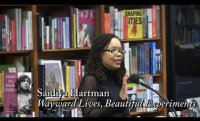
Saidiya Hartman Reading at Politics and Prose Bookstore

Caption: 

“I had written two books on slavery, and writing about slavery is to be in the center of a very difficult psychic territory, and so when I started doing the research for this project, I was very hungry for beauty—and I think I discovered it here,” says Saidiya Hartman about writing her book Wayward Lives, Beautiful Experiments: Intimate Histories of Riotous Black Girls, Troublesome Women, and Queer Radicals (Norton, 2019), winner of the 2019 National Book Critics Circle Award in Criticism, in this 2019 reading at Politics and Prose Bookstore in Washington, D.C.

Olivia Laing on Everybody

Caption: 

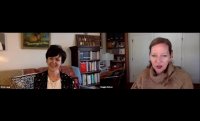
“I was really interested in the idea of the body as a place of imprisonment but also, the body as a place of liberation.” Olivia Laing speaks about her latest book, Everybody: A Book About Freedom (Norton, 2021), and how she addresses the themes of illness, sexual violence, and incarceration with imagery and by including historical figures of the past century in this conversation with author Maggie Nelson for the Center for Fiction.

Upcoming Contest Deadlines

Writers of all stripes will find opportunities in the last contests of May and the first of June. With deadlines of May 30, May 31, or June 1, these opportunities include a prize for undergraduate fiction writers, several contests awarding book publication, and grants supporting the translation of book-length works of poetry and prose. All offer a cash award of $1,000 or more and three charge no entry fee.

American Short Fiction Halifax Ranch Fiction Prize: A prize of $2,500 and publication in American Short Fiction is given annually for a short story. Deadline: June 1. Entry fee: $20.

Anhinga Press Prize for Poetry: A prize of $2,000, publication by Anhinga Press, and 25 author copies is given annually for a poetry collection. Ellen Bass will judge. Deadline: May 31. Entry fee: $25 ($28 for electronic submissions).

BOA Editions Short Fiction Prize: A prize of $1,000 and publication by BOA Editions is given annually for a short story collection. Peter Conners will judge. Deadline: May 31. Entry fee: $25.

Boulevard Emerging Poets Contest: A prize of $1,000 and publication in Boulevard is given annually for a group of poems by a poet who has not published a poetry collection with a nationally distributed press. The editors will judge. Deadline: June 1. Entry fee: $16.

Bridport Arts Centre Bridport Prizes: Two prizes of £5,000 (approximately $6,871) each and publication in the Bridport Prize anthology are given annually for a poem and a short story. Two second-place prizes of £1,000 (approximately $1,375) each and publication are given in each category. A prize of £1,000 (approximately $1,375) and publication is also given for a work of flash fiction. Raymond Antrobus will judge in poetry and Robert McCrum will judge in fiction and flash fiction. Deadline: May 31. Entry fee: £10 (approximately $14) for poetry, £12 (approximately $17) for fiction, and £9 (approximately $12) for flash fiction.

Center for Fiction New York City Emerging Writer Fellowship: Nine fellowships of $5,000 each and a one-year membership to the Center for Fiction in New York City are given annually to fiction writers living in New York City who have not yet published a book of fiction. Winners also have the opportunity to meet with editors and agents who represent new writers, and have access to the center’s writing space, the Writers Studio, for one year. Students who will be enrolled in a degree-granting program during the fellowship period, or who are currently under contract with a publisher for a work of fiction, are ineligible. Deadline: May 30. Application fee: none.

Elixir Press Fiction Award: A prize of $2,000, publication by Elixir Press, and 25 author copies is given annually for a short story collection or a novel. Ann Harleman will judge. Deadline: May 31. Entry fee: $40.

Milkweed Editions Max Ritvo Poetry Prize: A prize of $10,000 and publication by Milkweed Editions is given annually to a U.S. poet for a debut poetry collection. Henri Cole will judge. Deadline: May 31. Entry fee: $25.

PEN America PEN/Heim Translation Fund Grants: Ten grants of $3,000 each are given annually to support the translation of book-length works of poetry, fiction, and creative nonfiction that have not previously appeared in English or have appeared only in an “outdated or otherwise flawed translation.” An additional $5,000 grant, the PEN Grant for the English Translation of Italian Literature, will be given to support the translation of a book of fiction or nonfiction from Italian into English. Manuscripts with up to two translators are eligible. Deadline: June 1. Entry fee: none.

Salamander Fiction Prize: A prize of $1,000 and publication in Salamander is given annually for a short story. Yiyun Li will judge. Deadline: June 1. Entry fee: $15.

Southern Poetry Review Guy Owen Prize: A prize of $1,000 and publication in Southern Poetry Review is given annually for a single poem. Deadline: May 31. Entry fee: $20.

Stony Brook Southampton Undergraduate Short Fiction Prize: A prize of $1,000 is given annually for a short story by a college student. The winner also receives a full scholarship to attend the Southampton Writers Conference in summer 2022, and their winning work will be considered for publication in Southampton Review. Deadline: June 1. Entry fee: none.

University of Georgia Press Flannery O’Connor Award for Short Fiction: A prize of $1,000 and publication by University of Georgia Press is given annually for a collection of short fiction. Deadline: May 31. Entry fee: $30. 

Visit the contest websites for complete guidelines, and check out the Grants & Awards database and Submission Calendar for more contests in poetry, fiction, and creative nonfiction.

Fatherhood

5.20.21

In his essay “What My Korean Father Taught Me About Defending Myself in America,” published in GQ, Alexander Chee writes about his father’s adventurous life as a tae kwon do champion and community organizer in Maine, looking back on his father’s life as a way of learning how to protect himself and speak out about racism, and in particular, attacks against Asian Americans. “My father’s advice, about fighting being the last resort, has given me another lesson: You turn yourself into the weapon when you strike someone else—in the end, another way to erase yourself—and so you do that last.” Write an essay about a skill you learned as a child from which you can glean lessons as an adult.

Voices

5.13.21

“Is it the timbre of the voice, the poetry of the words?” writes Alessandra Lynch about becoming transfixed while watching Samuel Beckett’s play “That Time” in a piece for Poetry Foundation’s Harriet Books. In the lyric essay, Lynch tracks the emotional experiences of reading the works of her favorite writers aloud, quoting and discussing passages from the texts. This week, list writers whose works make you want to read them out loud and reflect on what emotions their words bring up for you. Construct an essay inspired by their works and consider how their words “gather and hold” you.

Summer Book Report

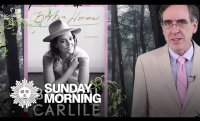
Caption: 

In this CBS Sunday Morning video, Washington Post book critic Ron Charles gives his book report on new recommendations for the summer, including Sanjena Sathian’s debut novel, Gold Diggers (Penguin Press, 2021), Great Circle (Knopf, 2021) by Maggie Shipstead, and The Man Who Lived Underground (Library of America, 2021) by the late Richard Wright, which is featured in Page One in the May/June issue of Poets & Writers Magazine.

PEN/Jean Stein Grants for Literary Oral History Accepting Submissions

Submissions are open for the 2022 PEN/Jean Stein Grants for Literary Oral History, which lend support to writers at work on “literary works of nonfiction that use oral history to illuminate an event, individual, place, or movement.” While the award was previously presented to a single recipient, this will be the second cycle in which PEN America offers two grants of $15,000 each.

Using online the online submission system, submit three statements, a curriculum vitae, a project outline, a writing sample of 20 to 40 pages from the project, and 6 to 10 pages of unedited interview transcripts relevant to the sample by June 1. There is no entry fee. Only unpublished works-in-progress are eligible. No submission may be slated for publication earlier than April 1, 2022. Visit the website for complete guidelines.

The PEN/Jean Stein Grants are named in honor of the author and editor Jean Stein, who died in 2017. Stein was well known for her literary oral histories, including books on Robert Kennedy and Edie Sedgwick. Last year’s grant recipients were Helen Benedict, whose work-in-progress chronicles the lives of refugees of Greece, and Brett Ashley Robinson, whose project reckons with the history of the 1985 MOVE bombing in Philadelphia.

Pages

Subscribe to Creative Nonfiction