Ten Questions for Nicholas Goodly
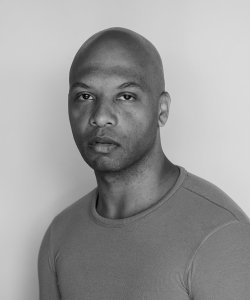
“It’s good to have a group of friends who make you feel like you can do anything.” —Nicholas Goodly, author of Star Power
Tags:
Jump to navigation Skip to content
“It’s good to have a group of friends who make you feel like you can do anything.” —Nicholas Goodly, author of Star Power
The machines are watching you . . . and they’re talking to each other. In an interview for Phaidon, Trevor Paglen, artist and author of How to See Like a Machine: Images After AI (Verso, 2026), speaks about how most images made in the world today are not centered around a human observer, but are made by machines for other machines. “A simple example is a self-driving car that is making tons and tons of images every second to navigate,” he says. “They’re not making those images for humans, they’re making them for themselves.” Spend some time imagining how a machine might “see” a photograph differently from how a human would, and write a poem with a particular image in mind. What might a machine notice or not notice? How might processing an image and communicating about it be different when we dispense with our conventional ideas of human emotional responses? Experiment with the way certain details are described and remembered.

“Work continuously and discipline yourself for this art that you love.” —Gregory Orr, author of We Interrupt This Broadcast
Write a poem that begins with directions you cannot give, whether it’s returning to a childhood home that no longer exists, finding someone you’ve lost, or reaching a place that has only ever appeared to you in dreams. Let the poem move between the literal and the imagined, charting not only streets and landscapes, but also memories, misdirections, and silences. What landmarks have shifted? What details remain sharp? Allow the act of mapping to reveal both presence and absence, and bring the reader in on what it feels like to be in the place you want to bring them.
In this installment of UC Berkeley’s Lunch Poems series, Cindy Juyoung Ok reads a selection of poems from her debut collection, Ward Toward (Yale University Press, 2024), which won the 2023 Yale Series of Younger Poets prize, and some newer poems inspired by her experience as a neurosurgical patient.
Poet and novelist Stacy Skolnik pieced together a series of Facebook posts from her old high school friend Robert Frost into a collaborative hybrid poetry collection, which is forthcoming from Book Works in June. In one of the collection's poems, the speaker expounds a moment of frustration after reading the signage outside a shopping area: “Can you believe this notice / in the middle of a seating and dining porch / it’s literally made for loitering // We have this seating area but NO ONE CAN USE IT!!!” Taking inspiration from themes that this poem touches upon—class, productivity, propriety—compose a poem of your own that meditates on what it means to loiter, which Merriam-Webster defines as “to remain in an area for no obvious reason.” What judgments do you make when you notice someone who appears to be loitering?
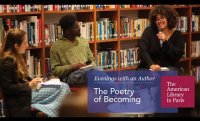
In this event at the American Library in Paris, Sasha Debevec-McKenney, author of Joy Is My Middle Name (Norton, 2025), and Oluwaseun Olayiwola, author of Strange Beach (Soft Skull Press, 2025), speak about their debut collections, published by Fitzcarraldo Editions in the U.K., in a conversation with writer and researcher Emma Gomis. Debevec-McKenney is the winner of the 2026 Swansea University Dylan Thomas Prize.
Fady Joudah, winner of the 2024 Jackson Poetry Prize, writes that he thought about how animals process trauma without speaking and how “intifada deserves a good rhyme” when composing his poem “Pink Panther,” recently published in the Academy of American Poets’ Poem-a-Day series. The poem concludes with the stanza: “See cicada or when home is a howling / intifada. Your heart, utterly flexible, / a wind like water, / the stubborn wind.” This week, begin by creating a short list of words or phrases that you find yourself circling around in your work, perhaps indicative of themes at the forefront of your thoughts. Then, select one term that is particularly difficult to rhyme. Challenge yourself to think of rhyming words and ways to connect the terms, even if far-fetched. Build your poem around this innovative and unexpected rhyme pairing.

“Every poem has work to do in the world, and recognition is the moment that the soul meets the poem it needs at that time.” —Beth Piatote, author of distant water
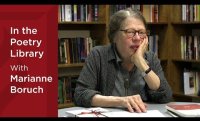
In this 2017 interview at Claremont Graduate University, Marianne Boruch talks about her 2011 collection, The Book of Hours, for which she won the Kingsley Tufts Poetry Award, and how poetry remains a “mysterious form” and creates a space where “it’s a pleasure to be elsewhere.” Boruch is the recipient of the 2026 Jackson Poetry Prize.