
Daniel Ruiz
Reality Checkmate
Four Way Books
The aches
accumulate into something greater. The horses
carry something heavier than kings—metal,
which is why they ordered their legs
so thin, their bases so heavy,
they cannot run.
—from “Remnants of Empire”
How it began: I always felt that I was writing poems, not a book, but after writing hundreds of poems, I got to the point where I felt proud or happy about enough of them to think they could exist together. My vision for the collection was as much a work-in-progress as the poems themselves. I needed to write a lot to realize what my tendencies were, so that I could responsibly make higher-order decisions regarding structure and aboutness. I bought a cheap printer, printed a stack of my poems, and then ordered them on the floor. By doing this I learned that ordering the poems felt in some ways like writing a poem. There was a rush to the process of moving the papers around that resembled the one I got moving the lines in the poems around. Once I realized this, there was no going back.
Inspiration: Friends and family. In these areas of my life, I really am one of the lucky ones. And my teachers. I would, in a very literal way, be a different poet and person without all of these people. I suspect I would be way worse off. Besides that, the answer is almost always to read or translate another poem so I can then write one of my own. Somehow that works for me, makes me feel like I’m in conversation with poets and histories I care about. Positive and negative examples have both been useful in this way.
Influences: The New York School, particularly John Ashbery and Frank O’Hara, has been a big influence. Their poems move into and out of so many modes, and those movements feel real to me and the way I think. Octavio Paz is another influence. In his book, The Bow and the Lyre: The Poem, the Poetic Revelation, Poetry and History (University of Texas Press, 1973), Paz argues that poetry is an image, in addition to having images. He means that, for example, when I speak, if someone doesn’t understand me, I can use other words to explain my point. In a poem, however, that’s explicitly not the case; changes made to a poem make it a different poem, and a poem cannot be reduced to an idea or an argument which would then stand in for it. So a poem, like an image, can be a space where contradictions are resolved and juxtapositions abound.
For me, the mind is also a kind of image, something irreplaceable which can tolerate juxtaposition and accommodate difference. It’s got poems, but also grocery lists, memories, everything you’ve ever loved, everything you’ve ever lost, both knowledge and feelings, and more, sloshing around inside it. I try to write poetry that presents and represents this.
Writer’s block remedy: I imagine that for a certain reader my work will never be good, while for another it already is, even if the poem in question is not up to my own standards. Pleasure in the act of writing may not yield a banger poem every time, but it does have a certain life utility; it makes me happy, which keeps my apartment clean. When I’m writing, I never wish I were doing something else. Another strategy I have for getting over burnout is changing something about the physical act of writing itself. If I’m working on a poem in my notebook, I move it to the computer. I switch from pen to pencil, lined to blank notebooks, and back again. I zoom in or zoom out of the Word doc. I read my poems out loud after shifting lines and line breaks around. It’s okay to let the process look a little different each day. And I try not to judge one day’s work by another’s.
Advice: Today I learned that continents drift at about the rate that our fingernails grow. The publishing world, at times, can feel even slower than that, especially to a young, energetic, enthusiastic poet. It can be unbelievably frustrating and tedious; you are basically waiting for e-mails to change your life. It’s a numbers game, in a sense. Something about “at bats” or attempts seems right. To paraphrase what Tomás Q. Morín once told me: Getting rejected still means someone is reading your work, and though it seems counterintuitive, you are actually building a readership this way.
I would say write the book you feel internal pressure to write, not the one you feel external pressure to write. Commitment to a vision can help make a lot of things we don’t want to feel—rejection, exclusion, etcetera—seem like their loss, and not ours, even though it’s both. Stay curious. Keep reading. Be open. Your work needs you.
Finding time to write: When I sit down to write I almost never start with nothing. I do what I suspect many other people do: I think up lines all the time (some of which are downright awful) and try to bend them into other lines to make a poem. Sitting down to write sometimes begins by dragging a line that I’m in the process of thinking up to my desk and scribbling it down as quickly as I can onto whatever paper I can find. I’ve learned to let this enthusiastic impulse interrupt other things I’m doing, even if it’s just for two minutes, so I can get it down right, so I can use it later. How do I put them together? That’s the part that’s consistently different. All I know is I often look up from my desk at a note my wife wrote me, or this postcard a friend sent me, or the Kandinsky print my dad bought me, and when I look down, something’s there.
Putting the book together: In general, I order by difference. Or what seems different to me, since I can’t escape myself. I like to say that not all my poems like each other. Even so, I knew I wanted a book without sections. Why? Well, nothing about the poems themselves seemed to point to an organizing principle I could identify and, say, build a section around. Does a section provide a formal breath, functioning basically as a break, or must it be thematized? After coming up with no answers to this question, I decided the book as a whole could be one gesture, so I wanted to see if I could sustain it in this way. I kind of saw the entire manuscript as one enormous swath, and each poem’s role in the collection was to keep up a sense of momentum I felt I was building, like not letting a balloon hit the floor.
What’s next: I’m working on a collection of poems that follows Francisco de Goya’s satirical series of etchings and aquatints, Los Caprichos. One of the things I’m doing with these is translating his original inscriptions from Spanish into English and incorporating them into the poems in different ways. It feels more disjointed and polyvocal than my first book, and that’s been an exciting change. I’m collaborating with a dead man, a master painter, one whom I am explicitly not in competition with, and feel grateful to.
I’m also translating Nicanor Parra and Vicente Huidobro, who—other than both being major male poets from Chile—are radical opposites aesthetically, so to move from one to the other has been illuminating and challenging. I think doing so has actually helped me understand both of them better.

Age: 33.
Residence: Denver.
Job: I’m a PhD candidate in English and literary arts at the University of Denver. I also edit poetry and translations for Denver Quarterly.
Time spent writing the book: The earliest poems in the book are about a decade old, having survived all my attempts to obliterate them. The majority are from my late twenties up until about two years ago, when I signed the book contract and pivoted to working on the Goya poems.
Time spent finding a home for it: Almost ten years.
Recommendations for recent debut poetry collections: There are so many! Personally I’d highlight Chronicle of Drifting (Copper Canyon Press) by Yuki Tanaka, When the Horses (Alice James Books) by Mary Helen Callier, What God in the Kingdom of Bastards (University of Pittsburgh Press) by Brian Gyamfi, Salvage (University of Wisconsin Press) by Hedgie Choi, and Late to the Search Party (Scribner) by Steven Espada Dawson. Also from Four Way Books, Isabella DeSendi’s Someone Else’s Hunger and Matthew Tuckner’s The Decline and Fall of the Roman Empire.
Reality Checkmate by Daniel Ruiz


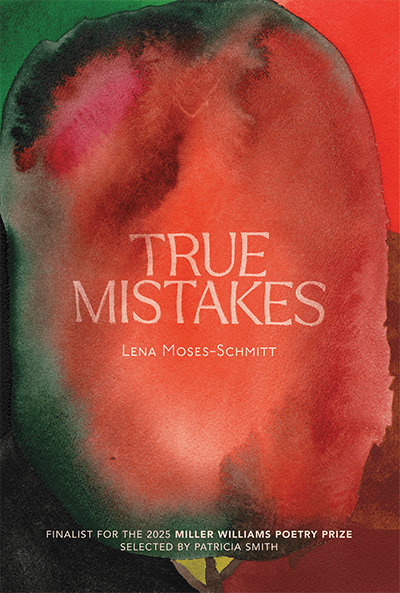
Lena Moses-Schmitt
True Mistakes
University of Arkansas Press
(Miller Williams Poetry Prize Finalist)
I put my eye into the window.
But it makes the room run dark.
It’s me—me who is descending.
Also me who runs.
—from “The Train”
How it began: I spent a long time sitting with this manuscript. I wrote the first version of it as my thesis for the MFA program at Virginia Commonwealth University (VCU), but when I graduated in 2014, I knew it wasn’t ready—looking back on it, it feels like a collection of poems by someone trying to figure out how to write poems—and I spent the next few years slowly overhauling it. The current version didn’t really start coming together until several years later, when I was living in California. I had been drawing and painting a lot, and that process started to work its way into my poems. I also began writing a bunch of epistolary poems to my future self, which turned into a series that now runs through the book. At that point, I knew my own obsessions more—I had also read more books and lived more life.
Because this is my first book, trying to answer this question feels like attempting to answer, “Why did you want to write poetry?” I think I was drawn to writing poetry, and the book, out of a need to feel my life at a deeper level and to understand—as well as put into language—the parts of us that exist outside of words. The poems in this collection are particularly obsessed with perception and what happens in the mind when you look closely at something, how looking can be transformative, unsettling, and also deeply and pleasurably confusing. They’re engaging with questions like what do we really see when we see an object, an image, an artwork, or another person—is it possible to really see them, understand them? Can we ever really know ourselves? I wanted to find a way to write into and transcribe that confusion. I often find that writing poetry is a way for me to be able to talk to myself about what I see and experience and think. Poetry creates a method of thinking that often feels safer and more creative than whatever goes on in my mind when I’m not writing.
Inspiration: Sightings—images, people, little anecdotes—I encounter on walks. Painting and drawing. California. Trees. My friends. Dancing. Artists who combine image and text. Novels and essay collections—I love inserting bits of my reading life into my poems; it makes them feel like conversations.
Influences: It’s so hard to answer this succinctly and satisfactorily! Claudia Emerson, whose poems—and personality—made me realize I wanted to take poetry seriously. Mary Ruefle, whose poems taught me that there are many different ways of making sense (and that poems can be fun as well as serious). The brilliant Kathleen Graber, who was one of my professors at VCU, for how she weaves philosophy into her poems and for her meditative, curious, and singular voice. Robert Hass and Larry Levis, for how they similarly combine narrative and emotion. Rainer Maria Rilke, Franz Wright, Louise Glück, Victoria Chang. Joan Mitchell’s paintings.
Writer’s block remedy: Anything to get out of my mind and into my body; it always helps to go on a run or to a dance class. Going to an art museum with a friend. Reading as much as I can—ideally I return to poets or writers I know I love, to remind myself why I love writing. I also write nonfiction and draw and make comics; turning to other genres and mediums helps refresh the others.
Advice: Trust and listen to yourself. Take all the time you need, and write the poems you want to read. Publishing is nice, but the real reason to do this is for the actual experience of writing poems—that’s the best part, the ultimate reward. Enjoy it, and don’t rush it.
This is less advice for publishing a book than it is advice for starting out in writing/publishing poems in general, but volunteer your time as a reader for a literary journal, if you can. When I was in graduate school I was the lead associate editor for the literary journal Blackbird. Reading so many submissions every week and getting to see the kinds of poems that people were writing was helpful—both to get a sense of what else was out there and to develop my own taste as a reader and writer.
Finding time to write: I reserve chunks of time in the early mornings before work and on the weekends. Even if I don’t get much writing done during those mornings, the fact that I have that time reserved means I’m at least thinking, and I’m sitting there at my desk in case anything happens. I also take notes constantly—in my notebook, in the Notes app on my phone, in e-mails that I send to myself throughout the day—whenever I get an idea for a line or if I see an image that strikes me or overhear something interesting. It’s a way of keeping myself in the mind-space of writing poems even when I’m not “officially” writing, a way of being in the world so that I don’t feel like those selves are too separate.
Putting the book together: I implemented the classic and beloved technique of printing out all the poems and hanging them on a wall. I was shocked at how making the manuscript “three-dimensional” helped me see things I hadn’t before. It also made organizing the book into a bodily sensation. I spent a few weeks walking around the wall, moving different poems around, removing poems I didn’t truly love (I placed them on the opposite wall, where they stared down the poems that eventually made it into the book), and considering how the various poems spoke to each other, which poems formed interesting energies when they were placed next to each other, which poems sounded too similar when they were too close together, etcetera. Having them printed out like that, all in front of me where I could see them, also helped me better access the emotional arc of the book.
What’s next: I’m a big believer in working on different projects at once (or perhaps I’m just resigned to my fate). Currently I’m working on a couple nonfiction manuscripts, one of which is a graphic memoir about cars (though it might turn out to be a graphic book-length poem…), and I’ve started a second poetry collection.
Age: 38.
Residence: I recently moved to Brooklyn, New York, though my book was written in Virginia, Texas, and California.
Job: I’m a book publicist.
Time spent writing the book: About ten years, though it went through many drafts, and I wasn’t steadily working on the book that entire time. There are one or two poems in the book that I first drafted in 2013, and I wrote the most recent poems in 2023.
Time spent finding a home for it: I submitted the first version of this book—which was pretty different, and had a different title—to various first book prizes and open reading periods for two years between 2016 and 2018, for a total of thirty-six submissions. It was a finalist and semifinalist a few times but ultimately didn’t land anywhere. By 2019, I felt totally divorced from the manuscript, like the poems didn’t really represent me anymore, so I stopped sending it out. At that point I was in the middle of focusing on a different writing project, so I hadn’t been regularly writing new poems, and I didn’t know if I would ever again. Then in late 2020, in the dark days of that pandemic winter, I started writing new poems again, and I overhauled the entire collection between 2021 and 2023. It took me about a year to find a publisher for the new version after I started sending it out in 2023.
Recommendations for recent debut poetry collections: Air Ball (After Hours Editions) by Molly Ledbetter, Salvage (University of Wisconsin Press) by Hedgie Choi, Joy Is My Middle Name (Norton) by Sasha Debevec-McKenney, We Contain Landscapes (Tin House) by Patrycja Humienik, and Cosmic Tantrum (Curbstone Books) by Sarah Lyn Rogers.
True Mistakes by Lena Moses-Schmitt