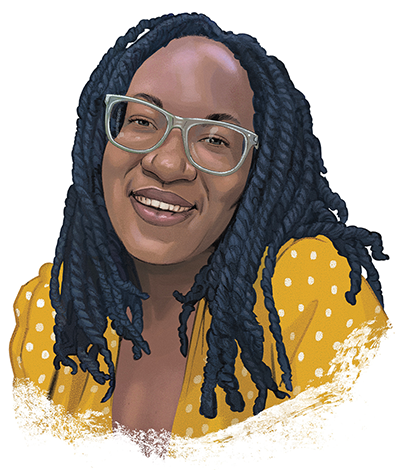
Nadia Alexis
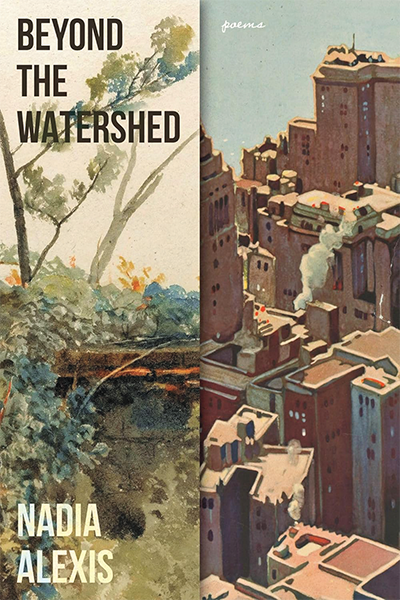
Beyond the Watershed
CavanKerry Press
we longed for cradled morning
when the sun’s mouth was gaping
oh how i secretly wished him to dust
so we would have permission to breathe
—from “Permission”
How it began: I wanted to resist silence. To make sense of my experiences and witnessing. I wanted to free myself. To understand love better. How water destroys, heals, and mirrors. To give offerings with my words and photographs that could have others feel seen, moved, changed.
Inspiration: The writings of Mahogany L. Browne, Cathy Linh Che, Edwidge Danticat, Natalie Diaz, Rachel Eliza Griffiths (and her photography), and Sonia Sanchez. The visual poetics of Monica Ong. The visual art of Carrie Mae Weems, LaToya Ruby Frazier, Madjeen Isaac, and the late Tamara Natalie Madden. Southern live oak trees, birds, bodies of water, cumulus clouds, cumulonimbus clouds. Haitian Vodou. Creating Their Own Image: The History of African-American Women Artists (Oxford University Press, 2005) by Lisa E. Farrington and Your Guide to Forest Bathing: Experience the Healing Power of Nature (Conari Press, 2018) by M. Amos Clifford.
Influences: To elaborate, Mahogany L. Browne’s Redbone (Willow Books, 2015) made me feel seen and gave me the courage to write through the difficult topics in my book. Monica Ong’s Silent Anatomies (Kore Press, 2015) was the first time I learned that you could bring visual art into poetry, and she inspired me to make my debut a hybrid collection. Carrie Mae Weems’s Kitchen Table Series and many other works showed me that there is freedom in turning the camera on yourself as a Black woman—and I gladly do so, with my ancestors and the natural world as frequent collaborators. And the paintings of the late Tamara Natalie Madden taught me that birds are kin, and that we are as beautiful as them, whether in flight or at rest.
Writer’s block remedy: I take walks among the trees or sit by ponds. I return to my drafts or finished poems. I revisit the work of others. I listen to interviews and podcasts. I write what sucks, knowing that it’s part of getting to what doesn’t. I remind myself that I am my best when I am rested and feel taken care of in a multitude of ways. I slow down, put my phone on Do Not Disturb, delete social media apps. I listen to the audiobook of We Will Rest! The Art of Escape (Hachette Audio, 2024) by Tricia Hersey again and again. And these days, I’m working on regulating my nervous system as I recognize its connection to creativity and many other things.
Advice: Be intentional and selective about where you send your book manuscript out for publication. Submit it to publishers that really feel aligned with your work, like they’d get the vision and celebrate it. You don’t necessarily need to send it to a bunch of places as if it’s a numbers game. Resist being led by fear or comparison. Release the false idea that if your book hasn’t been published by a certain age or year, you have failed. Befriend self-compassion. Revisit your love of writing and make a home there. Work on other projects. Give yourself space and breath. Trust that your day will come, and it will be glorious.
Finding time to write: I make time or steal it. And I do this imperfectly. Taking writing workshops helps. So does attending virtual writing sessions and craft workshops with The Sanctuary when I can. The Sanctuary is “a private, global membership community for BIPOC women writers who take their writing…seriously.” Lori L. Tharps is the founder and leader of the space.
Putting the book together: Initially I ordered it with respect to time and theme. But then I paid a manuscript editor to reorder it for me, and hers was so much better. While several poems and photographs ended up being cut from the final version, when I got to the point of editing the collection with my publisher, they kept it in the same order the manuscript editor had put them in.
What’s next: Regulating my nervous system and developing new habits. Shifting between short-story writing, writing new poems, and revising a YA novel-in-verse draft.
Age: 38.
Residence: Southwest Mississippi.
Job: I teach creative writing, freelance, give readings, write commissioned poems, exhibit my photography, and offer hybrid programs to colleges and universities that combine a reading, a poetry workshop, and a photography exhibition.
Time spent writing the book: About three years, though the oldest poems in the book were written about two or three years beforehand.
Time spent finding a home for it: Three and a half years, during which I sent it to seven publishers.
Recommendations for recent debut poetry collections: Encounters for the Living and the Dead (River River Books) by Jameela F. Dallis, Hardly Creatures (Tin House) by Rob Macaisa Colgate, Dead Girl Cameo: A Love Song in Poems (One World) by m. mick powell, and What We Do With God (Haymarket Books) by Daniella Toosie-Watson.
Beyond the Watershed by Nadia Alexis

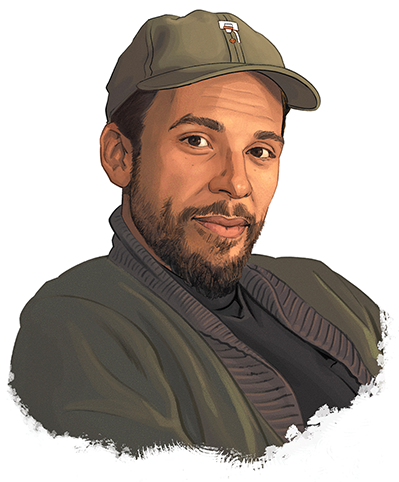
Bernardo Wade
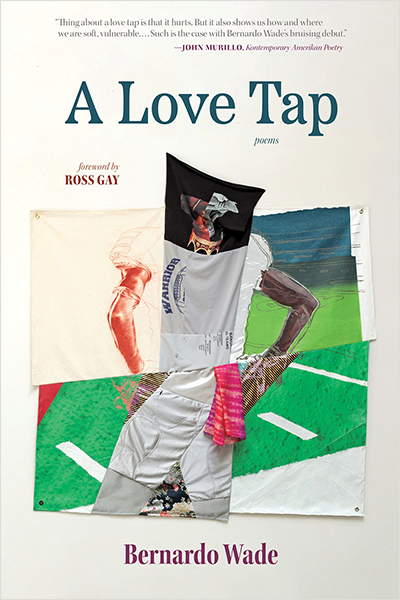
A Love Tap
Lookout Books
& we were no longer
a tangle
of two fiendish men
but became
ugly & tearful
seeing in the other
an animal
neither could hold.
—from “the coming of fox”
How it began: Sometimes life smacks you in the face hard enough to set you down a different path. It’s as if I can still taste that love tap. Since that day, I knew my life was changing, expanding. And in that process I found poetry was a way to share whatever this new way of seeing was. Or maybe it was a new way of feeling. I wanted to share it. I was compelled.
Inspiration: When I left for graduate school my father looked at me and said, “Don’t forget—you from someplace.” I feel wildly fortunate to be from New Orleans, a place that loves itself and its art. I try to live up to such high standards for creating. We really are a beautiful folk.
Influences: Ross Gay: my friend and mentor. He taught me how to see poetry as a way of living, of breathing. Bob Kaufman: Sometimes I think I could be a reincarnation of Bob, but those are in my more self-indulgent moments. He’s the impulse I’m in the wake of. Terrance Hayes: His was the voice where I went, Okay, yeah…this is poetry? Fuck yeah.
Writer’s block remedy: My momma taught me how to cook, so I might throw on some soul or R&B—Marvin Gaye to start—and cook myself a beautiful dinner. Probably New Orleans-style BBQ shrimp with grits. And some nice bread on the side.
Advice: I wish I’d known that the dream of a first book my imagination conjured in the first week or month or year of my MFA program was not a reality. Or at least it wasn’t mine. Almost immediately I was mired down with the confusion of how my work might be received. But by who? I made a big turn when I started to ask myself why I was writing these poems. Only then did the path toward a book become clearer.
Finding time to write: When I began writing poems, they were mostly nonsensical scribbles I did in the corner of the seafood joint where I waited tables. Often I’d give them away to whoever I was working with. (Maybe that’s why I’m not too precious about my poems in revision…) I might have written my first hundred poems that way. Today I’m blessed to be receiving a fellowship that offers me time I didn’t know existed. But no matter where I am, I try to get down what comes.
Putting the book together: I decided to break it into sections. I think that helped me untangle myself from what felt like a heavy pull to make things linear or neat. When in sections, each part kind of acts like a book in itself, which allowed me to focus on the organizing principles of each one.
What’s next: I’m trying my hand at a couple of essays, but I’m mostly keeping at poems. I’d like to extend the Black Masking Indians poem [“Origin of a Big Chief”] in my book into a full-length project, telling the story from different POVs throughout the generations of its history.
Age: 39.
Residence: Oakland.
Job: I am a Stegner fellow at Stanford University.
Time spent writing the book: Five years. These are the poems I wrote while in my MFA, and I’m really proud and honored to share such a transformative period of my life.
Time spent finding a home for it: I met my publisher by doing a reading. I work on performing my poems, and it’s paid off.
Recommendations for recent debut poetry collections: Gbenga Adesina’s Death Does Not End at the Sea (University of Nebraska Press) and Randall James Tyrone’s novel-in-verse, City of Dis (TRP: The University Press of SHSU).
A Love Tap by Bernardo Wade