

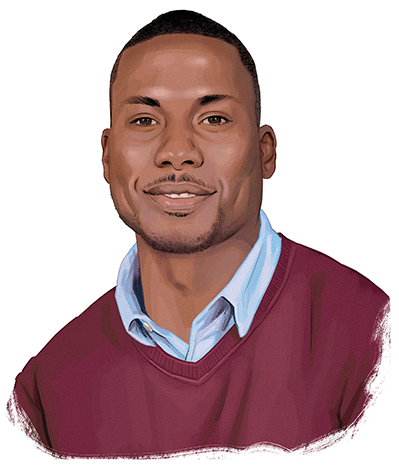
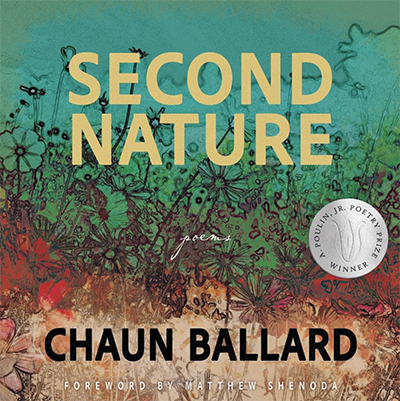
Chaun Ballard
Second Nature
Boa Editions
(A. Poulin Jr. Poetry Prize)
i mean to show you loss.
wherein. the mouth of the poem.
the words have gone missing.
& by missing. i mean.
what little we have had to hold.
—from “I Will Not Escape Without Leaving a Trail of Stars; Therefore, I Will Tell You How Spectacular You Are Under All This Light or I Want to Write a Song for You That I Will Not Complete Which Ends in Its Own Refrain or A Poem on How I Want”
How it began: I had been doing a lot of research, learning—listening, really—and receiving family history. These are the narratives that are passed down as heirlooms to the next generation.
Inspiration: My family members’ voices reaching through my cell phone, my wife relaying to me all things theory, the birds outside my office window, visits to my relatives’ migratory locations, learning family history, catching up with friends near and far, reading poems with beginner and seasoned poets, celebrating others’ successes, learning, sharing, then learning some more, repetition, etcetera.
Influences: A. Van Jordan, Tyehimba Jess, Jericho Brown, and Natasha Trethewey are all incredible poets. Their poems, prose, TED Talks, and, in Trethewey’s case, memoir, guided me throughout the writing of Second Nature. I admire these poets for their merging of received forms, particularly the blues and the sonnet.
Writer’s block remedy: Burnout? What is burnout? No burnout. No writer’s block. Yes, certainly an impasse. What is the plural for impasse? Whenever I am feeling stuck, I turn to the structures of received forms, or I give myself a prompt, or I find an old draft, dust it off a little until something emerges from those unfinished lines. I borrow a line or two from a draft that I have abandoned. I expand those lines. I piece them together. I go kaleidoscopic. I allow the poem to be what it wants to be. Then I name it. Another remedy is always to read more poems. Read Wendy Xu’s You Are Not Dead (Cleveland State University Poetry Center, 2013). Read her poem “This Year I Mean to Be an Elephant.” Then ask how did Xu get from her title to that last line? Read Hanif Abdurraqib. Read Hanif. Read Hanif. Read Trethewey’s “Graveyard Blues,” Brown’s “Duplex,” John Murillo’s crown of sonnets in Kontemporary Amerikan Poetry (Four Way Books, 2020). The unconscious work of uploading their words into your brain will settle in. Then, let them out.
Advice: Be patient with yourself and your poems. There is no rush. Develop. Grow with your register. I heard somewhere that Daniel Day-Lewis made a film every seven years. I believe Ilya Kaminsky is on that track as well. I could be wrong. Either way, a film like Gangs of New York and a collection like Deaf Republic (Graywolf Press, 2019) cannot be rushed, so be patient. Continue working, yes, but be patient.
Finding time to write: Writing is what I want to do. I can spend all day tinkering with a poem. But during the semester it is difficult to squeeze in the hours. Right now my Saturdays are precious, as are my evenings. I find myself bringing poem drafts with me to the bathroom—any chance to revise is helpful.
Putting the book together: I wanted to place my family’s personal archive within the conversation of U.S./American histories. I wanted to address the questions of how my family experienced Jim Crow, how they experienced the Great Migration. In order to answer these questions, I needed to provide narratives that would move through various decades. My goal was to begin with the personal and then unite the personal with the whole.
What’s next: I am currently working on two projects. One is a chapbook of poems that are in conversation with Afrofuturist thought and the other is a collection, I hope, of essays.
Age: 45.
Residence: Currently I am a resident of Alaska, so Alaska is where I call home.
Job: I am an assistant professor of English. I happily spend my hours reading my students’ writings, responding to the needs of the day, and encouraging students I come into contact with to grow in their relationships with words.
Time spent writing the book: This version of the collection took me less than a year to write, but I was living in a cave called graduate school at the time, so it could have been a bit longer.
Time spent finding a home for it: I sent out Second Nature to three or four presses in the same season, and Boa Editions was the last one to receive my manuscript submission. I am a serial withdrawer. I was well on my way to removing my submission from the queue—it made sense and/or it was late at night when most of my bad (writerly) decisions happen—but my wife recommended that I keep it in. She is never wrong (and this is how one maintains brownie points...).
Recommendations for recent debut poetry collections: I’ve had the honor of reading several wonderful poetry collections by Alaskan poets in 2025, though not all were debuts. Annie Wenstrup’s The Museum of Unnatural Histories (Wesleyan University Press) is certainly not one to miss. And if I may briefly shout out a few writers who I have recently spent time with—my gratitude to Peggy Shumaker, Andrea L. Hackbarth, and Shannon Gramse for their poems.
Second Nature by Chaun Ballard

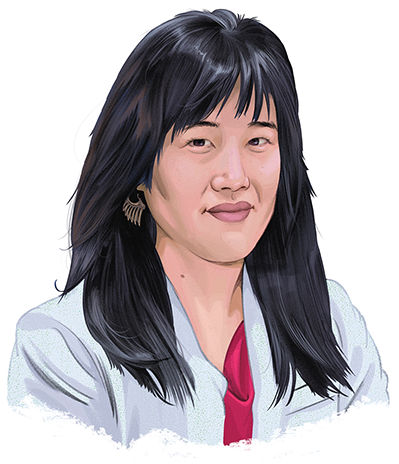
Esther Lin
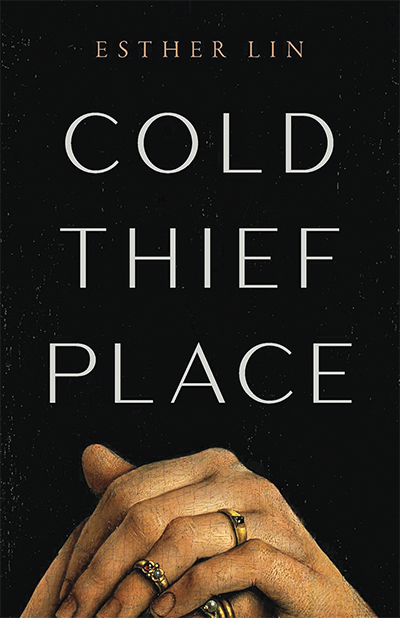
Cold Thief Place
Alice James Books
(Alice James Award)
What did I fear more?
A fire clawing
its way along my rug.
Offering me what I love best.
Or a man at the door asking
quietly my name, my date of birth.
—from “Cold Thief Place”
How it began: Poems are the primary way for me to think about my complicated parents, my complicated life. Why was I undocumented? What do I have in common with my parents when they had survived war and tyranny and lived in three continents, whereas I’d known only America? Poetry is a secret language that not everybody can understand—not my parents, not even me—so it was a safe language to write in: Then ICE wouldn’t deport me, and my parents wouldn’t rage. Poem by poem, I wrote to understand.
Inspiration: Literature, from the fury of Emma Bovary and the loneliness of Jane Eyre to the Old Testament and Greek mythology—by which I learned to read English—and some pop culture, like The Walking Dead television series and the X-men comics. These form the backbone of my imagination. What animates it are conversations with friends, the events of my life, which lead to questions of cause and effect, and whether or not I ever feel powerful.
Influences: I love the poets who, with glorious precision, render taboo feelings such as self-loathing, as Henri Cole does. I love glimpsing the interlocking of image and humor in Issa’s work. I learned how to write about country, complicated families, and history by reading Natasha Trethewey and Eavan Boland. I owe these two poets, especially—a happy debt.
Writer’s block remedy: Two years ago I stopped writing poems. Two weeks ago I gritted my teeth and revisited a draft I was afraid of. I had halted its progress because it told another woman’s story, and I was nervous about intruding on her life. Last week I called to ask for her permission. Thankfully she said yes, and I’m back. Perhaps there’s a lesson there. Ask for permission. Don’t halt a poem, maybe ever.
Advice: Unsentimentality. If you get rejected by ten presses without becoming a semifinalist, perhaps it’s time to revisit the book. Reorder the poems. Add poems, subtract them. Submit again. If you get rejected by ten more presses without becoming a semifinalist, perhaps it’s time to write a new book. You have to be quite unsentimental about your work.
Finding time to write: Lately it’s a determined act—stop this other task right now!—in order to write. I hide in little cul-de-sacs of writing time throughout the day, when my conscience allows me to “indulge” rather than tend to some other pressing need. I fear this is how entire years might slip away.
Putting the book together: I had just spent three months in Paris, courtesy of a fellowship, when I began organizing this manuscript for the second time. I was in the library at SOAS [School of Oriental and African Studies] University of London, under an open ceiling that automatically shuttered if it rained. It rained. I was in a state of—maybe—the sublime. Until then I’d never spent any significant time abroad; my family had been undocumented, and we’d lived below the poverty line for much of my childhood. In this library I brimmed over with joy, personal liberty, and the sadness that my father didn’t know I’d done all this; he’d passed away four years earlier.
I saw my poems in a new light, more like a play, with repeating characters and motifs. For example, there were poems that imagined how my mother claimed engagement to a man in order to leave China, and there were poems that described my marriage to a man in order to stay in the United States. The book needed to introduce these characters and their dilemmas, then reflect, then reverse. I tried to set poems against each other—to argue opposing viewpoints, to exercise irony, in the way the U.S. government forced me to view myself as an example of high-dumb dramatic irony; I exist, and the United States did not acknowledge my existence [for years].
What’s next: My second book. I’d written forty pages in 2022–2023, then endured a two-year break, which confounded the whole experience. So I’m trying to think about only individual poems for now. I should revise my answer: I’m working on four poems right now.
Age: 43.
Residence: Seattle.
Job: I’m teaching in the MFA Program for Writers at Warren Wilson College.
Time spent writing the book: The poems were written between 2016 and 2021.
Time spent finding a home for it: I sent it out each year from 2019 to 2022, with one year off somewhere in the middle.
Recommendations for recent debut poetry collections: I admire Nida Sophasarun’s Novice (LSU Press), which is elegant and full of trouble. The same goes for Patrycja Humienik’s We Contain Landscapes (Tin House). I feel a particular bookish sisterliness to them.
Cold Thief Place by Esther Lin