
Kalehua Kim
Mele
Trio House Press
(Trio House Press Editor’s Choice Prize)
But I will build my breath, Mother.
I will tongue a timbre that cements
siliceous lyrics into the shell of his ear.
I will revel in my expansion,
every vowel a crystalized chorus
ringing in woody resonance.
—from “After Everything”
How it began: I’ve been writing poetry for years but never imagined that a collection of mine would be published, so I don’t think I had a book project in mind. I just kept writing. Two of my teachers, Deborah Woodard at Hugo House and Jennifer Elise Foerster at the Rainier Writing Workshop, both offered time and attention to what I had assembled. With their encouragement, I kept shaping the manuscript.
Inspiration: I find the natural world to be a place of inspiration and expansive energy, which can offer space to move into poetic thought. Mele is pretty reflective, so places where I could be free to think about my mother, to be reminded of our conversations, her mannerisms, and especially her voice, brought me closer to her and the work. I should probably also mention my chickens, who make appearances in the book. Thank you, Misty Copeland, Amy Winehouse, Blondie, and Cher.
Influences: Lois-Ann Yamanaka’s Saturday Night at the Pahala Theatre (Bamboo Ridge Press, 1993) was the first book featuring Pidgin that I read after living on the continent. Books in ʻŌlelo Hawaiʻi and Pidgin were available to me growing up in Hawaiʻi, but it was a surprise to find the book while living in California. When I heard her read from it, I couldn’t believe that the language and rhythms of my homeland were published in a collection that was then presented to audiences outside of Hawaiʻi. That book was really validating for me as I incorporated more Pidgin and ʻŌlelo into my work.
I can say the same for This Is Paradise (Hogarth, 2013) by Kristiana Kahakauwila. Her characters are more than portrayals on the page for me—they are my aunties, my uncles, my family. I strive to portray my community in the same manner she does, with attention to the complications of balancing being of one place yet living in another, of holding true to my cultural values while exploring contemporary literature.
Writer’s block remedy: If I’m not gaining traction on the page, I usually take a walk or do some kind of house cleaning. Moving my body helps me get out any frustration while also offering a rhythm and meditation that I find soothing. I also enjoy other modes of creative expression like paper craft, collage, or linocut to stay inspired.
Advice: Keep returning to the work. As much as I enjoy—and need—writing, I have many obligations away from the page. But I can always return to it. Matt Young, one of the instructors at the Rainier Writing Workshop where I got my MFA, spoke at our last residency about how consistently getting back to writing helps him. Until he mentioned it, I didn’t realize that was integral to the completion of my book—no matter how long I stepped away from writing, I always made my way back.
Finding time to write: I try to piece together moments of inspiration wherever I can, which means I rely on the Voice Memos app on my phone a lot. It comes in handy when I’m walking the dog or running errands. Those recordings—or scraps of paper when I’ve had some on hand—get transcribed when I can sit [and write] for an extended period of time. I’ve joined generative sessions and accountability check-ins with cohort mates and writing groups, which I hope to continue. I also try to set deadlines for myself, which is why I like the demand of the Grind Daily Writing Series.
Putting the book together: Because I’d been working on this collection for so long, some of the material I had fit with the new work I was generating and some didn’t. My first step was to determine which poems felt complete. The poems dealing with grief from my mother’s passing reflected where I wanted to be as a writer and helped me process my emotional state at the time, so those were strong contenders. Then I looked for parallels between my older poems and those elements. This led me to consider how my relationship with my mother affected my other relationships, especially with my husband and children. Could I connect what my mother handed down to me to the way I engage with being a partner and a parent? That female lineage, whether intentional or not, resonated strongly throughout. Making the leap to the musical aspect of the collection came naturally after that. My family’s oral tradition feels so ingrained that sometimes I forget that thread exists in my work. When I applied a Hawaiian song structure to the structure of the collection, everything clicked. The challenges that plagued me with past iterations of the manuscript kind of fell away and I knew that’s how I needed to organize this work.
What’s next: I have a solid start on what might be two very different projects. The first is a collection of epistolary poems and the second wants to be a story-in-verse that incorporates Hawaiian mythology. After the excitement of releasing Mele, I’m glad to have very different projects waiting for me.

Age: 53.
Residence: I live in the Seattle area, on an island.
Job: I’ve been the primary caregiver for my children, doing part-time administrative work around their school schedules. Our youngest just finished high school, so it’s wonderful to give writing and Mele more attention right now.
Time spent writing the book: Decades! I’d say a large portion of the book was written over the past five or six years, but more than a few of them are older than my children. My oldest turns twenty-five this year.
Time spent finding a home for it: The manuscript took many iterations over many years, and I’d send it out from time to time. One version was a chapbook that actually became a finalist for a prize. I continued to revise and reorder, then submit when I could—sometimes that meant years in between submissions. I didn’t submit very widely. With this latest version, which felt the most complete, it took a couple of years.
Recommendations for recent debut poetry collections: I’m still thinking about The Museum of Unnatural Histories (Wesleyan University Press) by Annie Wenstrup and Maria Zoccola’s Helen of Troy, 1993 (Scribner).
Mele by Kalehua Kim


John Liles
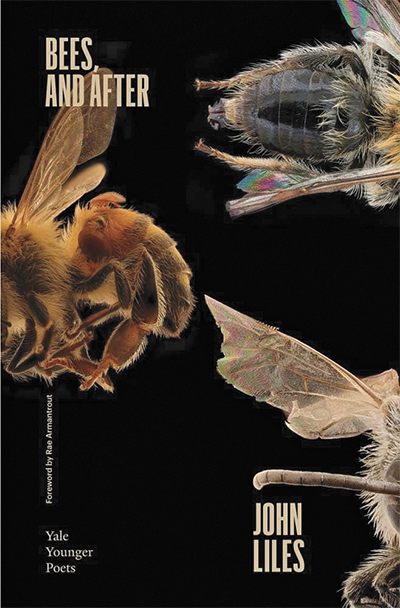
Bees, and After
Yale University Press
(Yale Series of Younger Poets)
when a little bright gives to dying :
when a dog
comes hungering
down
—from “Dog spark”
How it began: I set off writing in the effort to reconcile being a human here. I never understood what it is that so many others seem to know. What makes this life worth it, given everything we, a brief iterant species, have done to others, ourselves, across a planet. Against this toil of being human, years ago now, I went looking for something to love about remaining here and found nematodes, honeybees, the way a(n embryonic) heart grows. Then and now it made total sense to spend my moment on earth gesturing toward other life forms. Not because a mollusk will ever read my work, but because the words you say matter. I believe in language. I believe it’s how we reach each other (across time and space and death and rot). And if I can have a moment to be heard, I’d like to form new empathies. I’d like to challenge who “we” are, who gets to be included in our “us.” I want to live in a world of radical companionship, nonhuman narratives, multispecies storytelling.
Inspiration: It’s been found that some wandering salamander, Aneides vagrans, live nearly their whole lives one hundred-plus feet up in redwood canopies. The hardest material formed biologically can be found in many tide pools—the teeth of limpets. Some isopod species co-parent. Cows have best friends. Bees make mistakes. Common vampire bats share food, and greater spear-nosed bats babysit. Mesozoic cockroach mothers carried their young everywhere. My stance is that there’s nothing (good) in this world that is uniquely human. There is so much to learn. I read through a lot of old textbooks.
Influences: Cody-Rose Clevidence, for having the words for being an animal among animals. Rae Armantrout, for her poetic structures, which grant syntactical permission. Paul Celan—“You be like you, ever.”—whose poems bring me home. Scholar Donna Jeanne Haraway, for the task of making kin in this living and dying together.
Writer’s block remedy: Inertia is a struggle. I think of writing as walking down a dark hallway with a plate of candles. The task is to go on and place my lights until I’m over and now the next person can see a little further. I am trying to find “the words for”…
I think of the cancer that engulfed my grandmother’s brain, and then near the end—once she stopped talking—the look on her face when our eyes would meet.
A sentence can change your life. Think of someone somewhere who might need to hear something that, without you, won’t ever be said.
Advice: Think of writing poetry as a method for listening closely to/in the world. Pick up stones. Learn. Learn more. Write more about less. Create the poems you want to see in the world.
Finding time to write: I stay up way too late walking in circles with my notebook and mumbling to myself while most everything else but the ocean keeps quiet.
Putting the book together: Very carefully. I was looking for a tacit thematic thread from one poem to the next and a logical/mindful, emotional carry-through.
What’s next: A hybrid work of species-specific poems, each highlighting an organism living in our tide pools, set alongside a factlet or two and a small, accurate watercolor of each being—if a field guide could be made with poems.
Age: 34.
Residence: I split time between a one-room hut in Fort Bragg and a backhouse in Auburn, California.
Job: I work as a head naturalist for the Pacific Environmental Education Center. We teach ecology across biomes and facilitate connection with, and appreciation of, nature for students who stay with us in the woods on the rocky Pacific coast. I love the work, and I have worked alongside incredible people. There’s nothing like stopping everything to sit in the dirt with a slug. I will say, we’re dang good at what we do, in an education-centric approach; the time is honestly magical for some students every week.
Time spent writing the book: I started writing the poems in this book eleven years ago.
Time spent finding a home for it: Five years of sending off iterations.
Recommendations for recent debut poetry collections: Not exactly 2025, but poetry debuts that I’ve read and loved recently: The Kissing of Kissing (Milkweed Editions, 2022) by Hannah Emerson, fox woman get out! (Boa Editions, 2023) by India Lena González, Song of My Softening (Alice James Books, 2024) by Omotara James, and FREELAND (Alice James Books) by Leigh Sugar.
Bees, and After by John Liles
India Lena González is a multidisciplinary artist and the features editor of Poets & Writers Magazine. Her debut poetry collection, fox woman get out!, was published by Boa Editions in 2023. Find her online at indialenagonzalez.com.