Switcheroo

8.14.25

The Freaky Friday franchise, including the recently released film Freakier Friday, consists of film and theater productions revolving around the premise of a contentious parent-child relationship and a subsequent body swap, through which each character gains understanding and sympathy for the other as they are forced to live in each other’s shoes, and their relationship is strengthened. This week write a personal essay that considers how you would respond if given the fantastic ability to switch places—and bodies—with someone you are close to in your life. Perhaps begin by thinking about friends and family members whom you wish you understood better. Provide illustrative examples of the specific elements of this person’s life for which you seek clarification and understanding, and ultimately, a closer connection.

Ed Park: An Oral History of Atlantis

Caption: 

In this Politics and Prose event with novelist Angie Kim, Ed Park discusses the twenty-five-year process of writing his first story collection, An Oral History of Atlantis (Random House, 2025), which is featured in Page One in the July/August issue of Poets & Writers Magazine. For more from Park, read his installation of our Ten Questions series.

Genre: 

A Mysterious Error

8.13.25

Last month, new research published in the Review of English Studies presented findings from a pair of scholars that solved a centuries-old mystery in Geoffrey Chaucer’s writings. A typo was discovered in a transcription of a twelfth-century sermon referencing a long-lost, and once popular, poem “The Tale of Wade” in which the word “wolves” was mistakenly written as “elves” and “sea snakes” written as “sprites.” In Chaucer’s Troilus and Criseyde and The Canterbury Tales, he referenced the poem and this same bumbled transcription appeared through the centuries, perplexing scholars as to why Chaucer would include mythical creatures in his stories of courtship with knights and ladies. Write a short story in which a typographical mistake results in a cascade of consequences for those who interpret the language in unexpected ways. Is the mistake eventually rectified or does the story conclude without anyone knowing?

The Poem I Wish I Had Read: For What Binds Us

Caption: 

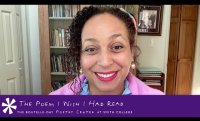
“There are names for what binds us: / strong forces, weak forces. / Look around, you can see them.” Danusha Laméris reads and talks about “For What Binds Us” by Jane Hirshfield and shares why this poem is meaningful to her for “The Poem I Wish I Had Read” series in this video from the Boutelle-Day Poetry Center at Smith College.

Genre: 

Beyond Stability

8.12.25

“I often think of poetry as something that is beyond the true and the false,” says poet and critic Michael Leong on what he feels is true about the art of poetry in a Literary Hub interview with Peter Mishler. “Poetry’s strangeness is so tied up with how it productively messes with what we previously thought were stable truths and stable falsehoods.” Taking inspiration from this notion that poetry exists in a space that is “beyond the true and the false,” write a poem that explores a seemingly stable truth or falsehood, one that you may be interested in interrogating and undermining. Experiment with using surrealist imagery, playing with expanding far out into the white space of the page to stretch further into the incongruity of your subject.

Mieko Kawakami and Fernanda Melchor

Caption: 

In this 2020 Wheeler Centre virtual event, Roanna Gonsalves hosts a discussion about womanhood in fiction and the power of translation with Fernanda Melchor, author of Hurricane Season (New Directions, 2020), translated from the Spanish by Sophie Hughes; and Mieko Kawakami, author of Breasts and Eggs (Europa Editions, 2020), translated from the Japanese by Sam Bett and David Boyd.

Banned Artists

In a recently published article in T Magazine, artists, including John Waters, Andres Serrano, Karen Finley, Khaled Hosseini, Geraldine Brooks, Art Spiegelman, Kate Bornstein, and Dread Scott, were interviewed about how censorship changed their work and lives. “The censorship does the opposite of what it wants to do,” said playwright and director Moisés Kaufman. “It makes people really think: ‘What are the issues in the play? Whose stories get to be told?’” This week write a personal essay that focuses on either a work of art, literature, or performance that has endured censorship at some point. Describe the work and the themes within the work that provoked censorship. How did this banning affect your ideas of the role of an artist?

Pages

Subscribe to Poets & Writers RSS