In Your Element

11.21.23

The American dipper is said to be North America’s only truly aquatic songbird: a small, undistinctive brownish gray bird that chirps a pretty melody nearby river rapids and dives up to twenty feet into the water, even walking underwater along the riverbed to catch tiny fish, larvae, and small insects to eat. Flying fish also straddle multiple elements, launching themselves out of water and gliding through the air to escape predators. Unexpected animal behavior can act as a reminder of our own flexibilities or potential to exceed expectations that might otherwise keep us constrained. This week write a poem about a time when you have been propelled into unexpected territory, like a fish out of water or a bird under water. Is it possible that you might feel in your element while out of your element?
Lauren Groff on The Vaster Wilds

Caption: 

Lauren Groff discusses how she unpacks the history of British colonialism in America and reckons with the frontier narrative in her new novel, The Vaster Wilds (Riverhead Books, 2023), in this conversation with Atlantic managing editor Andrea Valdez held at the 2023 Atlantic Festival.

Genre: 

Praise Song for Oceania

Caption: 

“Praise your capacity for birth / fluid currents and trenchant darkness.” In this short film directed by Justyn Ah Chong, poet Craig Santos Perez reads “Praise Song for Oceania,” which appears in his collection Habitat Threshold (Omnidawn, 2020). Perez’s latest collection, from unincorporated territory [lukao] (Omnidawn, 2023), the fourth in an ongoing series about his homeland of the Pacific Island of Guåhan (Guam), won the National Book Award in poetry.

Genre: 

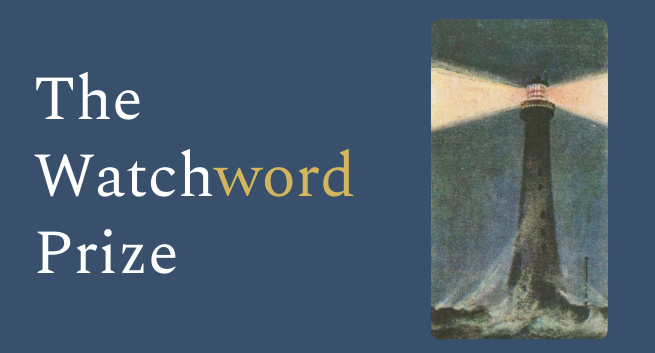
Deadline Nears for Watchword Prize

Begin the last month of 2023 by showing a little faith in your poetry: Submit to the inaugural Watchword Prize from Georgetown Law’s Center on Privacy & Technology by December 1. The author of the winning poem will receive $2,000, publication on the center’s website, and an invitation to read at the Color of Surveillance conference.

Using the online submission form, submit up to three poems for consideration on the broad theme of surveillance. There is no entry fee, and poet Carolyn Forché will judge. Visit the website for complete guidelines.

As technology enables governments and corporations to more easily and frequently monitor individuals, the Center on Privacy & Technology advocates for legal polices to protect privacy rights. The center launched the Watchword Prize to engage poets in thinking about what it means to be surveilled and the consequences for a society that keeps such close tabs on its people. “Artists and poets have a deeply-rooted tradition of participation in movements for social change, and we want to help foster and inspire the production of new works of art that evoke and critique experiences and practices of surveillance,” says a statement on the center’s website explaining the impetus for the prize.

Justin Torres on Blackouts

Caption: 

Justin Torres reads from his second novel, Blackouts (Farrar, Straus and Giroux, 2023), and joins Melissa Febos for a conversation in this event hosted by the Chicago Public Library and the Women & Children First bookstore. Torres won the 2023 National Book Award in fiction for Blackouts. (This video has been removed by its host.)

Genre: 

Alien and Familiar

11.16.23

In a recent piece published in the New Yorker, Rivka Galchen writes about a new nature documentary miniseries titled Life on Our Planet, in which dozens of species of dinosaurs and other long-extinct animals are rendered into existence alongside footage of animals still living on the planet today, with the help and expertise of paleontologists and cutting-edge CGI technology. Galchen notes that the effect “does as much to reveal the extraordinary and alien nature of the animals we currently share the world with as it does to make familiar the extinct ones.” Write a pair of short creative nonfiction pieces—one about someone no longer in your life and one about someone still in your life. How can you bring the past into the present and vice versa? Do familiar memories somehow feel alien to you now?

K-Ming Chang on Organ Meats

Caption: 

Award-winning author K-Ming Chang reads from her latest novel, Organ Meats (One World, 2023), and joins Amanda Mei Kim for a conversation about the sensual qualities of language and the intimate relationship between writing and the self for this event hosted by the Center for Literary Arts of San José at the Hammer Theatre.

Genre: 

Wilting Lettuce

11.15.23

In Adania Shibli’s novel Minor Detail (New Directions, 2020), translated from the Arabic by Elisabeth Jaquette, the second part of the book is narrated by an unnamed Palestinian woman who gives a first-person account of her life in Ramallah in near-present day as she investigates a violent wartime atrocity that occurred in the region in 1949. The character recounts everyday details of her life living under occupation in the West Bank, revealing that “there aren’t many people alive today who remember little details about what life was like before all this, like the detail about the wilting lettuce in an otherwise closed vegetable market, for example.” Write a story that hinges on a before and after. Instead of being explicit about the inciting incident or pivotal occurrence, focus instead on the smaller, everyday details. How can you rely on the seemingly mundane to create a sense of tension?

Megan Fernandes on Humor and Humiliation

Caption: 

“Humor is humanizing and it helps us remain in a space of authenticity and lightness.” In this video for PBS NewsHour’s “Brief But Spectacular” series, Megan Fernandes offers her take on humor and humiliation in poetry and reads a poem from her collection I Do Everything I’m Told (Tin House, 2023). For more from Fernandes, read her installment of our Craft Capsule series.

Genre: 

Put the Bunny Back

11.14.23

Action films provide excitement through fight scenes, car chases, explosions, and other high-octane thrills, but emotional conflict is what keeps audiences engaged. Whether it’s the death of a puppy or the bond between a cyborg and a child, emotions fuel the action. In the classic 1997 blockbuster Con Air, Nicolas Cage plays a good-hearted ex-convict waiting for the moment he can reunite with his wife and young daughter when his transport plane descends into chaos as a planned prison break unfurls aboard. Throughout the turbulent turmoil, the protagonist goes to great lengths (at times to a comedic level) to protect and hold onto sentimental objects: a handwritten letter from his daughter and a plush stuffed bunny for her birthday. Consider how action and sentimentality can work together and experiment with inserting an opposing emotion or sensation into a poem you’ve written in the past. How might the contrast emphasize or highlight a previously submerged aspect of the poem?

Pages

Subscribe to Poets & Writers RSS