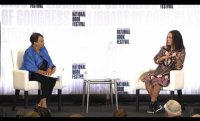
Jesmyn Ward on Why Fiction Matters

Caption: 

“I write toward what hurts. I write toward the truth, and I tell it again. I scribe the whole.” In this National Book Festival event, Jesmyn Ward, recipient of the 2022 Library of Congress Prize for American Fiction, speaks about how her grandmother influenced her work as a writer and joins Librarian of Congress Carla Hayden in a conversation about her award-winning novels, grief writing, and cultural authenticity.

Genre: 

Duped by Duplication

10.26.23

In his 1919 essay “Das Unheimliche,” translated from the German as “The Uncanny,” Sigmund Freud describes and examines the concept of uncanny or eerie feelings and how they can be expressed in the presence of a doppelgänger or a doubling. In this situation, something unexpectedly recurs—a repetition which may seem random, but when given context, takes on significance or meaning. Write a memoiristic anecdote about a time when you observed or experienced an unsettling recurrence. Perhaps you saw, in a short amount of time, the same number, person, or chain of events. Or perhaps you were wandering aimlessly and found yourself on the same street again and again. How were you able to break out of the cycle of duplication? Does it still creep into your mind at inopportune times?

Going, Going, Gone

10.25.23

Earlier this month the United States Fish and Wildlife Service officially removed twenty-one animal species from the Endangered Species Act after determining they are now extinct. The list includes the Little Mariana fruit bat from Guam; ten bird species, most of which are from Hawaii; the Scioto madtom fish from Ohio; and the Turgid-blossom pearly mussel. Many of the species were placed under protection in the 1970s and 1980s when they were in very low numbers and may have already past the point of no return. Write a short story this week that revolves around something that is the last of its kind, whether a plant, animal, or place. Is protection possible? What happens once something endangered is gone forever?

The Fall of the House of Usher

Caption: 

The Fall of the House of Usher is a gothic horror drama miniseries created by Mike Flanagan based on the short story of the same name and other works by Edgar Allan Poe. Starring Carla Gugino, Bruce Greenwood, and Mary McConnell, the eight-episode series follows the demise of the uber-wealthy Usher family, as their heirs mysteriously die one after another.

Genre: 

Gothic Glory

10.24.23

“The Tell-Tale Heart,” “The Pit and the Pendulum,” “The Raven,” “The Masque of the Red Death.” Each episode in filmmaker Mike Flanagan’s The Fall of the House of Usher, a new television miniseries based on Edgar Allan Poe’s eponymous story, is named after a famed poem, story title, or line penned by the master of the macabre. While Poe lived and wrote during the first half of the nineteenth century, his lyrical words continue to resound in all their gothic-horror glory in contemporary times. Browse through Poe’s works—all of which are in the public domain and freely available to read online—and write a poem inspired by his favorite themes of love, death, uncertainty, guilt, sickness, regret, revenge, and the subconscious. If you’re having trouble getting started, choose one of Poe’s famous lines as the first line of your poem.

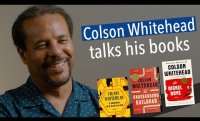
Book by Book With Colson Whitehead

Caption: 

“The book that I didn’t know I could do was the one I should be doing.” In this Penguin Random House video, author Colson Whitehead talks about the origins of his award-winning novels, The Underground Railroad and The Nickel Boys, and continuing the stories of his character Ray Carney through his two latest novels, Harlem Shuffle and Crook Manifesto.

Genre: 

An Author’s Family Stops a Book Ban

Caption: 

“Freedom of expression is everything.” In this PEN America video, family members of George M. Johnson read and reflect on a letter from the author in response to a call to ban their book, All Boys Aren’t Blue: A Memoir-Manifesto (Farrar, Straus and Giroux, 2020), and other books from a library in New Jersey, just miles from where Johnson grew up.

Deadline Nears for Translation Prize

Poetry translators: Try for a treat this Halloween by submitting to the Malinda A. Markham Translation Prize by October 31. The award of $2,000 and publication by Saturnalia Books is open to translators who identify as female (including those who are assigned-female-at-birth [AFAB] nonbinary, genderfluid, agender, and intersex) and who are translating the work of a woman poet (including those who are AFAB nonbinary, genderfluid, agender, and intersex).

Using only the online submission system, submit a manuscript of 48 to 120 pages with an entry fee of $25. Visit the website for complete guidelines.

Founded in 2002 to offer “an edgy alternative to traditional public narratives around poetry and visual art,” Saturnalia typically publishes five books a year by established and emerging poets. Chronicler of the “gurlesque” poetry movement with the 2010 publication of Gurlesque: The New Grrly, Grotesque, Burlesque Poetics, edited by Lara Glenum and Arielle Greenberg, the press is known for challenging the status quo. It has published Cortney Lamar Charleston’s Telepathologies (2017), Diamond Forde’s Mother Body (2019), Kayleb Rae Candrilli’s All the Gay Saints (2020), and other innovative poetry collections.

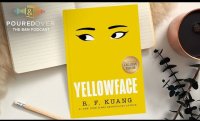
R. F. Kuang on Yellowface

Caption: 

“I want to trouble the idea that any representation is good representation. I think there’s a lot of frustration in Asian American circles about being told to appreciate the crumbs you’ve been given.” R. F. Kuang speaks about her fifth novel, Yellowface (William Morrow, 2023), issues of cultural appropriation, and her own experiences in the publishing industry as a Chinese American woman writer in this live conversation with Poured Over: The Barnes & Noble Podcast host Miwa Messer in New York.

Genre: 

Pages

Subscribe to Poets & Writers RSS