Broken Bowl

11.30.23

In her essay “Memory and Delusion,” which appears in a 2015 volume of previously unpublished works titled Let Me Tell You: New Stories, Essays, and Other Writings, Shirley Jackson writes about an occurrence one evening when a ceramic bowl in the room suddenly shatters and each of her guests—a musician, a chemistry teacher, and a painter—has a vastly different response. Jackson imagines that her observations, as well as her guests’ responses, will undoubtedly work their way into her writing, whether describing an exploded house, the complexities of feeling sudden shock, or deep loss. “I will keep the recollection of those scattered pieces, lying on the piano, and someday when I want a mental image of utter destruction the bowl will come back to me in one of a dozen ways,” Jackson writes. This week jot down notes of unusual occurrences you’ve encountered. Use your imagination to make vivid descriptions, while hewing as closely to what you genuinely observed. Save these descriptive gems for a future essay, story, or poem.
Narratives of Borders and Migration

Caption: 

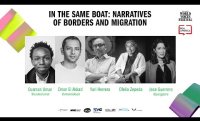
In this PEN America event from their 2022 World Voices Festival, authors Jean Guerrero, Omar El Akkad, Ousman Umar, and Yuri Herrera come together for a conversation about border and migrant narratives, the current global crises of displacement, and how literature tells the stories of those often ignored or hidden.

Storytelling Salve

11.29.23

“Poetry…is a form of salvation,” writes Najwan Darwish in his foreword to Chaos, Crossing (World Poetry Books, 2022), translated by Kareem James Abu-Zeid, the English-language debut of Olivia Elias, a poet of the Palestinian diaspora. “It may not make the pain tolerable, but it keeps the pain from becoming trite, banal,” writes Darwish, pointing to the way artmaking can save, vivify, protect, commemorate, and dignify lives. Adopt this empowering perspective and think back to an experience that brought you pain—perhaps an insecurity or fear, a difficult relationship with a loved one, or a distressing loss—and turn that pain into art by writing a short story that explores the specific, idiosyncratic essence of that memory. How can you use fiction and storytelling to transform your memory, and at the same time, protect its emotional truth?

Vauhini Vara on This Is Salvaged

Caption: 

For this LIVE From NYPL event, award-winning author Vauhini Vara reads from her short story collection, This Is Salvaged (Norton, 2023), and discusses exploring the intimacy of relationships between children, parents, friends, siblings, neighbors, and lovers in a conversation with novelist and essayist Leslie Jamison.

Genre: 

Know Thyself

11.28.23

How well do we know ourselves? Studies done by psychologists over the past several decades have demonstrated that people often process information about the world around them through cognitive biases. The way in which an event is remembered can then lead to biased thinking and decision-making. Positive memory biases cause one to remember events more favorably than they actually were and view their overall past with a rosy outlook, while negative memory biases often occur when recalling an emotional event. Write a poem that approaches one memory from two different cognitive biases, playing with the ways in which an event or situation might be remembered differently depending on how it was experienced. Does this multivalent approach allow you to expand your initial perceptions of what happened?

The Art of Mealtime

11.23.23

Thai artist Rirkrit Tiravanija has a long history of rejecting traditional art objects and instead, cooks and serves food in museums and galleries as a way to construct communal environments and reconfigure the concepts of artmaking and art spaces. How do you view the intersection or overlap between everyday life activities and art? Write a personal essay that explores your own perceptions of how writing and other creative pursuits overlap with your daily living. What art or creativity can be found in the simple act of brushing your teeth or commuting to work? Are there larger themes, such as community, interpersonal relationships, identity, consumerism, and pleasure, that float to the surface when you examine the roots of mundane habits and routines?

Ned Blackhawk on The Rediscovery of America

Caption: 

In this episode of the Yale University Press Podcast, director of Yale University Press John Donatich speaks with author and historian Ned Blackhawk about his book The Rediscovery of America: Native Peoples and the Unmaking of U.S. History, for which he won the 2023 National Book Award in nonfiction.

Inner World

11.22.23

In Braudie Blais-Billie’s short story “Hello, My Relative,” published in Evergreen Review and featured in the Community of Literary Magazines and Presses’s Native American Heritage Month reading list, the protagonist is a young poet living a lonely post-college life in New York City, far from where she grew up on a Seminole reservation in South Florida. Cleo works as a cat sitter, allowing her access to vacant homes, which she describes as, “visiting the ghost of someone’s inner world.” As Blais-Billie writes: “The home became a ghost because it was no longer alive when the client was not there to exert force upon the objects, suck in the air, laugh or chew or cry.” Write a short story that begins with a scene describing an unoccupied home. What do the items left behind reveal about the person who lives within its walls?

A Conversation With Mosab Abu Toha

Caption: 

Palestinian poet and scholar Mosab Abu Toha reads his poems and discusses his life as a writer in Gaza for this 2021 virtual event moderated by Refqa Abu-Remaileh and hosted by the Literatures of Annihilation, Exile, and Resistance research collective and lecture series. The author of the award-winning book Things You May Find Hidden in My Ear (City Lights Books, 2022) was detained by Israeli Defense Forces while trying to leave Gaza after his home was bombed, and was later released.

Genre: 

Pages

Subscribe to Poets & Writers RSS