Winters

12.19.23

“Cold, moist, young phlegmy winter now doth lie / In swaddling clouts, like new-born infancy,” writes Anne Bradstreet in the opening lines of her 1650 poem “Winter.” In her seasonal poem, Bradstreet traverses from the month of December to “cold, frozen January,” and finally to “moist snowy February,” cycling through the movements of the sun, the length of day, and the sensation of warmth or chill on the body. Though we often think of winter as one portion of the year’s seasons, how do the individual months of winter feel to you? Write a poem that tracks your personal memories from multiple Decembers, Januaries, and Februaries (or Junes, Julys, and Augusts in the Southern Hemisphere), perhaps thinking of these months as smaller, concentric or overlapping circles within a larger one.

Yu Miri: The End of August

Caption: 

In this event hosted by the Korea Society in New York, prolific and award-winning author Yu Miri talks about her family’s history under Japanese occupation, her struggles writing for Japanese and Korean readers as a Zainichi Korean author, and the themes in her latest translated novel, The End of August (Riverhead Books, 2023), translated from the Japanese by Morgan Giles.

Brenda Shaughnessy’s Five Basic Rules

Caption: 

In this 2014 State of the Arts video, Brenda Shaughnessy speaks about the themes of her first three books, what motivates her to write, and her “Five Basic Rules” for aspiring poets. Shaughnessy’s essay “Air: Speak and Breathe” is featured in the January/February issue of Poets & Writers Magazine.

Genre: 

Simon Shieh: Master

Caption: 

In this Books Are Magic event, Simon Shieh reads from his debut poetry collection, Master (Sarabande Books, 2023), and speaks about the themes within his book, the power of language, and truth in poetry with Ama Codjoe, author of Bluest Nude (Milkweed Editions, 2022). Shieh is featured in “Performing the Future: Our Nineteenth Annual Look at Debut Poets” in the January/February issue of Poets & Writers Magazine.

Genre: 

A New Me

12.14.23

The work of French novelist Édouard Louis concerns itself with capturing the past and its indelible effect on the present, as the author explores the facts of his life through novelistic means. In his first autobiographical novel, The End of Eddy (FSG, 2017), translated by Michael Lucey, Louis details the experience of growing up poor and gay in a homophobic, working-class French town; in History of Violence (FSG, 2018), translated by Lorin Stein, Louis endures a brutal attack and then overhears his sister telling her husband about the assault; and in A Woman’s Battles and Transformations (FSG, 2022), translated by Tash Aw, Louis tells the story of his mother’s moving to Paris to live a new life on her own terms. Inspired by Louis’s autobiographical novels, write an essay that considers a time in your life in which you felt the urge to change or become someone new. Try to capture the intricacies of the past—the difficulties, the hopes, the dreams—through a form that reflects the transformative urgency of that moment.

Next Word, Better Word: The Craft of Writing Poetry

by
Author: 
Stephen Dobyns
Published in 2011
by Palgrave Macmillan

Author of Best Words, Best Order, Stephen Dobyns offers a helpful framework for creating poetry and navigates contemporary concerns and practices in this accessible guide to poetry. Each of the thirteen chapters includes useful lessons learned from renowned poets’ works, and covers topics such as subject matter, the mechanics of poetry, and the revision process. Dobyns explores the complex relationship between writers and their work, and in the process, demystifies a subtle art form. “Good poetry deals with emotions, and its purpose is not just to give the reader a sense of those emotions, but also to let the reader experience them as directly as possible,” writes Dobyns in the introduction. “For many writers, the world isn’t real until they have put it into language.”  

Air of Mystery

12.13.23

While a character’s backstory can often provide the engine to a plot, how much backstory is too much? In “The Case Against the Trauma Plot,” published in the New Yorker in 2022, Parul Sehgal discusses the prevalence of the “trauma plot,” which relies on a character’s past trauma to move the story forward. Citing examples such as Hanya Yanagihara’s novel A Little Life (Doubleday, 2015), Jason Mott’s novel Hell of a Book (Dutton, 2021), and the television series Ted Lasso, Sehgal argues that the trauma plot “flattens, distorts, reduces character to symptom, and, in turn, instructs and insists upon its moral authority.” In contrast, Sehgal cites instances in which omitting backstory provides an effective air of mystery to a character, or what Shakespeare scholar Stephen Greenblatt calls “strategic opacity.” Taking inspiration from this critique, write a story in which the backstory of your character is kept from the reader. What happens when you resist explanation for a character’s choices? What tools other than backstory can you use to create a dynamic character?

Joy Harjo and Camille T. Dungy on Nature Poems

Caption: 

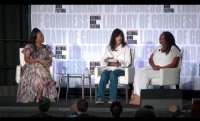
In this 2023 National Book Festival event, Joy Harjo, author of Weaving Sundown in a Scarlet Light: Fifty Poems for Fifty Years (Norton, 2022), and Camille T. Dungy, author of Soil: The Story of a Black Mother’s Garden (Simon & Schuster, 2023), read from their work and discuss writing about nature in a conversation moderated by NPR’s Ayesha Rascoe. Dungy’s essay “Manifest Some Magic: Get Out of Your Own Way and Do the Darn Thing” is included in the January/February issue of Poets & Writers Magazine.

Pages

Subscribe to Poets & Writers RSS