Campus Story

Take inspiration from the concept of a campus novel—which takes place in and around the campus of a university and often involves the intertwined dynamics of students, professors, and conventions about learning and power—and write a story that engages with a school setting, whether prominently situated in the context of the plot or used for a particular scene. Some recent additions to the campus novel canon include Elif Batuman’s The Idiot (Penguin Press, 2017), Xochitl Gonzalez’s Anita de Monte Laughs Last (Flatiron Books, 2024), Kiley Reid’s Come and Get It (G. P. Putnam’s Sons, 2024), and Brandon Taylor’s Real Life (Riverhead Books, 2020). Will you include a character who is a student, teacher, administrative staff member, custodial worker or caretaker, or possibly an alumni revisiting the past? Consider the multitude of ways the incorporation of an educational environment might permeate the atmosphere of the narrative.
Paul Auster: How I Became a Writer

Caption: 

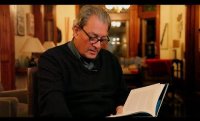
In this 2014 Louisiana Channel interview from his home in Brooklyn, Paul Auster talks about how a chance meeting with legendary baseball player Willie Mays led him to become a writer and what he has learned about writing. “The essence of being an artist is to confront the things you’re trying to do, to tackle it head on, and if it’s good, it will have its own beauty.” Auster died at the age of seventy-seven on April 30, 2024.

The Last Friend

“The day the last friend / dies / we sit alone. / A visitor / from outer space / tries hard / to summon us. / Someone says / EAT DEATH. / I fish around for answers / but the questions / still won’t come,” writes Jerome Rothenberg, who passed away in April, in his poem “The Last Friend.” Included in his collection of one hundred poems, A Book of Witness: Spells & Gris-Gris (New Directions, 2022), the poem presents a list of statements and observations, many of which refer to death or dying in some personal way, though the connections are enigmatic and the logical progression is oblique. Try your hand at writing a poem that mentions its subject directly, but which also deliberately obfuscates or remains ambiguous in its intentions. How might using the “I” as a witness include the reader into your point of view?

Paul Yamazaki on Reading the Room

Caption: 

“I always start asking myself, if I really love this book, how did it get to me?” In this conversation with Politics and Prose Bookstore co-owner Bradley Graham, Paul Yamazaki talks about his book, Reading the Room: A Bookseller’s Tale (Ode Books, 2024), and discusses his life and career as the principal buyer at City Lights Booksellers & Publishers in San Francisco.

Wildcat

Caption: 

Directed and cowritten by Ethan Hawke, Wildcat is a film based on the short stories and letters of Flannery O’Connor and explores both her characters and her life. Starring Maya Hawke and Laura Linney, the film dramatizes some of O’Connor’s most famous short stories and delves into the author’s craft and faith.

If I Must Die by Refaat Alareer, Read by Brian Cox

Caption: 

“If I must die, / you must live / to tell my story…” In this video filmed for the Palestine Festival of Literature, actor Brian Cox reads “If I Must Die” by the late Palestinian poet and English literature professor Refaat Alareer, who died after an Israeli airstrike on Gaza on December 6, 2023. Alareer’s posthumous book of the same name will be published in September by OR Books.

Genre: 

Mind Your Manners

The New York City culture and news website Gothamist recently asked New Yorkers about their thoughts on sidewalk etiquette in the crowded, bustling streets of their beloved city. What are the rules, who has the right-of-way, and who should yield? Respondents focused on always walking to the right of the sidewalk and to “move quickly and never stop.” One thoughtful respondent considered the cultural differences of sidewalks used for recreational strolls versus commuting. But the overall consensus was that among nine-to-fivers, tourists, parents with kids, dogwalkers, bicyclists, and groups, seniors deserve the right-of-way. Write an essay about the unwritten rules or etiquette you have observed in your daily surroundings. How have these common practices adapted to fit the needs of different people? Do they evolve over time as social norms change? Consider some of your own experiences with how public etiquette has helped or hindered harmonious community life.

Sub Rosa

The term sub rosa means “under the rose” in Latin and refers to something said or done in private. The rose has been associated with secrecy since ancient times, a decorative symbol often carved and painted in places like meeting rooms, banquet halls, and confessionals as reminders of confidentiality. This week write a short story that revolves around a conversation or discussion that occurs sub rosa in an enclosed space. Does a certain detail get leaked out or overheard? How might the secretive nature place a burden on your characters? Consider the ways in which the atmosphere and tone of your story feel distinctive in the time and space of your sub-rosa conversation versus the scenes that take place before or after the talk.

Victoria Chang on Grief and Art

Caption: 

“This year I turned my back to the world. I let language face // the front. The parting felt like a death.” In this About the Authors TV video, Victoria Chang speaks about her award-winning collection, Obit (Copper Canyon Press, 2020), and reads a poem from her new collection, With My Back to the World (Farrar, Straus and Giroux, 2024), which engages with the paintings and writings of Agnes Martin.

Genre: 

Pages

Subscribe to Poets & Writers RSS